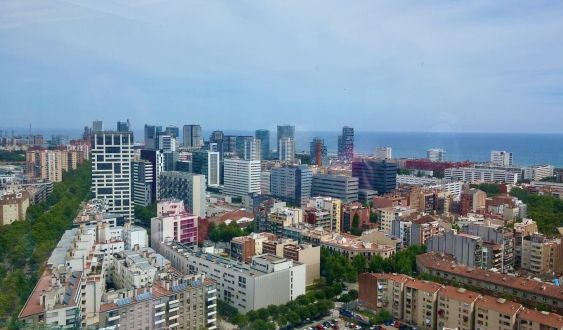
More than 20 years after the 22@ began to be promoted as the city's technology district, the City Council has subjected the original idea to an update, reinforcing the economic potential it has consolidated and incorporating new factors, such as more housing and public facilities. "We defend a mixed city model: it has to be for living and doing so with quality of life, calmly and with health, but we also have to create spaces where job opportunities are generated," explains the first deputy mayor, Jaume Collboni. This new roadmap will involve a modification of the Metropolitan General Plan, which will have to be approved by the municipal plenary session at the end of February.
The main priority of the new planning is housing, one of the most demanded issues by residents. When the 22@ was conceived in 2000, only 9,000 homes were planned in an area of 200 hectares. Of these, 5,000 were affordable and 4,000 were market-rate. Now, the total figure is increased to 17,000 homes, almost doubling it. Specifically, 12,000 homes will be affordable, of which 80% are expected to be public, and only 5,000 market-rate.
This growth in the space dedicated to housing is achieved by establishing that new constructions will have to have 30% housing, while for 22 years only 10% has been allocated and the rest went to economic activity. Mixed buildings that combine offices and housing will also be promoted. "We want the 22@ to go from being a space in the city where only people worked to being a space where people can live and work," summarizes the deputy mayor for Urban Planning, Janet Sanz.
This growth in the space dedicated to housing is achieved by establishing that new constructions will have to have 30% housing, while for 22 years only 10% has been allocated and the rest went to economic activityThe forecast of having more housing will be accompanied by more local facilities, reserving 35,000 square meters of land for this use.The council has already detected 15 plots with sufficient dimensions to accommodate, for example, schools, institutes, primary care centers, sports centers, and a new market.
To continue boosting economic activity in 22@, the new urban planning contemplates adding one million more square meters of economic floor space by 2030. With 1.2 million square meters already developed and 800,000 in process, the planned increase will allow reaching the potential of three million square meters for companies and economic activity that was foreseen in 2000. According to the City Council, this will create 60,000 new jobs, reaching a total of 175,000. Currently, a total of 11,500 companies are located in 22@, a figure that represents 11% of the city's economic activity, and employ 115,000 workers. Of all the companies in this district, 25% are startups.
This modification only affects the land pending development, 40% of the total, which will also benefit from a flexibilization of permitted uses. Sectors such as creative industries, sports, education, the green economy, or the social economy will be added, Sanz details. The aim will also be to protect companies already located in the one million square meters pending development. These companies will be able to stay in 22@ to "avoid economic gentrification," Sanz emphasizes.
To crystallize these changes, the council is committed to streamlining all urban planning processes. To do this, it will create a direct license, which will avoid having to make the previous urban plan as it had to be done now, shortening processing times by two years. The technical office created at the end of 2020, responsible for centralizing attention to companies and citizens, will also be reinforced. In its first year of operation, it has already handled 329 requests, of which 87.3% have been informational requests; 10.3%, for processing new activity licenses, and 2.4%, for urban planning registrations.
More green spaces
The 22@ also gains more green spaces in the new urban planning. Specifically, one out of every three horizontal and vertical streets will become a green axis, characterized by dedicating 70% of the space to pedestrians and vegetation, compared to the current 40%, dominated by vehicles and parking spaces. This will translate into the creation of 12 green axes, which will be accompanied by 15 new squares, also green, at their intersections.
The streets of Almogàvers, Sancho d'Àvila, Cristòbal de Moura, Pujades, Doctor Trueta, Bolívia, Àlaba, Ciutat de Granada, Lope de Vega, Fluvià, Treball and Puigcerdà will be transformed under this new concept, adding ten hectares of green to the district and linking with the transformation that is being done in the Eixample, which will also gain 21 axes and 21 squares.
Likewise, the city council will encourage the rehabilitation of existing buildings to make the district more sustainable, and will promote the application of sustainable construction criteria. A total of 450 properties and 20 passages will also be preserved to safeguard the history of this area of the city, formerly populated by factories and known as the Catalan Manchester.
First planning with feminist urbanism
The new 22@ roadmap will incorporate concepts of feminist urbanism in space design. "This is the first planning in the entire State that incorporates feminist urbanism," Sanz emphasizes. The aim will be for everyone to feel safe on the street, reactivating empty spaces with temporary uses and transparent fences, filling corners and resting areas with urban furniture, and encouraging the establishment of commercial premises on the ground floors. "We want streets for everyone," she concludes.
Add The New Barcelona Post as your preferred Google source for free
Stay informed with the latest news.
