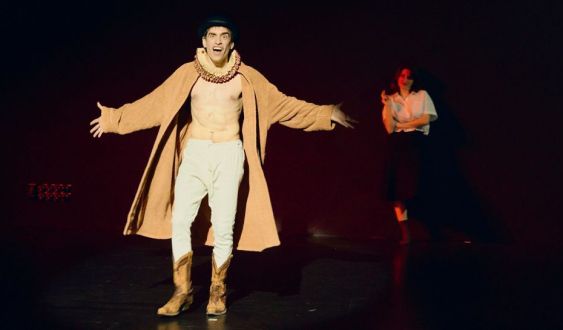
Tendrament (currently playing at Teatre Akadèmia on Carrer de Buenos Aires, having premiered a few months back at the Sala Beckett) is a tour de force across performance, concept, and style. At once poetic and humorous, it is deceptively simple in its production (above all in its conception, gestation, and no doubt birth) alongside an extraordinary narrative drive. I say narrative drive because I cannot bring myself to call it a script, since from the opening moments this production feels entirely unscripted: the performers address the audience directly and intimately right from the start, inviting us to become part of the situation (and I say situation, rather than story). There is no story; there is a couple eleven years into a relationship who first met in the world of theatre. Two characters – or rather two people – who navigate memories, traumas, hopes (and expecting a child), and contradictions with a raw, touching intensity, so transparent it verges on naive. Lost children, at times, navigating a world of adult choices.
Autofiction, but without much fiction: a moving self-portrait, one might call it. I had never seen it pulled off so masterfully on stage. Pau Vinyals is a whirlwind of sensitivity, a display of hyperactive brilliance, chameleonic and unpredictable, with a frayed patina reminiscent of the Joker. A character-slash-person who never exhausts his own self-exploration (particularly regarding sex and affection) and who seems to believe every single word he utters, every gesture he makes: it must be one of the perks of what they call the “theatre of the self” (or of “us”), raw, unfiltered, full throttle. Because the other half of that “us” is Judit Colomer: hilarious, dynamic, hailing from Manlleu, with an effortless, conspiratorial warmth that makes you want to take her out for drinks on the spot, alongside an overwhelming emotional authenticity. She laughs, she suffers, serving as the clever clown of the double act, much like most women in heterosexual relationships (if indeed we can assign gender to the members of this couple, given that everything is relative – just as it has always been arbitrary that in Catalan a table and a chair should take the feminine gender).
The core idea – the concept – is as eccentric as it is brilliant and honest. It works seamlessly throughout, with a baby monitor in the background and the internal (and mutual) battles the pair wage around two pieces of furniture. The central inquiry revolves around the classic heteropatriarchal couple, and how the configuration and layout of furniture in a home already prefigures (or challenges, depending on the household) that template. It is a sharp touch to have the spotlights illuminate the chair and table while the two actors remain off-stage, carrying on their conversation – alongside clever theatrical devices evoking the couple’s shared past (an insultingly mechanical first kiss, or an initial glance exchanged during an interval) and an ingenious vehicle for Vinyals to indulge a certain brand of performative exhibitionism (hyperbolic, restless). Colomer holds her own ground, though without a shred of exhibitionism: right from the outset she makes it clear to us that she has never done this before, that she is a set designer. Lest anyone forget.
The central inquiry revolves around the classic heteropatriarchal couple
Condensing the plot is an uphill battle, which is why the house programmes never quite do it justice. What is this play actually about? Because it is not about a story with a neat beginning and end; it is about an emotional climate, about great expectations and dashed hopes, about a crossroads combining middle age and impending parenthood with the relentless madness of the theatre world. Certain cultural nods or metaphors may occasionally take a moment to untangle, but the overarching poetry succeeds regardless and continues to resonate with everyone in the room. That is why we laugh: because we see ourselves reflected in it, because together we feel like old friends of the couple. A deliberate turning of the screws on the audience, as they invite spectators up to tap dance or kiss on stage, in an effort (I imagine) to cultivate empathy for the vulnerability intrinsic to the performing arts. Stage fright, as they call it, but endured from the auditorium. A neat device, however squirm-inducing it may be.
Ultimately, it is a triumph of live stagecraft and of the concept itself. Free of conventional plot or narrative, built solely upon a candid portrait of a couple in an unconventional world – or rather one where convention has become cluttered with endless alternatives. Non-binary identity, polyamory, homosexuality, heterosexuality, bisexuality, queerness, confusion, discrimination, the TNC, Joan Ollé, the Institut del Teatre. The flat, settling down, becoming parents. How to navigate parenthood before such a fractured mirror, confronted by countless possible fictions, countless possible personal narratives. The theatre of “us” taken to its highest power, drawing the audience directly into the concept. Once again, a heartening celebration of our acting talent. Yes, ours. In the very same breath with which we say, when we truly feel it, that we are going to win the Champions League.
Add The New Barcelona Post as your preferred Google source for free
Stay informed with the latest news.