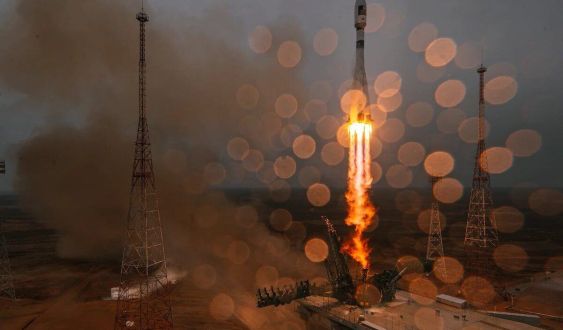
After a few days of delay, the first nanosatellite of the Generalitat, named Enxaneta, successfully lifted off at 07:07 this Monday aboard the Soyuz 2 rocket, from the Baikonur cosmodrome, in Kazakhstan. The small satellite, approximately the size of a shoebox, is already in orbit, about 500 kilometers from Earth. It will operate for a period of three to four years and, afterwards, its re-entry into the atmosphere and subsequent disintegration will be forced.
From space, the Generalitat's nanosatellite will deploy global Internet of Things (IoT) connectivity services with 5G coverage. It will allow communication and data acquisition from sensors located throughout Catalonia, even in hard-to-reach areas or those without coverage from conventional terrestrial telecommunications networks.
Specifically, these connectivity services will be used to monitor river flow and water reserves, with the aim of improving and making water management more efficient; track and protect wild fauna; receive meteorological data from stations located in remote places, monitor ground movements to predict natural disasters and herds and crops to detect diseases.
Open Cosmos and Sateliot have been responsible for developing Enxaneta. Both are among the main Catalan companies operating in the so-called new space economy, a sector with great growth potential, expected to generate 1,200 jobs and 280 million euros in revenue by 2025, and a driver of other technologies.
Government's New Space Strategy
The launch of this nanosatellite is part of the New Space strategy promoted by the Government, with the aim of Catalonia making a name for itself in the field of nanosatellites. In total, it has a total budget of 18 million euros for the period 2020-2023 and is co-financed by FEDER funds.
This will not be the only satellite the Government will send into space. The second nanosatellite is expected to be launched in the middle of next year. The management and control of the nanosatellites will be carried out from a ground station managed by the Institut d'Estudis Espacials de Catalunya (IEEC) in Sant Esteve de la Sarga, in Pallars Jussà. The Ground Station located at the Montsec Astronomical Observatory will be responsible for supervising the activity of these small satellites and receiving the data they will collect.
Add The New Barcelona Post as your preferred Google source for free
Stay informed with the latest news.
