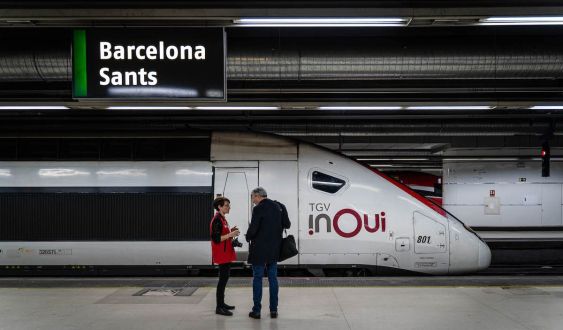
After almost 10 years of cooperation and more than 5.5 million travelers, Renfe-SNCF, a company formed equally by the Spanish and French operators, ran its last trains between Barcelona and Paris last Saturday. A day later, SNCF became the only one offering this route, after breaking with Renfe, whom France has not yet enabled to cover other lines that have now been left unattended, such as those connecting Barcelona with Lyon and Madrid with Marseille.
The divorce has been complicated, with SNCF being the one that decided to end the alliance, despite Renfe's rejection. In fact, just over a year ago, Renfe-SNCF had future plans such as promoting Barcelona as a railway hub by doubling frequencies, considering that the city acted as a stop that centralized connections from Tarragona, Lleida, Zaragoza, Madrid, Valladolid, Valencia, Alicante, Seville, and Malaga to the neighboring country.
However, the French company has preferred to unilaterally break the agreement with Renfe, according to the Spanish operator. It has happened as in Italy, where SNCF also offered a joint service with the Italian operator until it ended the agreement and started doing it alone. It is not the same case as other countries like Germany and Switzerland, where France has preferred to extend cooperation.
SNCF also broke cooperation in Italy, but not in Germany and SwitzerlandFrom the French company, they argue that the service shared with Renfe has been loss-making from the beginning, with losses they estimate at 10 million euros per year, and that it has not been possible to reach a consensus with its Spanish rival to make it more efficient. Given this scenario, SNCF has decided to operate only the Barcelona-Paris route, which had a healthier balance sheet, almost breaking even, but not quite. The other two routes, Barcelona-Lyon and Madrid-Marseille, incurred greater losses and are the ones Renfe is trying to operate, pending French approval. SNCF emphasizes that they tried to wait for Renfe to get approval so that there would be no service interruption, but that they could not wait any longer for the Spanish operator to complete all the procedures.
The second cause of the breakup, according to SNCF, has been railway liberalization, which had turned them into competitors on routes such as Barcelona and Madrid, with AVLO and Ouigo, while they continued to cooperate on the connection with France. "It was very complicated to be a competitor and a partner, even impossible," says the director of projects for Europe, Caroline Chabrol. In comparison with other markets where cooperation is maintained, she points out that "the competitive intensity is not the same." To all this, Renfe responds: "SNCF makes this decision once the Ouigo high-speed service has consolidated in the Spanish railway market."
In this disagreement, moreover, it has happened that, while Adif has enabled SNCF trains to use the Spanish high-speed network, the French have not done the same with Renfe trains, which are still pending homologation, despite being manufactured in France by Alstom. Renfe can only reach cities in the south of France such as Marseille and Lyon, but not Paris.
Frequencies with the French capital are maintained
SNCF will continue to offer two daily round trips between Barcelona and Paris, with a duration of 6 hours and 35 minutes. The train will stop in Girona, Figueres, Perpignan, Narbonne, Béziers, Agde, Sète, Montpellier, Nîmes and Valence. In summer, where 60% of the demand is concentrated, an additional frequency will be added. From Barcelona, the train will depart at 10:33 and 14:32, arriving at 17:20 and 21:21, if there are no delays, something quite frequent with French high-speed rail. In the opposite direction, from Paris Gare de Lyon, they will depart at 9:42 and 14:56, arriving at 16:34 and 21:25.
The French operator expects to reach 2,000 daily users, rising to 3,000 daily users in the summer season. According to the company, since tickets went on sale in mid-October, they have already sold 52,000. Currently, compared to other means of transport, the train's market share on this route is 10%.
SNCF will continue to offer two daily journeys between Barcelona and Paris, adding one more in summerPrices to travel to the French capital with SNCF start from 39 euros, if traveling in second class, and 49 euros, in first. Children, only considered up to 11 years old, three years less than in Spain, have a 50% discount. Tickets can be canceled free of charge up to seven days before the trip.
TGV Inoui trains, the brand that operates this connection, have capacity for more than 500 users, distributed in six cars, two first class and four second class. Like those Ouigo now uses to go from Barcelona to Madrid, they have two floors, a rare feature outside of France, but they cannot be compared, considering that Ouigo is a low cost brand and charges for most services, such as Wi-Fi or traveling with large suitcases, options that TGV Inoui includes in the ticket price. The cafeteria offer also varies, with cold catering on Ouigo and cooked dishes on TGV Inoui.

Add The New Barcelona Post as your preferred Google source for free
Stay informed with the latest news.
