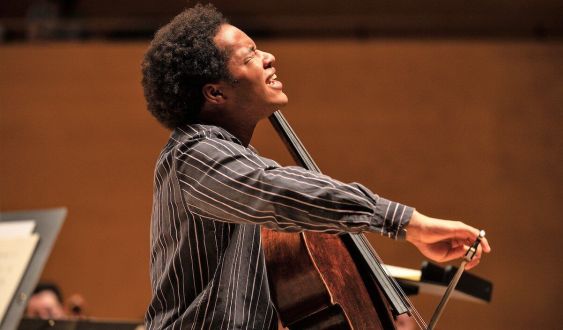
The jolt that everyone who knows Edward Elgar's Cello Concerto, inextricably linked to the ill-fated Jacqueline du Pré, expects to experience, came after the lavish display of sound resources of U, a work by local composer Bernat Vivancos. Even conditioned by the saturation of the sound space that the brass instruments achieve in that work, the audience enthusiastically received the performance of the young protagonist of the concerto, Sheku Kanneh-Mason. The British cellist has performed in major auditoriums, has been sponsored since the beginning of his career by an emblematic record label, and enjoys the loan of an antique instrument, a wonderful 1610 Amati. Erected as a figure of classical music, he is accustomed to being news not only in specialized media, in a way for belonging to a very large and very artistic family (five sisters and one brother, all of them musicians) and for having performed in world-renowned events, specifically ---Bernat Dedeu reminded us in his Saturday Punyalada--- at an English royal wedding.
The need to forge idols and venerate them, to obtain in return some kind of compensation ---different if one is on the side of the industry or the public--- invites us to reflect, indeed, about their real impact on the musical landscape. It happens that there is no "reality" that is not based on the expectations drawn by imagination, more or less pragmatic or romantic depending on the case. And that music, in itself, already possesses the capacity to bring back images and make us experience sensations as if for the first time. This, on the listener's side. But also on the performer's.
The cellist's modest demeanor, between shy and smiling, transforms into gravity when he attacks the first chords of the concerto. A declamation that has been etched into auditory memory, without the reminiscence of Du Pré's mythical interpretation being able to be absent. Her 1965 version, performed with conductor John Barbirolli, elevated her for its unmatched intensity and the understanding between artists, but an interesting recording with her future husband, from whom she would eventually separate, Daniel Barenboim, has also transcended.
It is probably the tendency towards pathological explanation, typical of the romantic imagination, that detects in tonal inflections and jumps the fluctuation of a tragic discourse; that of a voice that seems subjected to the onslaughts of destiny and oscillates between acceptance and rebellion. The struggle against an incurable disease, like the impossibility of keeping a loving relationship intact ---two young prodigies united by musical eros, which a priori seemed scripted by Uncle Walt--- provide a highly tempting interpretive key, from which it seems difficult to abstract oneself.
Objective evidence is not abundant, despite advances in neuroscience, but there is also no doubt that the effective "reality" of music lies in its affective impact, obviously enabled by each person's capacity to imagine, remember, and feel emotion. All the more so given the instrument involved, which some specialists have compared to the human voice in terms of timbre, phrase inflections, and tonal range. Kant already pointed out the practical nature of expectation ---"What can I hope for?"--- in his Critique of Judgment. The work perhaps most influential in Romanticism polarizes the multiplicity of responses to that not only aesthetic experience with the mention of its two extremes ---"pleasure" or "displeasure"--- which refer to satisfaction or disillusionment, in turn made possible by the doubling or play of mirrors inherent in artistic artifice.
The director of L'Auditori, Robert Brufau, argues in the substantial booklet for the choice of the Love-Hate binomial as "second movement", the motto of a polyptych designed for a three-year period: after a season focused on the notion of Creation (2020-21), and prior to the one that will conclude the project under the motto Death or Return (2022-23), in the current one the impulse of desire has been set as the guiding thread. Several thinkers have tried to explain this transport ---perhaps Schopenhauer above all, when speaking of music as a reliable manifestation of will, essentially unrepresentable by concepts--- but the two allusions we find at the beginning of the volume with all the year's programming belong to the young Pol Guasch, author of the successful Napalm al cor (and, here, of the Poema de la FI II: "L'amor també era això: un recer en la intempèrie i totes les ventades, després") and, as a drastic, less incendiary counterpoint, to the psychologist Erich Fromm, whom Brufau quotes to highlight the thaumaturgical effect of love. Perhaps because it is a romantic topos, the director chooses to specify the inspiring potential of its reverse: "the failure in love, frustration and disillusionment have been catalysts for the generation of great masterpieces."
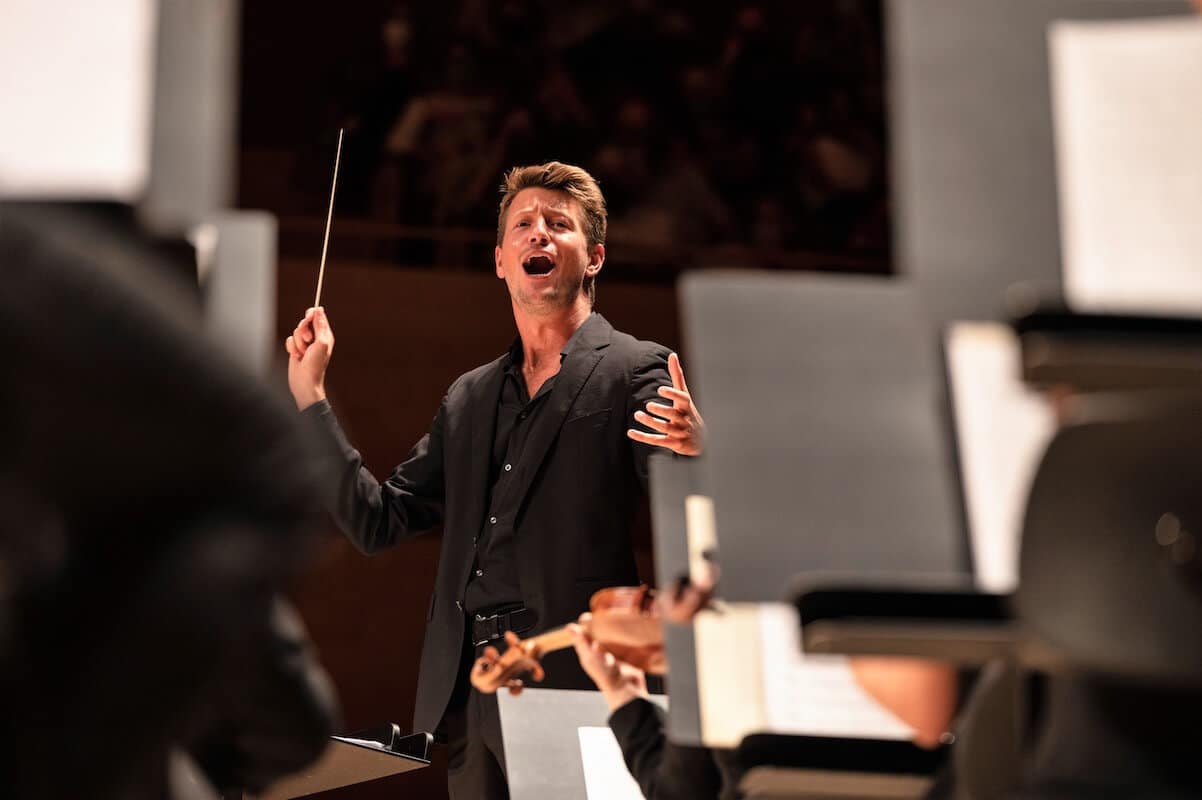
Of course, this statement cannot be sustained in reverse, it is not proven that from every experience in hell an alchemical work beneficial to oneself and transcendent for the history of humanity derives. In any case, it seems that since the inauguration of this "Second movement" the option is to contemplate the confrontation in a creative way, not only destructive or painful. In addition to discovering the cosmogonic explosion of U, or reliving the emotional intensity of Elgar's cello, it was possible to see how the OBC, under the direction of Duncan Ward, performed with a nuanced forcefulness a selection of passages from Sergei Prokofiev's ballet Romeo and Juliet. In the year that West Side Story will once again capture attention, with Spielberg's remake ever closer ---sixty years later--- the clan struggle of the Shakespearean drama works at a macro level, externally; corresponding to the narrative that happens beneath the skin, in the loving encounter and disagreement that also opens the door to hatred. And, perhaps, back to love.
"Failure in love, frustration, and disillusionment have been catalysts for the generation of great masterpieces," recalls Robert Brufau.The 2021-22 season is so rich and extensive in events that it is impossible to summarize, as irrefutable proof, the almost 200 pages of promotional booklet that compiles all the proposals, among which are the OBC's symphonic concerts, the Early Music, Chamber, or the Mozart Festival cycles during the summer. It is, for all that has been said, an intense year, with openly classical proposals but also others rooted in our present and looking to the future. Cycles likeSit backorSampler seriesincorporate top-level artists and a strong commitment to local creation, with names like Bernat Vivancos, Joan Magrané, or Raquel García-Tomàs. In this sense, theEmergents Festivalaccredits the quality of young people at the beginning of their respective careers, an accompaniment that continues to be shown in the pedagogical vocation of L'Auditori, through theSocial and Educational Projectand with activities around the Museum of Music. To maintain the accessibility of its projects, L'Auditori relies on digital support—one of the lessons learned during the past year—that window open to the world that Lisi Andrés, head of communication and marketing, illustrates withStravinsky's words: "listening to music is not enough, one must also see it."
The OBC, under the direction of Duncan Ward, performed with a nuanced forcefulness a selection of passages from Sergei Prokofiev's Romeo and JulietThe visualization of images is not casual or fleeting, but leaves a mark. Many of us still we seeto a Jacqueline du Pré absolutely devoted to the interpretative cause, oblivious to the fate that awaits her, but secretly intensifying its weave.We met with her again on the occasion of the season's inauguration in L'Auditori's main hall, named Pau Casals, in honor of someone she greatly admired. Inauguration officiated by Sheku Kanneh-Mason, whose gestures also reveal that emotional embargo, between serenity and fury. An affective ambivalence that is in fact always richer than what the polarities ofLove and hate. Life unfolds and modulates in unrepeatable moments, thanks also to creations and interpretations that endure. The Casals Quartet, Ian Bostridge, Kian Soltani, Pierre-Laurent Aimard, Nuria Rial, Matthias Pintscher, Xavier Sabata, Nicola Benedetti, Trevor Pinnock, Pablo Ferrández, the Phace ensemble, Jordi Savall, Patricia Petibon, Kings of Convenience, Lucia Fumeiro, Ton Koopman, Paul Vallvé, Frames, Aaron Zapico… These are just a few, a part of the enormous list of artists who will delve into the dialectical complexities of that second ---but not definitive--- movement.
Add The New Barcelona Post as your preferred Google source for free
Stay informed with the latest news.
