
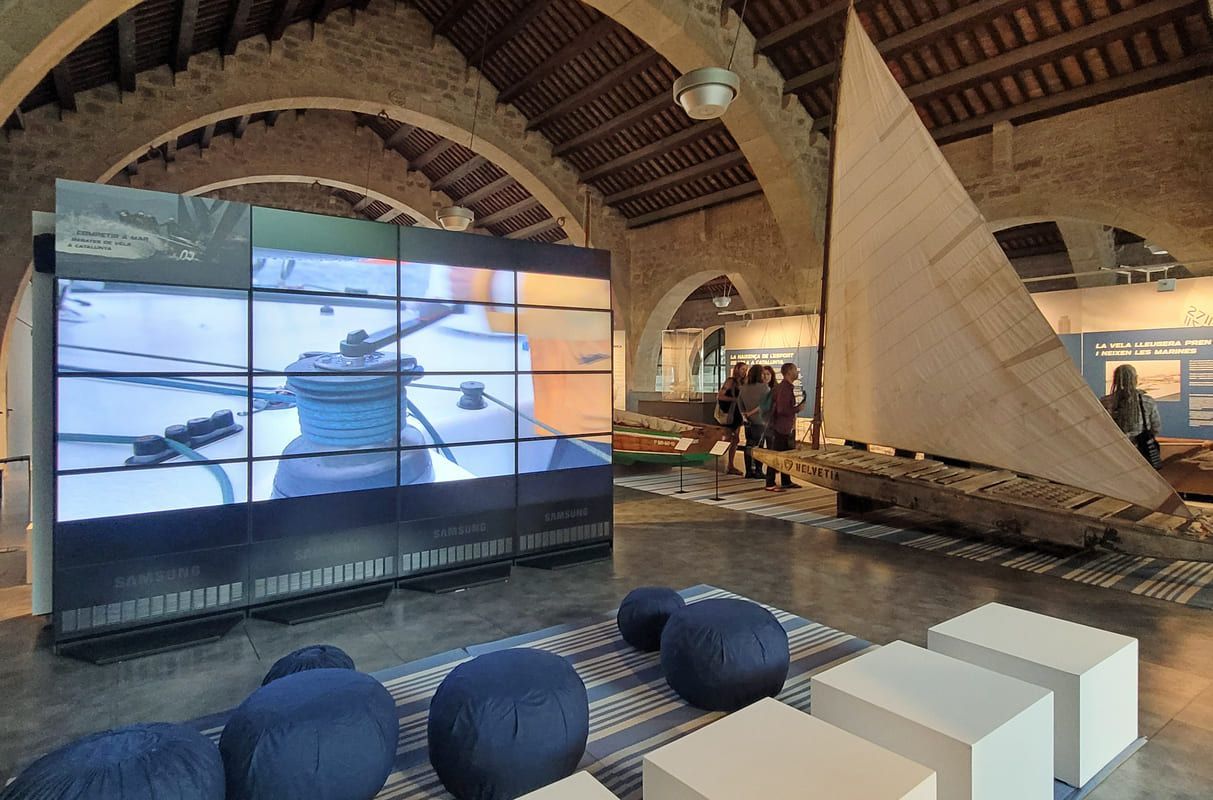
The Maritime Museum has organized two new exhibitions. The first can be visited since last June 6. It is titled Competir a mar. Regates de vela a Catalunya (Competing at sea. Sailing regattas in Catalonia), and is a retrospective on the history of sailing competitions on the Catalan coasts. The second premiered this week with the name Penèlope. La mar és teva (Penelope. The sea is yours), and focuses on the trajectory of six women from different generations who excel in the practice of this sport. Both exhibitions have in common the historical vindication of sailing in Catalonia, which has been a reality for a century before the current irruption of the America's Cup in Barcelona, where it will be held between next August and October.
Competir a mar is organized chronologically. In Catalonia, competition between boats dates back to the early 19th century. June 10, 1821, is when the first competition of rowing boats in Catalan waters is recorded. In 1878, the Club Nàutic Tarragona was founded, the oldest in Catalonia and second oldest in Spain. In 1979, the Club Catalán de Regatas de Barcelona was founded, and in 1881, the Club de Regatas de Barcelona. These were the embryos of the current Reial Club Nàutic de Barcelona and the Reial Club Marítim de Barcelona. Originally, these pioneers were dedicated to rowing, and it was in later years that they incorporated sailing.
In the center of the exhibition, two small historic sailboats that are part of the museum's heritage are displayed. One is an optimist class boat made of wood. It is a sailboat for a single crew member used for the initiation of the youngest. Next to it, the Helvetia catamaran, also made of wood in 1932. This type of boat, very popular on beaches, was born on those of Barcelona. Initially, it was a catamaran with oars that swimmers used to get away from coastal pollution in search of clean waters. Subsequently, a mast and a sail were added. One of the characteristics of the catamaran is that it does not have a rudder and is steered by shifting the navigator's weight. Catamarans are part of the indigenous Catalan maritime heritage.
Sailing experienced its great moment of expansion in Catalonia after the civil war, a time when competitions resumed and new yacht clubs were created along the coast. In the 1970s, Miquel Company, then president of the Spanish Sailing Federation, created the Palamós Sailing School, with the mission of training Olympic sailors. It was the beginning of the golden age of dinghy sailing in Spain, which provided great medalists in the Games held since then. But before that, there was Santiago Amat, to whom the exhibition pays special attention. At the beginning of the 20th century, he began practicing sailing and participated in the Paris 1924, Amsterdam 1928, and Los Angeles 1932 Games, where he won the bronze medal. Years later, the success of sailing in Barcelona 92 left as a legacy the Centre Municipal de Vela de Barcelona, in the Olympic Port. Since then, thousands of people of all ages have been trained in this sport.
The second exhibition, Penèlope, is the feminine view of sailing through six athletes of different ages. Abril Marfà is the youngest, at 11 years old, and Ana Pujol, the oldest, at 68. The rest are Nora Garcia (18 years old), Andrea Emone (28), María Torrijo (49) and Natàlia Via-Dufresne Pereña (51). The exhibition is structured through a common interview with the six in which they share their experiences and challenges.
Both exhibitions are part of the Cultural Regatta, the program of activities that will accompany the celebration of the America's Cup. The Maritime Museum demonstrates that the tradition of sailing in Catalonia goes far beyond the prestigious competition that will take place this summer. Initially, it was expected that the Drassanes, where the museum is located, would be one of the institutional and activity venues for the regatta organization. It is a unique building in the world and the maximum exponent of the relationship between Barcelona and the Crown of Aragon with the sea. But America's Cup has decided to focus its activity on the port. In fact, their participation was planned in both exhibitions, which ultimately did not take place.
Barcelona trusts that the celebration of the America's Cup in the city will be a catalyst in the development of the so-called blue economy, one of the great strategic lines of economic development in the metropolitan area. The Catalan capital hopes to attract talent linked to the technology of this sector that will make it the great hub of the Mediterranean. The America's Cup, since its origin in 1851, is more a technological than a sporting competition, as the design of the America, the ship that started it all, already obeyed the ambition of the New York Yacht Club to build a winning sailboat using the latest in maritime engineering of the time.
That year, the America defeated 14 other British boats in a race. Today, cutting-edge technology continues to be the great protagonist of the regatta, which positions it as a benchmark for the aforementioned blue economy due to the new generation navigation and maneuverability solutions it provides to the maritime industry. This is Barcelona's great bet in hosting this event, which has become one of the great global sporting events. And of technology.
Add The New Barcelona Post as your preferred Google source for free
Stay informed with the latest news.
