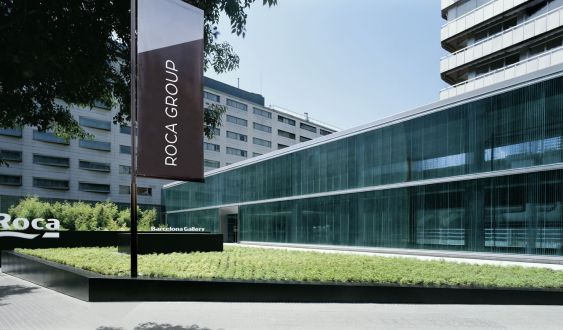
The general shareholders' meeting of Roca Group has approved the 2022 accounts, a "complicated" year as a result of the withdrawal from the Russian market and other factors such as the decrease in demand caused by the increase in energy costs, problems with the supply chain, and the international inflationary escalation. Despite this adverse context, the Catalan company, a leader in sanitary porcelain and bathroom equipment, has managed to consolidate a turnover volume above 2,000 million euros and an EBITDA level equivalent to 17% of its revenues.
"In a year as complicated as the present, our professionals have demonstrated their commitment and effort, prolonging the company's growth," highlights its CEO, Albert Magrans. In this sense, sales have increased by 1.9%, to 2,092 million, far from the 22% rise achieved in 2021, the first year in the group's history that the 2,000 million barrier was broken. "The financial indicators show the group's adaptability, which despite the complexity of the environment reaches a historical maximum turnover for the second consecutive year," explains Roca in its annual report, after pointing out that, without the effect of Russia and thanks to improved efficiency, the results would have been better than in the previous year.
The company's shareholders, with 100% family capital, approved on Thursday afternoon the group's balance sheet and income statement, which resulted in a net profit of 42 million, 76% less than the 179 million profits recorded in 2021. EBITDA has been cut by 11%, to 356 million. "Net equity amounted to 1,707 million, which reflects the financial solidity of the group, which bases its growth on self-financing through reinvestment of profits," said Magrans. Net financial debt stood at 154 million euros at the close of the 2022 financial year.
For Roca, the forced divestment in Russia as a consequence of the war in Ukraine has been a severe setback, not only because of the losses generated by withdrawing from that market, but also due to the group's close ties with the country, where it had operated for 30 years and had a strong industrial presence, with seven factories that it transferred to its local management team for a symbolic price. The company has been able to compensate for the loss of that market with "significant" sales increases obtained in other key geographies such as Brazil, India, and China.
Despite these setbacks, in 2022 Roca increased its investments by 9%, with 135 million allocated to expansion and improvement projects for the productive capacity of plants in Brazil and India and to the construction of a new plant for resin shower trays and bathtubs in Poland. Other investments have been allocated to expanding the bathroom furniture business in Spain and Portugal and to financing initiatives aimed at improving the group's sustainability and efficiency, with sensórica, decarbonization, and circularity projects. In 2022, Roca also transformed its plant in Croatia into a logistics center that will serve Central European markets.
Acquisition of Madeli and investment in Aquí Tu Reforma
The group, owner of brands such as Roca, Laufen, Royo, Gala, or Cosmic, has taken a new step this year in its growth strategy in the United States with the purchase of the bathroom furniture company Madeli, based in Florida and with a network of 500 points of sale. According to Roca, this operation "generates a strategic pull effect," since in the US market, the choice of bathroom furniture is decisive in renovation decisions.
In addition, the company, through its new investment vehicle in innovative startups, Roca Group Ventures, has invested in the digital home renovation platform Aquí Tu Reforma. Throughout this first year, interviews have been conducted with more than 120 startups.
With a workforce of more than 21,000 employees, 76 production centers, and presence in 170 countries, Roca is a world leader in its sector, in which it operates through different business areas: sanitary porcelain, faucets, bathroom furniture, installation systems (toilet flushing mechanisms), screens and accessories, steel bathtubs, and resin or plastic bathtubs (composites). Since 2018, the group has reduced its CO2 emissions by 39% and water consumption by 47%. In 2022, it installed nearly 10,000 photovoltaic panels, bringing the total to 21,800 operational panels for self-consumption. Its goal is to achieve carbon neutrality by 2045.
Add The New Barcelona Post as your preferred Google source for free
Stay informed with the latest news.
