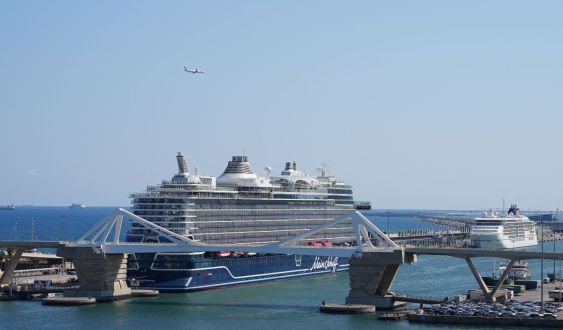
The cruises became a bargaining chip in the Barcelona City Council plenary session last week. Thanks to the votes of Junts and ERC —in exchange for a shadow plan and more aid for extracurricular activities and educational reinforcement— the progressive increase of the tourist tax for transit cruise passengers was approved, which will go from the current 4 euros to 24 euros in 2030. The government of Jaume Collboni in the city has been marked by returning Barcelona to the Barcelonians and policies like these are cooked with the hope of reducing the impact —but not the number— of tourists that the Catalan capital welcomes. This increase has not gone unnoticed by any of the actors affected by cruises. In fact, it has been criticized by those in favor of the arrival of cruise passengers and by the detractors of this type of tourism, all, however, pivot on the same point: Why only transit cruise passengers? What differentiates a quality tourist from a traditional one?
The closing of the 2025 annual exercise of the Port of Barcelona confirmed that the number of accumulated cruise passengers in the Catalan capital was 3.9 million, 9.4% more than in 2024. These data, however, speak of the entire cruise sector in general, not just transit ones. Specifically, the cruise passengers who will have to pay more in Barcelona progressively until 2030 are those who do not spend the night or live there, that is, they arrive with their cruise at a certain time and that same afternoon they leave again. In contrast, base cruise passengers, those who depart from or arrive at the Catalan capital, are not affected by the regulations. "It's a washing of hands by the City Council," assures Daniel Pardo, a member of the Stop Creuers platform, to The New Barcelona Post. For the entity to which he belongs, there should be no differences between cruise passengers, but rather a real reduction of this type of tourism —and of all Barcelona tourism in general—. Pardo explains, then, that imposing this tax only on transit cruise passengers and not on base cruise passengers is a way of making some grow to the detriment of others: "It's to have a class of tourist who spends more time in Barcelona," he says and adds that "it's what they call quality."
The key that would explain the difference the city council makes between cruise passengers — according to the consulted experts — is the concept of quality tourism. In this sense, they assume that the basic cruise passenger stays longer in Barcelona and spends more money, which could qualify them as a higher quality tourist. However, Joaquim de Toca, spokesperson for Welcome Ashore, a global, volunteer-led coalition supported by Royal Caribbean Group, which gives a voice to local communities affected by cruise tourism, states that "the cruise tourist is a quality tourist." In this sense, De Toca also doesn't quite understand Collboni's regulation, but unlike Pardo, it's not because he believes all cruise passengers should be reduced, but because according to the data he provides, they only represent 2.4% of tourists arriving in Barcelona: "Cruises are not the most worrying point." Besides, he also comments that he doesn't understand this division between classes of cruise passengers, because with the new tax, transit cruise passengers "are the only tourists who pay and don't sleep in the city".
Joaquim de Toca (Welcome Ashore): "The cruise tourist is a quality tourist"
Thus, on the one hand, from Stop Creuers they believe that Collboni has wanted to approach their position, but "from the wrong side," says Pardo, as he confirms that this tax will not "reduce cruises." Furthermore, he reminds that it is not about choosing which type of cruise passengers are better: "We don't want to get into good and bad, we have to reduce them," concludes the platform member. De Toca, on the other hand, sees the City Council's move as a possible strategy. "I don't know if they did it because elections are coming now," reflects the Welcome Ashore spokesperson, who also reiterates that cruise passengers are not the city's main problem: "They don't overlap with Barcelona's traditional tourism peaks and are very destigmatized," reviews De Toca.
Cruise passengers' expenses in the city
Tourists who set foot in Barcelona also spend money there. In this way, the spokesperson for Welcome Ashore highlights the needs of all the commerce and restoration that lives off tourism. In addition, he speaks in the specific case of cruises and assures that "they have a transversal impact", since cruise staff training schools are created in the Catalan capital and ships buy provisions of material, food and drink from the port of Barcelona. "You can't play with this, there are many people who live off it," De Toca remarks. From his perspective, there are more benefits in cruises than disadvantages and he confirms that policies like this make cruise passengers look bad: "Since the time of Ada Colau, they have been demonized."
Pardo denies that the advantages outweigh the disadvantages and resolves that the regulation only applied to stopover cruise passengers will not help alleviate the gentrification that the city suffers. He also recognizes that if the city council wanted a real strategy, "it would state that it wants to reduce the impact." Thus, for Stop Creuers, "they only seek to reduce discomfort." In parallel, Pardo recalls that cruise passengers, especially those based, also use planes to get to Barcelona and stay there for a few days, which for them is "neither quality tourism, nor sustainable." An opinion not shared by De Toca, who puts these combinations with the airport in the advantages column.
Clash over housing
Undoubtedly, the most commented point is the housing crisis. According to Pardo's estimates, base cruise passengers, those to whom the new regulation will not yet apply, spend days in the Catalan capital and "put more pressure on the housing situation." For Stop Creuers, therefore, the right to housing cannot be solved if the number of tourists —in this case, base cruise passengers— who visit Barcelona every year is not truly reduced beforehand. De Toca, for his part, denies that the majority of base cruise passengers stay in seasonal accommodations in the capital and specifies that "according to the studies we have been able to see, almost all of them stay in hotels."
Daniel Pardo (Stop Creuers): "They put more pressure on the housing situation"
In short, Collboni wants quality tourism and this tax is his way of seeking it. Even so, neither the detractors nor the supporters of cruises are clear that the tax will have the desired effect. In fact, Pardo goes further and regrets that it is a regulation to try to calm the residents of the Catalan capital, since —for his platform— it is a way of reassuring the population to continue "promoting tourism": "They want calm because tourism cannot live amidst tension," he concludes.
Add The New Barcelona Post as your preferred Google source for free
Stay informed with the latest news.