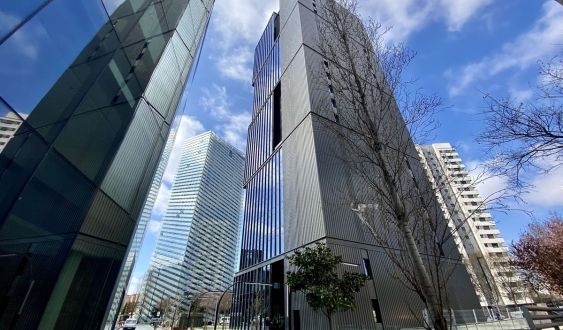
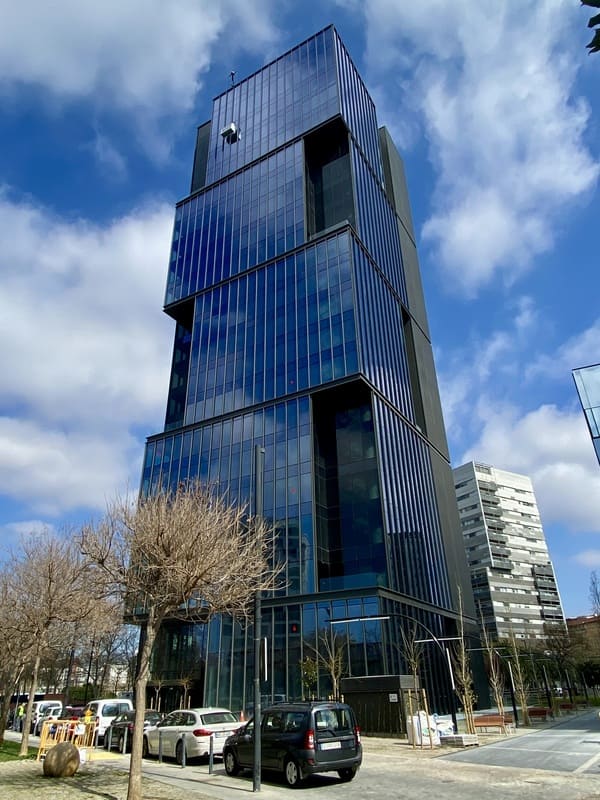
The beauty and fashion group Puig is preparing to undertake new projects after having achieved the best results in its history in 2022 and setting its sights on achieving its goal of reaching a revenue volume of 4.5 billion euros in 2025. To cope with this growth, Puig will double its presence in Plaza Europa in L'Hospitalet, where it is preparing to occupy a second skyscraper located next to its corporate headquarters and which will house, among other departments, the product design and innovation center.
The new tower has 20 floors, which Puig has fully leased to meet its future space needs, with the forecast that 400 people will work there, joining the 600 currently in its main building, a 21-story skyscraper designed by Rafael Moneo to which it moved in 2014. The new building, recently constructed, is practically adjacent to the current one, and Puig is expected to begin occupying it during the second half of the year.
The group's R&D hub will be located in the property, in addition to other technical departments such as engineering, packaging, purchasing, and supply chain. The building is owned by Colonial and Inmo, the real estate division of Corporación Exea, the patrimonial holding through which the Puig family manages its businesses. Inmo also owns the headquarters of the perfumery group, which it bought from BBVA in 2017.
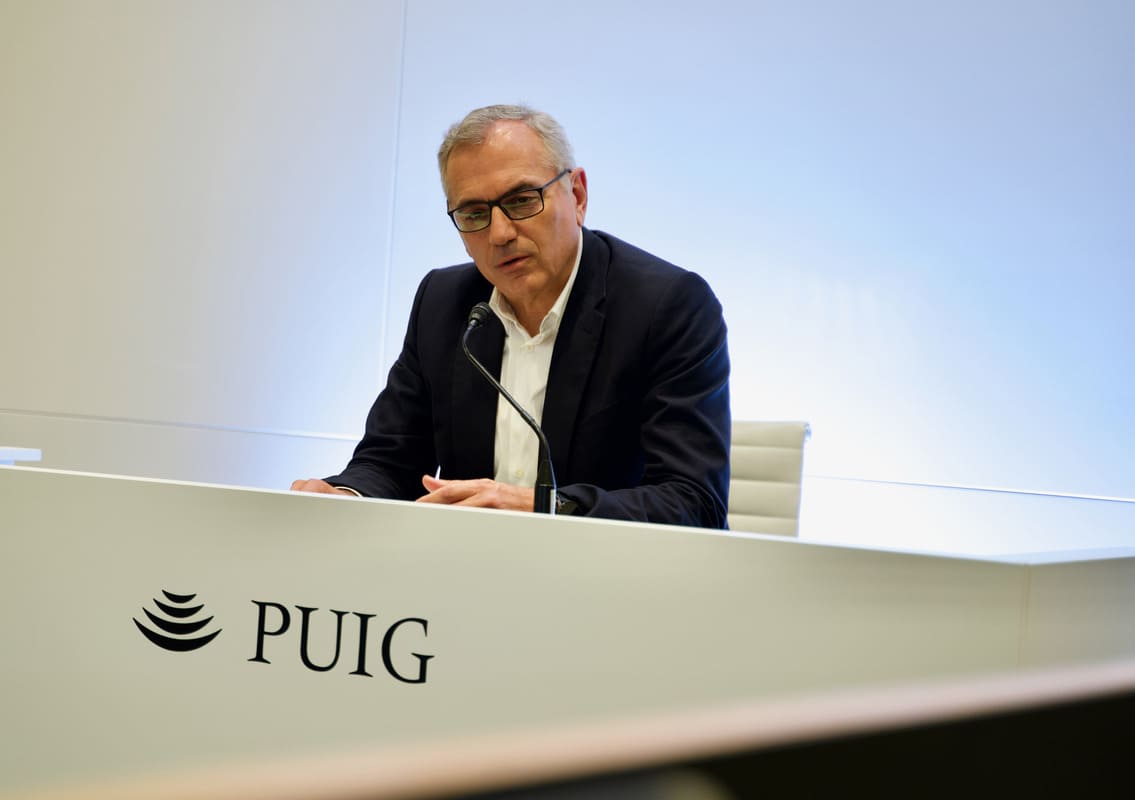
"We reaffirm our commitment to Barcelona, a city that has allowed us to be a combination of creativity and operational excellence. We are proud to work from Barcelona, being here has not hindered our great international development. Twenty years ago, Spain generated 50% of our sales, and today it only contributes 7%," highlighted this Thursday the president of the Catalan multinational, Marc Puig, during the presentation of the annual results.
The company that owns Carolina Herrera, Nina Ricci, Paco Rabanne, and Jean Paul Gaultier achieved record sales of 3.620 billion euros in 2022, up 40% (30% without taking into account the three acquisitions made and exchange rate variations). This figure means having doubled its turnover in just two years (in 2020 it earned 1.537 billion) and having far exceeded its plan to reach revenues of 3 billion in 2023, a year earlier than expected. "At this pace, we now see the goal of reaching 4.5 billion in 2025 as easier," said the CEO.
"It's surprising, but it took us 100 years to reach a turnover of 1.5 billion, and in the last two years, we've grown by a billion each year," emphasized the executive, who describes this evolution as "spectacular," a consequence, he states, of four major decisions adopted over the last two decades.
The first was to decide to focus on the fashion and selective perfumery sector, progressively abandoning its businesses of bath gels and all kinds of mass-market and supermarket products. "To succeed globally, we had to focus on something that was differential; only by focusing could we be excellent," he reflected. Twenty years ago, Puig controlled only 3% of the global selective distribution fragrance business and set the goal of reaching a market share of 10%, a goal that was achieved in 2022 thanks to strong growth.
The second major decision was to focus on own brands and abandon the strategy of being licensees. Along these lines, ten years ago a third strategic axis was defined: to bet on niche perfumery, that is, on brands with great potential in certain segments increasingly demanded by consumers, such as artisanal products or natural cosmetics. Consequences of this decision are, for example, the acquisitions of the companies Kama Ayurveda (India) and Loto del Sur (Colombia), made in 2022, a year in which a majority stake in the Swedish luxury firm Byredo was also acquired.
Puig's upward trajectory, finally, has been sustained by a fourth major decision: to diversify to achieve critical mass. Thus, 20 years ago, the group only operated in one of the three areas that make up the world of beauty, perfumery, while it had no presence in dermo-cosmetics ---where the bulk of the business is found--- and in makeup. Today this situation is totally different, as in 2020 Puig made a grand entrance into the makeup market with the acquisition of the British brand Charlotte Tilbury ---number one in the United Kingdom--- and in 2021 it integrated the brands Uriage and Aptivita, which had been previously acquired by the Exea holding company. Through Exea, the family also owns 50% of another reference brand in the pharmacy cosmetics sector, Isdin, which is not included in Puig's turnover; the other 50% belongs to the pharmaceutical company Esteve.
Marc Puig also boasts about having achieved a 37% increase in ebitda in 2022, up to 638 million, a figure that makes the group's net debt, amounting to 1,015 million, "very comfortable" as it is equivalent to 1.6 times ebitda. Much more pronounced has been the growth in net profit, which has soared by 71%, reaching earnings of 400 million. This figure will be used to "strengthen the balance sheet" and to remunerate shareholders, i.e., the Exea holding company.
Last year, Puig achieved double-digit growth in all its business areas, a trend that is expected to be repeated this year. Specifically, the fragrances and fashion division (74% of the total) advanced by 40%; makeup (with a weight of 17%) by 52%, and dermo-cosmetics (generates 9%) by 20%. "Paco Rabanne is the fifth largest global fragrance brand and Carolina Herrera the sixth," emphasizes Puig, which has two of the brands that dominate the global top 10, where it competes with large corporations such as L'Oréal, Estee Lauder, LVMH, Interparfums, Coty, Shiseido, or Revlon.
By geographical areas, in 2022 Puig has grown especially in America (+56%), followed by Asia (+41%) and the Emea area (+31%), which includes Europe, a continent where the group obtains 54% of its business volume thanks to five key markets: the United Kingdom, Spain, France, Germany, and Italy. Other reference countries for the Barcelona-based multinational are the United States ---first market in revenue---, Mexico, Brazil, and Chile. In Asia, the number one market is China, although sales in the country have been severely affected by covid, which has forced a review of the objectives set for the Asian giant, which was expected to contribute 25% of sales in 2025; now the entire Asian continent generates 10%. "We are very optimistic about the recovery of the Chinese market; we will not reach 25%, but it will certainly gain weight," said Marc Puig.

This January, Puig launched an office in Miami to manage all airport sales business (travel retail division) in the Americas. This business area saw its sales soar by 72% last year thanks to the recovery of tourism and international mobility, already exceeding pre-pandemic revenues by 28%.
Puig's digital sales have advanced 23% in the last year and now generate 25% of the business. The Catalan company has also multiplied its network of own physical points of sale through some of its brands, with 162 new establishments in 2022, totaling 241 stores. The group incorporated 2,000 new employees last year, and its workforce totals 10,000 people.
According to Marc Puig, "there is no indicator of signs of sales slowdown" in these first two months of the year, so he expects to grow again by double digits and advance towards 4.5 billion. The pace of acquisitions will slow down, as now "it's time to digest." "We are not active now in buying anything, but we always monitor the market; the priority is to consolidate," concluded the businessman.
After closing its plant in the Sant Martí district of Barcelona at the end of last year, Puig now has three large factories: one located in Vacarisses (dedicated to the production of dermocosmetic brands), another in Alcalá de Henares (Madrid), focused on fragrances, and another in France.
Add The New Barcelona Post as your preferred Google source for free
Stay informed with the latest news.
