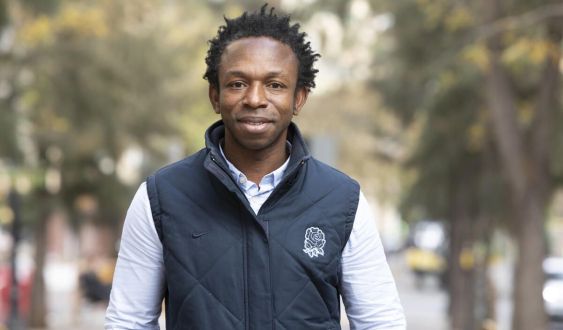
Ousman Umar is a survivor and his is one of those stories that is never forgotten. He was born in Fiaso (Ghana), worked as a welder in Lebanon, cornered by the mafia, and crossed the Sahara and the Mediterranean ---in a small boat--- in search of an opportunity. An opportunity he found in Barcelona thanks to Barça and Montserrat. It has not been an easy journey.
Founder of the NGO Nasco Feeding Minds, based in Barcelona and Ghana, and Princess of Girona Social Award 2021. He was an adult when he learned Catalan, Spanish, mathematics, and the art of reading and writing. He repaired bicycles in a shop in Gracia, studied Public Relations and Marketing, has a Master's from Esade, and is studying an MBA at IESE. His great university is life itself.
He has lived death too closely and that is why he has the great mission of helping others to have a chance at life. He is the voice of those who did not make it and the lifeline of those who are yet to arrive.
--- He was born in Fiaso (Ghana) in 1988.--- I am only sure that I was born on a Tuesday and they gave me the wrist test to find out my year of birth.
--- What memories do you have of your childhood?--- Seen now it seems I lived in the 18th century… However, I didn't miss anything. We believe that happiness is having good clothes or the best toys, but our ancestors lived without anything.
---And they were also happy.
--- I was happy with nothing. I also had no needs. My mother died in childbirth and I was condemned, but my father, who was the village shaman, saved and protected me. We lived in a hut. We set traps in the jungle to hunt, drank water and fished in the river where other inhabitants from other villages showered and washed clothes. Surviving in that environment is proof that natural selection exists and that only the strongest survive.
--- An airplane changed his life.--- My world was a village of 100 inhabitants in an 18th-century setting. I had no shoes and had to be creative and make my own toys. One day I was playing in the village square and saw a plane flying. Creativity and curiosity made me understand that the world did not end at the border of my village.
Surviving in that environment in Ghana is proof that natural selection exists. Curiosity and creativity made me understand that the world did not end at the border of Fiaso
--- What was beyond?
--- They explained to me that it was a plane made by white people and then I wondered who white people were and why they were capable of making a plane fly. My father offered me the option of going to Accra to learn and work as a mechanic. My best doctorate is this burn I got on my hand when I was welding the trucks and ships that arrived in the city. I wanted to know who white people were and that made me fall into a trap of mobsters and traffickers who told me that if I reached Libya I would have a salary every month.
--- You crossed the Sahara in search of an opportunity.
--- They promised me that I could fulfill my dream and reach paradise. I gave everything to get to Libya, but I was not aware that there were several kilometers of distance.
--- Thousands of kilometers.--- The worst of all is the lack of information and training. I only went to school for a couple of years, which was seven kilometers from home. They promised me I would reach Libya, and they set one of humanity's worst traps for me. I wouldn't wish it on my worst enemy. I arrived in Libya three terrible weeks later, with the vast majority of my companions having died along the way. We were 46, and only 6 of us arrived. Very cruel. Three weeks peeing to drink and survive. Living is another thing, and it still happens today.
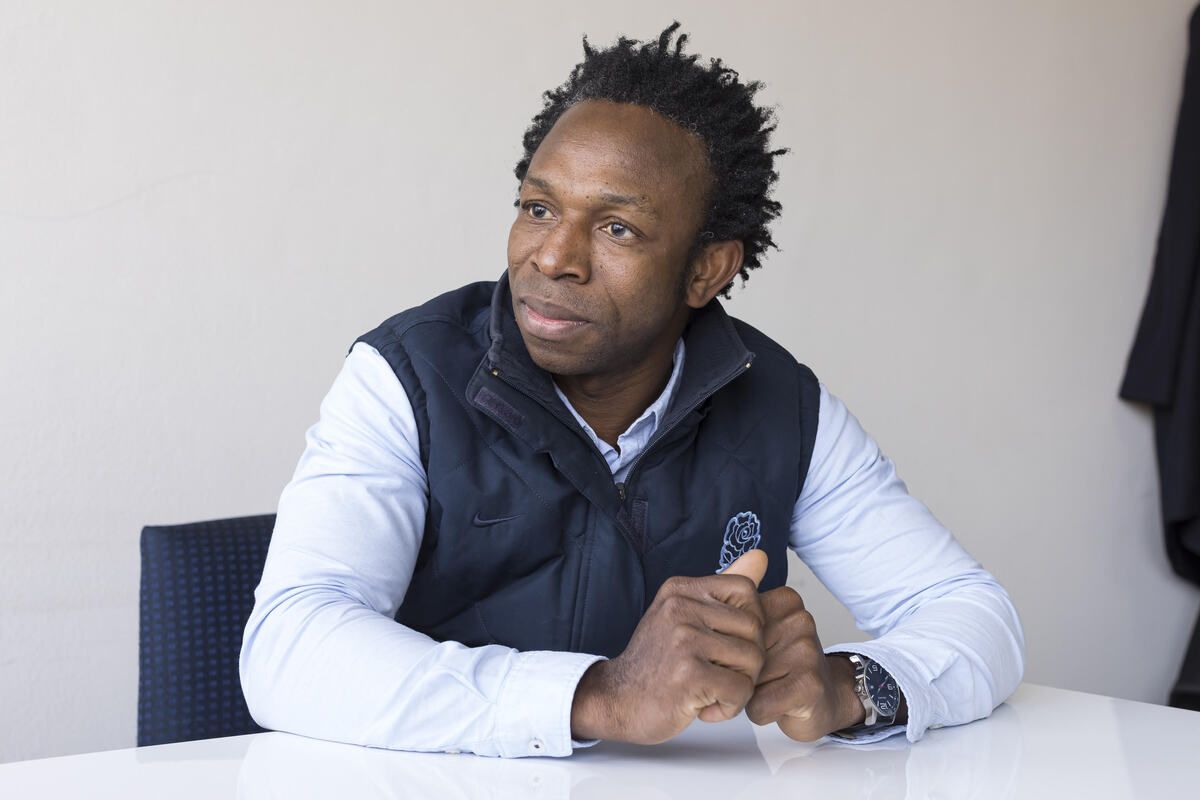
--- I lived in Libya for four years during Gaddafi's time and went to jail many times. I traveled to Tunisia, Algeria, Morocco, Mauritania, Western Sahara… The traffickers hid us and brought us wood to build the dinghies. I left Libya with the 1,800 dollars I had earned working for four years and gave it all to the mafia. We built two dinghies. One sank and no one survived. I lost Muusa, who was my best friend. We returned to the coast, the mafia brought more people, and we built two more dinghies. And again at sea, between desperation and agony. We ran out of gas and were lucky that the wind and waves were in our favor. Pure chance. We arrived north of Fuerteventura. I don't know how to swim. I hadn't stolen or committed any crime, but they decided my place was the CIE.
--- What was the first thing you thought when you arrived in Fuerteventura?--- I embraced the ground crying, thinking I had reached the promised land. I was crawling, my legs were frozen, and I couldn't walk. I was the last one to leave the coast. There were also two Nigerian girls with two babies. It was night and it was raining. There were police, ambulance, Red Cross, television cameras… Everyone in line. I didn't see these girls' babies alive or dead, and I doubt there are fish big enough to swallow them. I ended up in the same van and in the same jail with the Nigerian girls and I never saw the two babies again.
--- What was the first thing you said?
--- I was there for a month and a half and then I was granted freedom in Spain. They asked me where I wanted to reside and the only thing I could say was Barça. I arrived in Barcelona thanks to Barça.
--- More than a club.
--- Barça is much more than a club.
They asked me where I wanted to reside and the only thing I could say was Barça. I arrived in Barcelona thanks to Barça, which is much more than a club.--- He arrived in Barcelona on February 24, 2005.
--- I was very happy, I had arrived in Barça's city and lived in the country of the whites. I arrived by train from Malaga and I liked to greet everyone, but people didn't answer me and got scared. I thought the whites were very strange because in my town greeting was a basic rule of respect. I learned that in the country of the whites, people didn't talk or greet on the street. It was the university of life.
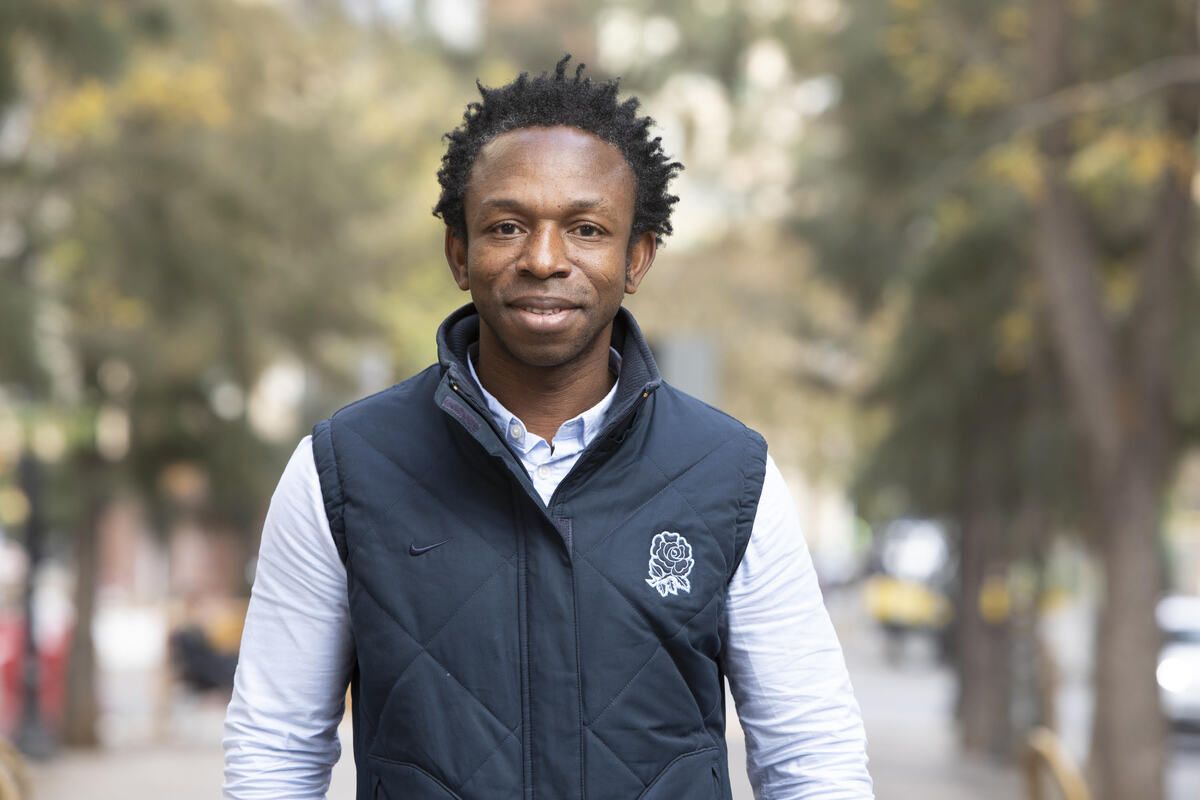
--- The university of life. How were your first days in Barcelona?
--- Quite hard. In fact, the first days in Barcelona were worse than in the Sahara desert because I felt very alone. In the desert, only six of us survived, but at least we felt accompanied. A piece of street furniture was worth more than me in the city. Barcelona is the concrete jungle and in the tropical jungle there are trees and fruits. I started eating from the trash and slept on the street. One day I woke up on Navas de Tolosa street with Avenida Meridiana.
The first days in Barcelona were worse than in the Sahara desert because I felt very alone
--- And you met Montserrat Roura.
--- Montse lived in Valldoreix but that day she was in Barcelona. We talked, she took my hand and called her husband because she didn't speak too much English. I was dirty and she didn't think I wanted to steal her phone. Today I am here talking to you because she dedicated 10 minutes to listening to what I needed. Anyone would have given me money and if it had been too much money, the police would have thought I had stolen it and they would have put me in jail. Five minutes of your time are worth much more than 1,000 euros.
--- Listening and accompanying is priceless.
--- Making a person feel like a person is not paid with money. With Montse we went through a long process, I went to the Red Cross and slept the first nights in a sports center in Poblenou and on city benches. Montse and her husband took me in as guardians and I went from living on the street to a house with heating. I remember that night very well.
--- What do you remember?
--- Arriving, showering, clean clothes and a hot plate on the table. A family trying to understand me. When we finished dinner, Montse accompanied me to the room, put me to bed as if I were a small child, gave me a goodnight kiss, turned off the light and left. I couldn't sleep all night.
--- Why?
--- Exactly. Why? ---I asked myself---. What had I done wrong to deserve so much torture and suffering? If everything was predestined for me to find this family, couldn't the path be easier? I was just a child... Why had I seen so many corpses of companions in the desert? Why? The next day I understood: the question was not why but what all I had lived through would serve me for.
--- What for?
--- To be the voice of all those who didn't make it and to work to prevent future victims from falling into the same trap as me. Then I could rest and understand that white people are not doctors because they have white skin, but because they have education.
--- You started studying.
--- I did night high school at the Menéndez y Pelayo Institute. I was illiterate. I learned Catalan, Spanish, mathematics, to read and write. I got to university in 2011, while working 40 hours a week. If I were American or European, they would say I'm a genius, but I'm nobody. I studied Public Relations and Marketing, I have a master's degree from Esade in NGO management, administration, and organization, and now I'm doing the IESE executive MBA. What can happen when we are given an opportunity? Talent has no color, it's a matter of opportunities.
--- Everything is a matter of opportunities.--- If we are able to distribute opportunities a little more, we would change the lives of many of those who live on the street and they could contribute to society. I am no more intelligent than any of those people who sleep on the street, but I had an opportunity. My mission is to do everything possible so that others also have one and can decide their future.
Talent has no color, it's a matter of opportunities
--- In 2012, he founded the NGO Nasco Feeding Minds to promote access to information and education.
--- I understood that everyone is the president of their world. It's too easy to blame and accuse the minister, but what's important is what responsibility you assume as an individual. If you can make small changes, make them. I used to fix bicycles in Gràcia, I earned less than 1,000 euros and with that money I hired two teachers and bought 45 computers for my village because I am the president of my community or the secretary general of my United Nations. The best entrepreneur bets everything they have on their project, otherwise, how can they expect an external investor to trust them?
--- The power of education.--- No society, institution, or country has been able to progress without fostering education as a basic tool. Only education is capable of changing a society. And I don't say this, but the great Nelson Mandela: "Education is the most powerful weapon which you can use to change the world." It's not enough to say it, you have to do it, even if it's little by little. Now, without education, let's call it a day…
Each one is president of their world. It's too easy to blame and accuse the minister, but the important thing is what responsibility you assume as an individual
--- How do you see the city of Barcelona?
--- Barcelona is one of the most human and welcoming cities in the world. With the Volem acollir demonstration in February 2017, we showed great multiculturalism and sensitivity towards the increasing immigration. It is a great fortune to be a citizen of Barcelona. It can always be improved. We have had many mayors with different visions, but all have tried to seek the best for the citizen. Barcelona can be the multicultural capital of Europe, although Madrid has been gaining ground lately. We must embrace multiculturalism and make room for everyone.
Barcelona can be the multicultural capital of Europe and we must make room for everyone
--- From theory to practice?
--- Everything can be improved, but I am very proud of all the social housing that has been built and the good work of associations and NGOs to help. Imagine sleeping on the street and having nowhere to go. Imagine not having a home to pee, wash your face, and everyone looking at you badly. Barcelona has welcomed me and given me the opportunity to be reborn and grow, and for that, I will always be grateful to this city, but there is still much work to be done. Addictions are also a problem. Citizens are increasingly mobilizing to help.
--- How can we help more?
--- We must provide training and information to have the possibility of creating a good future. Today things are done to feed people, but what about tomorrow?
--- Little thought is given to tomorrow--- The projects we undertake at Nasco have a purpose: not to do charity, but to create prosperity. I come from a tribe and I understand my people, I know that things given away for free have no value. Each family must pay 30 cents each quarter for their children to come to computer class. Some criticize me for that, but if you give 30 cents to a person, you are calling them useless. If you really want to help a child, start by helping their mother. How many models have gone to Ghana to pick up a small child and pretend to love them? This is posturing to fill our own ego. Taking a photo and saying you are a good person. That's not how things are done. I help mothers work in beekeeping so they can pay the 30 cents and their children can learn computer science. If you really want to help them, help them.
We don't want to do charity, but to create prosperity. Things given away for free have no value.--- Do politicians and the administration help you?
--- Not much beyond words. The political world is complex and often seeks image. Behind closed doors some have helped us, but the vast majority do it for show and have little commitment. The first public aid Nasco has received after 12 years is a grant of 3,000 euros from the Sant Cugat City Council because I went to present my book.
--- You published North to Paradise: A Memoir.
--- It is the translation of the book Viaje al País de los blancos (Journey to the Land of the Whites) which was also published in the United States, Canada, and Great Britain. I never imagined publishing a book and reaching the global market. It was a great dream. I ended up with the great publisher that is Amazon and was able to present it in New York.
--- The previous interviewee of Persona a Persona, Imma Amat, asks you the following question: "Have you seen an improvement over these years in how people arriving here are welcomed?"--- I like to see the glass half full rather than half empty, and this has always marked my journey. There has been a great improvement, especially due to the will of citizens and organizations, even if they don't have sufficient resources. Governments haven't moved as much, but citizens, associations, and foundations have.
--- The power of civil society.
--- I believe a lot in civil society, entrepreneurs, and people. In my case, it has been practically impossible for me to rent an office because I am Black and work for an NGO, but there are people who have also helped me. We hide behind brands and titles, but in the end, it's people with heart who move the world.
SEVEN LIVES
- Referent: José Mujica, Kofi Annan, Gandhi and Nelson Mandela.
- Book: Tres sombreros de copa by Miguel Mihura and La Plaça del Diamant by Mercè Rodoreda.
- Movie: Life is Beautiful by Roberto Benigni
- Song: Dream Maker by Rick James.
- Favorite spot: A garden in Gracia and Roses.
- Life motto: Be the change you want to see in the world.
- Dream: If we really want to help, we must change the humanitarian aid strategy that in many cases has made countries poorer than 50 years ago. War is won from within, like the Trojan Horse. We have to empower the people in the communities.
Add The New Barcelona Post as your preferred Google source for free
Stay informed with the latest news.