[dropcap letter="T"]
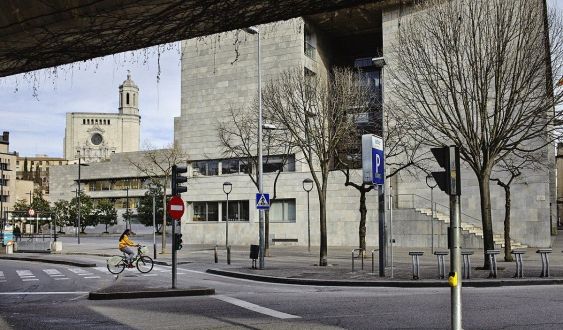
It's funny that a historian gives his name to a square that apparently has no history. Only apparently. A while of walking and sharpening one's ear in Jaume Vicens Vives square in Girona ends up bringing to the surface a handful of conversations and skins that were previously hidden. The square is located behind the Girona courthouses, very close to La Devesa park, whose plane trees, stripped bare by winter, form a soft fuzz on the horizon. Adjacent to the square are Berenguer y Carnicer street (a 13th-century religious figure) and a car park with a prominent entrance, a structure crowned by a pyramidal shape reminiscent of vintage kiosks, of that vintage that one never quite knows if it existed, but which everyone identifies as vintage. It's drizzling and the entrance structure to the parking provides shelter for the disheartened citizens and hurried conversations:
—Are you walking?
—Yes, but don't worry —timid doubts, almost imperceptible.
—Come on, I'll take you, man, it'll be a moment —she says, more determined.
Or a lady complaining about the spending on the credit card of someone who clearly isn't very sharp. Or a long phone conversation from a boy interested in a thyroid problem; the boy seems to be passing time, seems to be in a waiting period and takes advantage of it to make the seconds pass with a conversation that could be about the sex of angels and would end up being the same.
Looking towards the Onyar river (quite full), the archetypal profile of Girona extends, with its colorful houses, the cathedral, and the church. Not far away, at the exit of the square, is the independent theater hall La Planeta, which faces Jeroni Real de Fontclara street, a 17th-century chronicler. What landscape must the chronicler have seen, if he ever had time to stop in this square? Was it already a neuralgic center or an unknown periphery?The square behind the courthouses offers the quietness that is not found on the main facade, where all the urban nerve is more electrified. The poster stuck on one of these circular points overflowing with proposals announces the performance of La Húngara in La Mirona hall, presenting her latest album, The Pretty Girl XV, accompanied by a guest artist (the daughter): Laury "La Hungarilla". The logical mechanism of things provides an almost balsamic security. La Húngara and La Hungarilla. From here, we continue, and advance towards the center of the square, with dark tiles, where a sculpture that wants to represent the solar system and the planets reigns. In keeping with this, very close to the courthouse building (a gray block that forms an L) there is a row of eleven magnolias. Faced with details like these, a remote idea of universal harmony sways and a tourist sign directs me towards the Jewish quarter, the museums, and the cathedral. This places me in a corner of the square, a new perspective. Looking towards the Onyar river (it's quite full), the archetypal profile of Girona extends, with its colorful houses, the cathedral, and the church. Not far away, at the exit of the square, is the independent theater hall La Planeta, which faces Jeroni Real de Fontclara street, a 17th-century chronicler. What landscape must the chronicler have seen, if he ever had time to stop in this square? Was it already a nerve center or was it an unknown periphery?
The square insists on offering skins and more skins of life when it seemed that it was merely a gray, checkered square, with the headquarters of the Bar Association as the culmination of the rational logic that the space wants to display.From this corner, now and here, an old building stands, which seems to have its days numbered (the others are new or tastefully remodeled). On the facade, some peeling letters recall a nuance of what it must have been: "We are moving. C/ de Santa Eugènia, 108". The move happened some time ago. In this place, about to enter theparkingof the courthouse building, two vehicles of "funeral services, judicial transport" are expected to carry out another type of transfer. Once the operation of swallowing saliva in front of this exotic scene is done, the question inevitably arises: who do these vans transport and what story do they have behind them?
The square insists on offering skins and more skins of life when it seemed that it was merely a gray, checkered square, with the headquarters of the Bar Association as the culmination of the rational logic that the space wants to display. But in the symmetrical scales in which justice is drawn, which we assume to be both balanced and heavy, we never see the content, the exact weight. In the same way, urban landscapes hide unfathomable surprises that are not discovered in the first pass or in the second. The laughing mask, on the facade of the La Planeta hall, reminds the unsuspecting who may think they already know everything, like the tourist who quickly jumps from one museum room to another exclaiming "there's nothing to see here." I consult a friend, a true Gerundense, about what she can tell me about this square, about what was there before (that indeterminate "before," which neither knows when it begins nor when it ends, which superimposes skins and hardnesses on the landscape we see). I make the inquiry without much hope, and I foresee that she will send me packing when she sees my extravagant interest in a square that might not go down in history. But the answer lives up to my disguised skepticism:
—Well, in it was (is) the first apartment I lived in, and in front of us was the slaughterhouse. I remember seeing trucks leave with immense pieces of meat torn from top to bottom. La Planeta was a Sarfa bus station.
I widen my eyes as she continues her meticulous account:
—Where the entrance to the courthouse is, the firefighters were. Behind, where the square is now (at the point of the planets of the solar system), was the slaughterhouse, and in front of the cinemas (that is, in front of the current Albéniz Centre cinemas, where an arm of the courthouse now stands) there was a dairy. I used to go buy a bag of milk for five pesetas. It gave off a stench that has stayed with me.
Add The New Barcelona Post as your preferred Google source for free
Stay informed with the latest news.