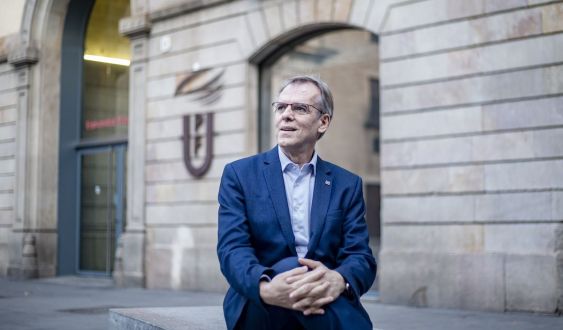
Oriol Amat is above all a public servant. Professor of financial economics and accounting and rector of Pompeu Fabra University (UPF). He was dean of the College of Economists of Catalonia, the Barcelona School of Management, president of Accid and the first Catalan advisor to the CNMV. He was also a member of Parliament between 2015 and 2017.
Born in Barcelona in 1957, he has always lived between Gràcia and l'Eixample. He has five children and his is a family of economists. As a young man, he played hockey for Barça and was a boy scout. He didn't have a television at home. He turned his shyness into a virtue to become a teacher. Politics has always interested him, although he has never been a member of a party. He is independent. He likes Benedictine leadership and humanism, shaking up organizations and always seeing the bottle half full. And if anyone has a better option than optimism, let them say so.
--- He dedicated himself to the world of economics and the university.
--- It's what I had always seen at home. My father is an economist, he had worked in a credit institution, he was a professor at the UAB and dean of the College of Economists. This weekend he turned 97. I wasn't too clear about which career to choose, but my older brother also studied economics.
--- His passion for economics comes from his family.
--- I started with many doubts and in my second year of university, I had an existential crisis. I wanted to change Business Administration for psychology, my father recommended that I do both degrees at the same time and with only one year of psychology, I already saw that it was not my path. In my fifth year of university, a professor commented that he needed a student to do an internship. I was very shy and blushed easily, but almost by chance, I gave a first class and realized that teaching and the world of higher education was what really passionate me.
--- As a child, he didn't have a television at home.
--- Now we have a television at home, but we don't watch it. Only during the New Year's Eve chimes and on election nights when the results are not yet known. I like to see the exercise of oratory and communication that the different party representatives perform to explain the electoral moment.
--- How do you get informed?
--- I have a peculiar information habit. I subscribe to three newspapers ---one digital and two in print--- and I receive the dossiers from the College of Economists and the UPF. Contrary to what many people think, I am not very active on social media. I spend five minutes in the morning and another five minutes at night. I also follow opinion leaders from the economic and political world.
--- He has been rector of Universitat Pompeu Fabra since May 21, 2021.
--- I consider myself a public servant, especially for the last 15 or 20 years. During the first years of an academic life, you have to research, publish, and prepare classes. You don't have time to think about how to improve the country. In my case, when I started teaching at the UAB, there were nights I didn't sleep preparing my classes. There comes a moment in your professional life when you ask yourself what you can contribute and how you can help leave this world a little better than you found it. I never set out to be rector.
"I consider myself a public servant, especially for the last 15 or 20 years. There comes a moment in your professional life when you ask yourself what you can contribute and how you can help leave this world a little better than you found it"--- Never?
--- The option of running was presented to me. I spoke with 300 people from the university community to create a 136-point program, the candidacy had a lot of consensus and no one else ran.
--- Why are you stepping aside now?
--- Due to the sum of three factors. I caught covid the same day in April that my mother died and I couldn't go to her funeral. I had persistent covid with side effects on my breathing and also very strong exhaustion, insomnia, and memory loss. I was a wreck.
--- And now, how are you?
--- I haven't taken a single day off for covid. Being a rector means taking planes and traveling around Europe and the United States. Between June and July, everything was very complicated and at the UPF we had different issues about to materialize, such as the date of the groundbreaking ceremony for the Mercat del Peix with the agreement of two ministries, the Generalitat, the UB, and the CSIC. We have also worked hard to lead the European University Alliance. I was about to throw in the towel due to persistent covid, but after six months I am perfectly fine.
--- So, what is the second factor?
--- I will be rector until the end of February and most of the 136 points of the program are done or are materializing. The university makes sense if the knowledge it generates is transferred to society. More examples of goals achieved: increasing knowledge transfer. When I started there were 7 institutional or company chairs at the university, now there are 15 and 12 more are in a very advanced stage of agreement. Soon we will have about 20 chairs. I proposed to modify the university calendar to finish the course before San Juan, which was a demand from students for decades. It's already done.
"The university makes sense if the knowledge it generates is transferred to society"--- And the points of the program that are not done?
--- They cannot be achieved because they either need more than two years or there is not enough consensus in the university to push them forward. Another historical demand from students is schedules more compatible with their lives. We set up response teams to work on it and a proposal and a code of good practices came out so that deans can improve schedules. However, this is a competence of the deans who are democratically elected by the university community of the faculty. Where we have arrived is where I can arrive and I cannot do more. Almost everything in my program is done and what is not done, I cannot do.
--- And the third factor?
--- I like to shake up organizations. I was dean commissioner of the Barcelona School of Management and in three years I made a very important transformation that is already a case study in some business schools. I want to shake up an organization again.
--- What will you shake up after the rectorship?
--- I am not leaving the university. I am a public servant and I have been at UPF for 30 years. I want to continue helping the university and I will be delighted to teach more classes, give more lectures and do more research while helping to shake up or transform an important part of the university. The next day I will do what the university and its governing team believe I should do and I will do it with great pleasure.
--- You were a deputy in the Parliament between 2015 and 2017.
--- Politics has always interested me, although I have never been a member. I am independent. When President Artur Mas proposed that I go on the Junts pel Sí lists as an independent, my idea was different and I told him no. I had just returned from four years as a CNMV advisor ---it was the first time there had been a Catalan in the executive--- and I wanted to return to the economic and financial world of the university. I remember I was in Iceland and my father asked me to help. I said yes. It was a very special moment and it was a list that brought together many conceptions of the country.
--- What memory do you keep of politics?
--- I learned how a law was made and I was the rapporteur for the statistics law. I had a great time until the last few weeks when everything changed. The months of September and October were very hard, everything became complicated and I suffered a lot. I am a person of pact and of seeking common ground, of trying to understand the other. When there was the 155 and the Parliament was dissolved, I returned to the university. Different political forces proposed that I continue, but I said no. I don't understand current politics too much.
--- Why?
--- When I was a deputy, I was very clear about where we came from, what we were doing and where we were going. I no longer look too much at the Catalan and Spanish politics section of the newspaper. If someone sees clearly where we are, let them tell it. I don't understand the current moment.
"I don't understand current politics too much. We need more humanism and empathy. We have to think first about the country and then about the party. We have to think about the new generations instead of the next elections"--- What do we need?
--- Each one is himself and his circumstances. That is why it is very important for teachers to occasionally have a responsibility or a position to understand the complexity of each moment. In Nordic countries, it is a tradition for people to dedicate a few years of their mature stage to public service in the city council or parliament. It is very easy to criticize, and being a politician today is complicated and has very few incentives. A politician must be willing to be criticized on social media. Public lynching was not so common before. We need more humanism and empathy. I see the bottle half full and the good side of people and situations.
--- Without health there is no economy, and the goal of the economy is well-being. How do you see the economy, health, and well-being of Barcelona?
--- Barcelona is a great city, and you realize it when you travel the world. Before the Olympic Games, everyone asked me where Barcelona was, and now it is one of the cities with the greatest prestige. A problem we have in our country is the validation of degrees and bureaucratic procedures with the public administration. Barcelona is a great city, and its location is unbeatable. We have a great capacity for attraction, and we must better organize tourism to make it quality and value-added and thus take advantage of all avenues for wealth generation. We cannot afford the unemployment we have; we must reduce it, and we need economic activity. Both Barcelona and Catalonia place excessive obstacles on entrepreneurs and businesses. I remember a manager who told me that a supermarket took eight years to get a license. Ordering means ordering, not being inefficient. Things must be done with consensus, and when there are changes in government, everything should not be thrown back. Consensus!
"In Barcelona and Catalonia, we have a great capacity for attraction, we must better organize tourism, and there are excessive bureaucratic obstacles for entrepreneurs and businesses"--- The constructive policy.
--- This is what I miss in political groups. We must think first of the country and then of the party. We must think of new generations instead of the next elections. Perhaps it is a utopian dream… I was thinking about the foundations of the Finnish educational system, which were not made with parties in mind, but with future generations. For 30 or 40 years, the laws have not had to be changed.
--- And the transfer of knowledge?
--- 30 years ago, we were quite bad in research in Catalonia. Andreu Mas-Colell led a very successful policy and made Catalonia today on the world research map. Catalans are 1 per 1000 of humanity, but we produce 1 per 100 of science. That is, we produce up to 10 times more than the average of humanity. In Catalonia, we are in the league of countries where more scientific and impactful research is done, such as in the United States, Israel, or the Nordic countries. In Catalonia, we do very well the research that serves to generate knowledge that must have an impact and that makes science advance. However, what we do not achieve is for that knowledge to reach society. This is the transfer of knowledge.
--- How do we solve it?
--- Transfer in the university means creating chairs with the Miró Foundation, the Barcelona City Council, or the Catalan Association of Municipalities, among others. A chair means making an agreement with an institution that gives you resources, and with these resources, you generate knowledge that reverts to society and allows society to be better. The connection with knowledge also makes companies better.
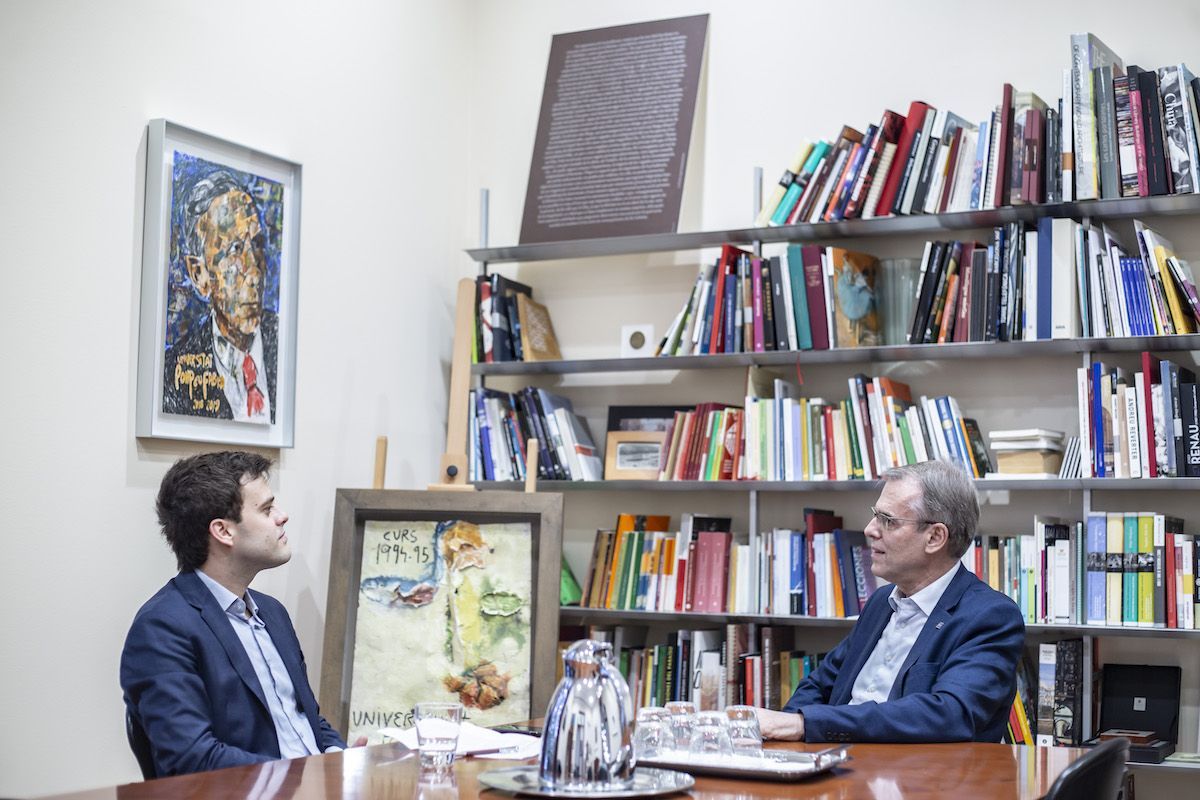
--- New times of crisis, new welfare leaderships?
--- In today's world, we lack humanism and the attempt to understand others. If we talk about political life, it means that a party leader should be able to recognize that another party's proposal is good. When everything the other does is negative, then it is delegitimized on its own. Citizens are treated as if we were people without the capacity to see good and bad. In the Parliament, they sometimes told me I should criticize more, but I will criticize what I believe is poorly done, but not what I believe is well done. We need a greater capacity to reach agreements and build. That is what the population wants.
--- And in the business world?
--- It depends a lot on leaderships, and this varies from place to place. In the UPF community, there are about 25,000 people, and I apply zero distance with everyone. I am almost never in the rector's office and I am always on the Campuses to talk to people and find out what worries them. The community is exceptional and is made up of empathetic people who understand how far you can go and how far you cannot. Zero distance is a way of practicing humanism and allows you to identify what you can improve and act immediately.
"In today's world, we lack humanism and the attempt to understand others. Zero distance is a way of practicing humanism"--- The previous interviewee of Persona a persona, Xavier Marcet, asks you the following questions:
--- How do we activate an optimistic drive in companies even in times of difficulty?
--- Beyond health problems, there is no better strategy than being optimistic. Optimism is thinking that even in the worst moments, the situation is not so bad. My grandfather had an expression that went like this: "May God not send us everything we can bear." When we were in full lockdown, I wrote a book called The Half-Full Bottle. Even then there were opportunities with financial investments. I always remember a phrase from Nobel laureate Daniel Kahneman that goes like this: "Optimists make more mistakes, but they do better." Being optimistic does not mean being a dreamer, but seeing the situation you are in and what is the best way to move forward. Those of us who think the world can improve will be told that we are too optimistic. But if someone has a better option, let them say so.
"There is no better strategy than being optimistic. Optimism is not being a dreamer, it is thinking that even in the worst moments, the situation is not so bad"--- Is the future of management humanistic management?
--- Generally, there are good people and everyone does what they can. If someone harms you, you should try to make them understand what happened and give them the opportunity to correct it. In recent years I have read a lot about Benedictine leadership. The Rule of Saint Benedict: when one makes a mistake, you must give them at least three opportunities.
--- 1,2,3…
--- When a professor has bad surveys, I talk to him and he usually makes the change on the second or third try. Humanism is putting yourself in someone else's shoes. I try to treat everyone how I would like the people I love to be treated.
SEVEN OF LIFE
- Role model: My father
- Book: Gog by Giovanni Pepini
- Movie: 2001: A Space Odyssey by Stanley Kubrick
- Song: Boig per tu by Sau
- Favorite spot: The views of the Noguera Pallaresa with the mountains of the Geganta from Bresca (Baix Pallars)
- Life motto: "Life is not how it is given to you, but how you take it," as Father Tronxo says
- Dream:That the people I love and everyone in general can live a dignified and full life
Add The New Barcelona Post as your preferred Google source for free
Stay informed with the latest news.
