
Signing up for a last-minute plan is no longer possible. The end of the pandemic brought a lot of eagerness to do things, as if they hadn't been done before, and this behavior has resulted in tickets selling out for almost everything: concerts, plays, and even open-air cinema. This year's edition of Sala Montjuïc has become the first to run out of seats ---in its case, sun loungers--- even before the screenings began. If the lineup was announced in mid-May, a month and a half later, there wasn't a single free spot, with nearly 40,000 tickets sold for the 16 scheduled sessions.
"It had never happened to us before," says Nathalie Modigliani, one of the three directors of Sala Montjuïc, a cultural proposal born in the likeness of the open-air cinema held in La Villette park in Paris. Until now, the sold out sign had ended up being hung, but always throughout the different sessions. Since its inception in 2002, the screenings in the moat of Montjuïc Castle have attracted some 595,000 spectators over 22 editions, with only one cancellation, the pandemic one in 2020.
From late June until this week, this year's big Oscar titles have been shown, meaning Poor Things, The Holdovers, Past Lives, The Zone of Interest, or Oppenheimer, and classic classics like Charade, but also Back to the Future, Pride and Prejudice, or Billy Elliot ---the latter are chosen from the most voted in a survey conducted among spectators---. To anyone's surprise, Barbie was the hardest to sell, but, obviously, many dressed in pink to see it. Local films have little weight in the program, with only two, Casa en flames ---coinciding with its premiere day--- and Te estoy amando locamente, in a year that has seen many more.
But it's not just that tickets have to be bought in advance, but also that you have to arrive very early to find a good spot. People leave earlier and arrive with time to spare for appointments, and, furthermore, Sala Montjuïc has changed its operation. Since 2021, it has gone from a disordered and authentic format, with everyone stretching out on the ground as they wished and with the option of bringing their own sun lounger (or renting one), to a division of the playing field by zones. This had to be done, as Modigliani recalls, because with the pandemic they were forced to know the name and surname of the attendees in each zone. It has also allowed them to organize everything and place more sun loungers.
Now, there is the first zone, which maintains the original spirit and is closer to the screen, with space for 650 spectators, and three more zones where one sits in a hammock as if it were an unnumbered cinema hall, with capacity for 1,800 attendees. In total, 2,500 people each night, with tickets costing 8.5 euros for those who lie on the ground and 11.5 euros for the rest. Nerves are palpable upon arrival, when one always tends to think that there are already many people and worries about calculating where the best perspective of the screen will be given the existing conditions. The look of disappointment when a spot that seemed free is actually occupied is a classic. To prevent anyone from sitting further forward than they should, a wristband of different colors is given depending on the zone marked on each ticket.
It must be said that the freedom to lie down in any way has been lost, but, at least, no one stands in front with an stratospheric sun lounger and the current ones in which most of the public sits are relatively comfortable. However, it must be appreciated, even more so in these times, that the policy of allowing food to be brought in for dinner before the screening has not been changed. In addition, they have added a welcome tapita of fuet at the entrance, a D.O. shared by all the public, even more so if it's free.
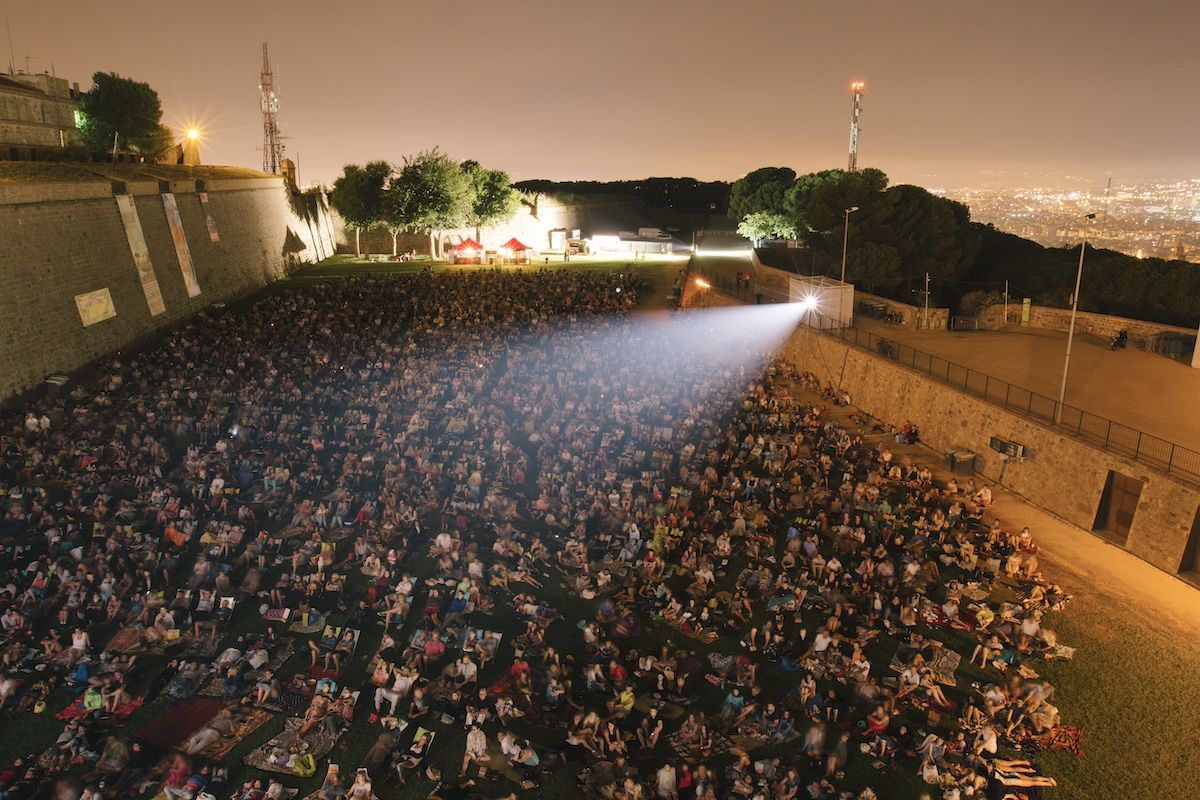
It may be an industrialization of a leisure plan that was previously less planned, more summery, but the pandemic has brought less improvisation in culture and, above all, less room to rest on one's laurels. Everything is consumed in advance and everyone wants to do things, whether they like them or not.
This is how you notice when conversations, more or less noisy, occur during the screening of Pride and Prejudice at Sala Montjuïc, regardless of whether it is a key moment for the story between Elizabeth Bennet and Mr. Darcy ---all of them are---, because, for some, the movie is just background noise. Of course, they haven't forgotten about the Instagram story. The final blow comes when, with the start of the credits, there is an anxious and tumultuous dispersion, clearly suffering from something very local, the typical boredom of a Barça member who doesn't stay until the end of the match. This, with a movie that, despite everything, stirs passions, with many "Ohhhhh" when there is a minimal gesture between the two protagonists, because, of course, the viewer of the so-called "teacup" plots knows that even the most insignificant thing is a world.
Works in Montjuïc in sight
Given the sold-out sessions, the organizers would like to do more screenings, but for that, the regulations governing activity in the moat of Montjuïc Castle would have to change, which establishes a maximum number of activities per year. Before this regulation, they had managed to do 18. Seeing that tickets sell out so easily, they would like to extend the program into August.
However, what worries them most for next year are the planned works in the area. "It was very difficult for us to find the place 22 years ago and there is no other with this magic, away from everything, where it even gets a little cool at night," Modigliani points out. To avoid having to look for alternatives, they are negotiating with the Barcelona City Council for the works to finish before summer.
Add The New Barcelona Post as your preferred Google source for free
Stay informed with the latest news.
