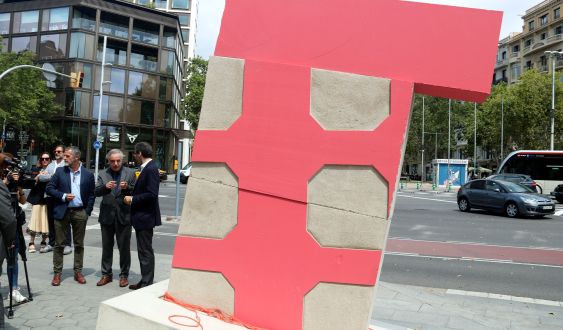
Pink Barcino is one of the latest monuments installed in Barcelona, in this case on the occasion of the bicentenary of Passeig de Gràcia, a work by Lluís Lleó. The initial intention was for it to be an ephemeral installation (it was to be exhibited in its current location until January 2025), but it has finally been maintained and, I can attest, it remains there. The scarce controversy is surprising, in a city so accustomed to discussing even obvious things like the necessary continuation of the Sagrada Família, but it is important that we look not only at what has been added to our collective heritage for decades but also at what we are contributing. And to evaluate its meaning, its symbolism, its enduring (or not) character and obviously its (or not) success. Before, Barcelonians discussed these things. Now, what we do with things is just walk past them. I'm afraid that must be what being contemporary consists of.
I will say upfront that I don't like the sculpture, but that's the least of it. I will leave my justification in a brief sentence: its combination of aggressive angles with natural stone is too harsh, a combination half cold, half frivolous, which seems to forget that Passeig de Gràcia is soft (and that it was a path that organically connected a town with a city, before being the central piece of an urban grid). I believe that the problem is not the sculpture, which has an undeniable expressive force, but its location and its pretext. The salmon pink color is a pleasant and striking color in itself, but it clashes with the city's own colors. The problem of the pretext is not the problem of the work, but it is precisely what does it no favors: the idea seems more like a tribute to Cerdà's rigid mind than to the customary elegance, the communion with modernism and with our Belle Époque that the Passeig still evokes. This makes it seem, more than a monument to a promenade, like a monument on a promenade. Therefore, the problem is not the sculpture, but the place, similar to that old statement by the mayoral candidate, Miquel Roca, when they talked to him about the future of the Imax cinema.
There are things that endure in the city and others that barely endure in our retinas, but this could be due to the city's problem with contemporary art. A mutual problem, a mutual disdain. This is a flaw I would not want to fall into and, therefore, it makes me put my opinions in a corner that is not the central one of this article. At the center of the article is the monument: located, precisely, in the urban center of Barcelona, which is this promenade that goes from Plaça Catalunya to Cinc d'Oros. The five "oros" have precisely disappeared from the intersection, that is, the five wrought iron lampposts by Falqués that are now on Gaudí Avenue, but the absurd obelisk without a name and without a cause has remained, which seems, precisely, another monument to nothingness. And in our case, the Pink Barcino is located right in front of the Palau Robert in a contrast of aesthetic styles frankly difficult to digest. I am sure that, located in another more suitable and more weathered place (why not in Plaça de les Glòries, where the Eixample also intersects with Diagonal, and which was the true future "center" of the city according to Cerdà?), the piece's rotundity would break the air well, as it intends, without breaking the gaze.
“There are things that endure in the city and others that barely endure in our retinas”
I don't know if it's true that pink (fuchsia, the chronicles say, but I don't see fuchsia) evokes the proximity of the historic Saló Rosa or the Bulevard Rosa, but I don't think so, as I would say that this color tone is simply a product of Luis Lleó's personal palette, as can be seen with the pink half of the Morpho's Nest in a Cadmium House, installed in 2017 between 52nd and 56th Street in Manhattan, and which since the following year has been visible in front of the Pedralbes gardens (along with its other half, in Klein blue). Lleó wants to unite natural and neutral stone (it is three meters high and eight tons of solid stone) with the uniform and colored sheet, spontaneous and enduring nature with human order in concrete, more artificial. As a work of contemporary art, I insist, it has strength and personality. I believe that its location and symbolic conceptualization could have raised more controversy, and in fact I would say that, in such a central place as it is, it should theoretically attract much more attention. That this is not the case may be the fault of contemporary art, or ours. Or perhaps a dubious intermediation between one thing and the other.
Add The New Barcelona Post as your preferred Google source for free
Stay informed with the latest news.