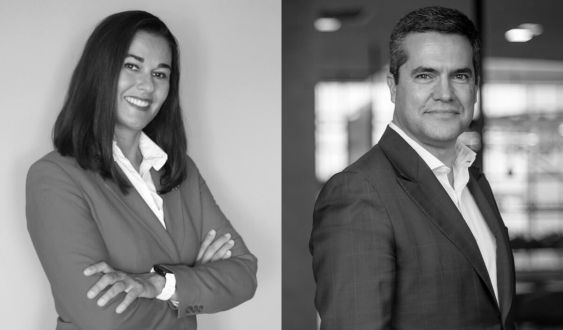
EIT Urban Mobility is a European initiative responsible for defining what mobility will be like in the cities of the future from Barcelona. The link between EIT Urban Mobility and the Catalan capital has recently been strengthened with the incorporation of two key figures in Barcelona's urban mobility into its supervisory board: the founder and CEO of Social Car, Mar Alarcón, and the director of Seat Mó, Lucas Casasnovas. They become the first Barcelona representatives to be part of this decision-making body, made up of a total of ten members, including the former mayor of Eindhoven, Rob Van Gijzel.
This supervisory board is responsible for advising EIT Urban Mobility from a strategic point of view, reviewing and controlling compliance with the strategic lines entrusted to it by the European Institute of Innovation and Technology (EIT), the project created by the European Commission in 2008 to promote innovation among member states and on which it depends. In operation since the beginning of 2019, EIT Urban Mobility has a budget of up to 400 million euros until 2026, which comes from the resources that the European Union (EU) allocates to promote research.
Alarcón and Casasnovas, two protagonists of Barcelona mobility
Alarcón is present in many of the city's main institutions. She is vice-president of Foment del Treball, a member of the board of directors of Fira de Barcelona, and a member of the boards of Barcelona Tech City, the Spanish Association of Executives (AED) and the Spanish Association of Digital Economy (ADigital). As an entrepreneur, she has promoted Social Car, a private vehicle rental platform, but she was also co-founder of Social Energy, an engineering and renewable energy project development company, among other initiatives.
For his part, Casasnovas became head of Urban Mobility at Seat in October 2019. Until then, he had held the position of Global Product Marketing Director at the car manufacturer. Seat presented Seat Mó, its new urban mobility brand, in June last year. With Seat Mó, the company aims to make individual mobility accessible to everyone and Barcelona is one of the main scenarios for this commitment.
[subscribe_newsletter_cat]
A close collaboration with the Catalan capital
With their incorporation, Alarcón and Casasnovas will have the opportunity to influence the activity of EIT Urban Mobility and have a direct participation in its strategy. As explained in an interview in The New Barcelona Post, the director of EIT Urban Mobility for Southern Europe, Daniel Serra, initiatives like this have a very clear impact on their immediate surroundings, taking into account that, being headquartered in Barcelona, a good part of the funding it receives ends up in the Catalan capital and they hire workers from all over Europe who settle here.
Beyond the participation of Alarcón and Casasnovas, the relationship of EIT Urban Mobility with its Barcelona partners, such as the Barcelona City Council, the Universitat Politècnica de Catalunya (UPC) and Seat, is very fluid. For example, it meets regularly with members of the municipal government, an intense political participation that does not occur in other member cities of this European consortium, made up of 48 partners and 15 countries. All this translates into a high number of projects achieved by Barcelona partners in the calls opened by EIT Urban Mobility to finance pilot projects, such as the one it opened to offer solutions to the impact that covid had caused on mobility.
For example, thanks to this call, a disinfectant with a more prolonged effect and a lower environmental impact than traditionally used products was tested from June to the end of December in Barcelona's metro and buses, with the help of Ferrovial and Transports Metropolitans de Barcelona (TMB). It also served to test a hygienic solution on Seat's shared motorcycles, the Seat Mó, which repels most viruses and bacteria, developed by the company Nano-Care.
Add The New Barcelona Post as your preferred Google source for free
Stay informed with the latest news.
