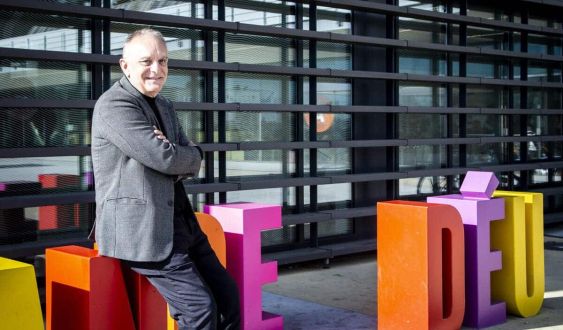
Manel del Castillo is managing director of the Hospital Sant Joan de Déu of Barcelona and is also president of the advisory board of the Fundació Factor Humà. On three pillars: conscious organization, full person and the best possible world.
Doctor specializing in family and community medicine, he did a master's degree in public company managementinEsade. "I am a manager, but I have never stopped being a doctor," he recalls after having held different management positions andof having received awards such as Arthur Andersen, Barea or Mercè Sala. He is passionate about history, management and humanism. This is his mission: "To humanistically care for vulnerable people (families or sick children) and contribute to a more just society." His raison d'être is hospitality. "We are not here to accept what cannot be changed, but to change what cannot be accepted," he asserts. In the purest giraffe leader style: long gaze, attention, good relationships and the biggest heart.--- ¿Why did you dedicate yourself to medicine?
--- I wouldn't know why, but I was clear about it since I was 12 years old. My father asked me if I was aware that I would have to be on call and work holidays, nights, and weekends. I was very interested in medicine because of its technical and humanistic combination. I didn't want to be an engineer, but neither did I want to be a philosopher. Medicine has become sophisticated, but the essence is the same.
--- ¿What is the essence?
--- To take care of someone. To have empathy and compassion.
--- From doctor to manager.
--- I am a manager, but I have never stopped being a doctor. I bet a friend a dinner that I would return to medicine in a couple of years, and I had to invite him. I like that there are changes when I also see problems. When I worked in primary care, I did a first organizational job to reduce waiting times, and they asked me if I was interested in management.
--- ¿Is directing a hospital more about being a manager than a doctor?
--- There are magnificent hospital managers who are economists or lawyers, but if you are a doctor, you have the advantage of better communication with professionals. This is reflected in the Management matters study by McKinsey
--- 35 years of management go a long way.
--- I started very young. Now no one would give a management position to a 30-year-old, but in the late 80s and early 90s, even the Prime Minister was very young. It was a generation that entered the world eager to earn everything, and now I miss the reformist spirit that existed at that time.
"I miss the reformist spirit and the critical and innovative outlook of the 90s. Now there is a very conservative position, and we are afraid of losing what we have"
--- ¿What was the reformist spirit like?
--- Everything could change: primary care, the hospital, labor reform, industrial reconversion… Everything was subjected to a critical and innovative gaze. Everything had to be changed and improved. Now there is a very conservative general position, and we are afraid of losing what we already have, from citizens to unions and politicians.
--- ¿Fear of change?
--- They think it's better not to touch anything, but an aggiornaménto is needed. We need to update and review what was good 30 years ago. There is a lot of fear of reform, especially in the healthcare environment.
--- Are politicians afraid of doctors?
--- There are no incentives to make changes. This is the case for politicians, unions, and even professionals. Everyone knows that the Spanish healthcare system is in a critical situation and that important transformations are needed. It is not just a problem of resources ---which it also is---, but above all a problem of reforms.
--- What would you ask of politicians?
--- To take risks. Reforms are paid for in the short term and collected in the long term. Politicians who start a reform know that they will face many difficulties because perhaps no one understands them, due to the reaction of those who lose and the fear of those who win.
--- So, there are no incentives to reform.
--- Reformers always face opposition from those who lose and do not always have the support of those who win. A reform always has a political cost and perhaps the fruits are reaped during the next legislature. Reforms are risky and this poses a great barrier for politicians.
"Reforms are paid for in the short term and collected in the long term, and this poses a great barrier for politicians. Reformers always face opposition from those who lose and do not always have the support of those who win"
--- The current system is more about party-to-party than policy-to-policy.
--- Exactly. You need grand coalitions for grand reforms. The historian Tony Judt said that the creation of the welfare state in Europe occurred thanks to the grand coalition between social democrats and Christian democrats against the threat of communism during the postwar period. The center-right and center-left were separate, but there was a grand pact on pensions, healthcare, or education.
--- The Moncloa Pacts.
--- They came later, but the Moncloa Pacts made the transition possible. Here, there will be no healthcare or public services reform until a new coalition is formed. Meanwhile, we will remain as we are now, and nothing will happen.--- Is the current system sustainable?
--- Sustainability depends on a political priority. It is sustainable because no one dares to dismantle it. The problem is what we will have and what we will not have will not be lorsame as we had until now.
--- ¿What will we have? Or what will we not have?
--- The public systemoris clearly deteriorating after the pandemic, but before it alreadywas going toforced marches. If nothing is done, we will havea dual system, between poor and richs, like inLatin America. There they have social security only for the poor and private healthcare for the middle and upper classes. Here it is happeningorthe same with mutuals: 40% of the population alreadyhas a private insurance company.¿Why? Because people don't find what they are looking for within public healthcare.--- ¿And what are people looking for?
--- People find quality and catastrophic risks in the public sector, but they seek accessibility and personalization in the private sector. The public system is very good for major problems but works worse for more trivial or less complex things. People are not willing to wait for complementary tests and that is why they pay for a mutual insurance."Sustainability depends on a political priority. The public system is deteriorating and if nothing is done, we will have a dual system, between poor and rich"
--- ¿Does the private sector also get saturated?
--- The private sector is not prepared to replace the public system, but to be complementary. A much larger network is needed. The public healthcare system is collapsing and the private healthcare system will not be able to respond if this continues. According to the CIS, more than 70% of people say that the healthcare system needs reforms. However, politicians still do not dare to get involved and I doubt they will. ¿Sustainable? Yes, it can be sustained but with a progressive decline that is already a reality. If we have a dual system between poor and rich, we will have lost one of the great assets we have as a country.--- The Hospital de Sant Joan de Déu is a success story of public-private collaboration.
--- The demonization has no foundation and it makes no sense to think that the public sector has to do everything. Do they also have to manufacture drugs, ambulances, and hospital beds? Where is the limit? Public-private collaboration has to exist, but it is not enough. It is necessary to reform. Nor does it make sense to think that the private sector has to do everything. It is necessary to allow civil society to collaborate with the public sector and have an impact on the network, as is our case, but it is also necessary to reform Vall de Hebrón Hospital. The solution is not to privatize, but to implement modern public management.
--- What is the diagnosis?
--- We are a public sector and are financed by CatSalut but we have private management. Public hospitals receive a budget whether they listen to CatSalut or not, and we have to listen no matter what. The public part has to be reformed and function like in other countries. In Europe, a movement called New Public Management began many years ago and changed the rules of the game for public management.--- The theory of public decision.
--- You can have very administrative management that guarantees legal certainty, but to provide services, you also need modern business-oriented public management focused on results. The administrative model is not suitable for caring for the elderly in a residence. Oh, and business tools do not mean making money. Public management can also be business-like.
--- How?
--- It can be undifferentiated administrative management or business management. It does not happen anywhere else in Europe, but here hospitals do not have legal personality and, therefore, do not have the capacity to contract or make personnel policies, just as they cannot form a governing board or establish an alliance.
--- Is it necessary to reform public administration?
--- The public administration of Spain was designed centuries ago and has not evolved much. It is not exactly modern. We have a public administration that is heavy and bureaucratic and is not the best instrument to manage servicess. In nowhere in Europe is there a hospital that has the size of one of ours with a budget of 800 million euros and does not have a board of directors or company policies. Itthe same happens with primary care."Public management can also be modern, business-oriented and results-oriented"
--- ¿How is it managed then?
--- Here with doctors who are civil servants, but in the vast majority of Europe it is not like that. In fact, only in Portugal, Greece, Spain and Iceland. In all the other countries there are liberal doctors who in most cases do not have a contract with the administration and only have a payment agreement per act or per capita. The British doctor is the paradigm of Spanish healthcare because they charge per card and per patient. Top-level specialists and primary care doctors in France, Germany and Holland charge per act.
--- Everything has its pros and cons, I understand.
--- If you charge per act, you tend to do more actors and this can generate induced demand. If you get paid by salary and it's the same to do 10 as 100 then you tend to do 10. With a fixed salary there is underactividtod and with act there is overactividtod.--- "In the middle ground lies virtue", Aristotle used to say.
--- One mustto look for a middle model where it is paiduefor salary and also for results. The Spanish healthcare model has a big organizational problem. Vocation is necessary but incentives too. I put yougothe example of the Puigcerdà cross-border Hospital, which is a perfect laboratory to analyze the impact of the organizational model on clinical practice and patient flow. There, the emergency rooms are full of Catalans, but there are almost no French people.¿Why? Because the French doctor charges per act and is accessible when the patient has a problem.--- A matter of model.
--- Before, we had doctors who charged per booklet and who didn't want there to be competition. Now there are always doctors missing and we want more cards. It's neither good nor bad, it's simply the incentive. The organizational model is one of the big problems in this country. The healthcare system is collapsing due to lack of resources but, above all, due to lack of reforms. The specialist outpatient clinic was eliminated and sent to the hospital. Primary care centers should be created with doctors, primary care nurses and accessible, personalized and resolute specialists. Make a polyclinic.
--- What does a good healthcare leader need?
--- In Sant Joan de Déuwe like leaders to be giraffes. It's a metaphor for an animal withfour important characteristics: 1) Height, long gaze and global vision, 2) It is the animal that sleeps the least and, therefore, is awake and attentive to what happens in its environment, 3) It is a calm animal with good relationships and 4) It is the terrestrial mammal with the largest heart.--- "Before we looked for the hands of the workers, then their heads and now we look for their hearts".
--- A good leader has to understand the whole picture and see what impact a decision has. A good leader has to be attentive and have good relationship skills. I remember an anecdote about Louis XVI who kept a diary and on the day of the takeof the Bastille pointed out that nothing was happening. It cost him his head. The leaderships of giving ora blow on the table. A good leader has to have a heazóngreat that gives inspiration, passion, and tenacity. Things don't work out the first time, and living is not easy."We have a public administration that is heavy and bureaucratic and is not the best instrument to manage services"
--- A good leader has to serve and not serve themselves and work for others, as Xavier Marcet says.
--- The most basic step is to administer or manage, but the leader has to inspire and build narratives that generate commitment. If people are committed, they go beyond their strict obligation because they share the values and feel the pride of transcending their work. If there is commitment, you can do everything you want. The key to a leader is to inspire and perspire. [Laughs]. A strategic plan alone is not enough; you have to have a narrative. We dedicate a lot of effort to explaining why we are here.
"Leaders have to be giraffes: long gaze, attention, good relationships, and the biggest heart. They have to inspire and build narratives that generate commitment"
--- Why are we here?
--- To humanely care for vulnerable people (sick families or children) and contribute to a more just society. This has been our mission for many years now. Societies that treat well a the most vulnerable are fairer. In the United States, they are very dynamic, but there is a lot of inequality and many people who are homeless and have mental health and drug addiction problems. In Denmark, they do take care of the vulnerable. Taking good care a the rich and a the winners is easy, take good care a the vulnerable is much more complicated.--- ¿How is the relationship with patients?
--- Everythingthe world says the same thing, but in our case it is nuclear: patients have to be at the center.Inmy epitaph will say that I didn't mess it up. [Laughse]. Before I arrived, there was already a very high commitment to the institution, a humanist attitude, and a global vision with families and children. The values and culture have been maintained. Our raison d'être is hospitality and humanism. We have a very powerful department of experiencewith ethe patient who mideyour satisfaction. When we opened thePediatric Cancer Center"Taking good care of the rich and the winners is easy, taking good care of the vulnerable is much more complicated"
--- What is the first thing that comes to your mind when you hear the word cancer?
--- Before, cancer was a death sentencee and now it is a serious disease that can be cured. To many friends them I say that health is given to you for a few years and from a certain age, you have to workit and a lot. You have to take medication, have a good diet and exercise. Before, cancer was taboo and now it has changed a lot. In Sant Joan de Déu 82% of children with cancer are cured and we fight to reach 100%. Every lost case is a tragedy.--- ¿What is the Liquid Hospital project like? It reminds one of Zygmunt Bauman.
--- Exactly,itthe only thing is that we are more positive than Bauman with the liquid society. En2010 we started talking and wemastersthen the patient portal to be able to communicate non-presentially. Now this is acommodity and everyonealready it relates like this. The liquid hospital goes beyond walls.--- Neither walls nor borders.
--- We specialize in rare diseases with low prevalence but that affect up to three million people throughout Spain. These diseases are so rare ---the vast majority of genetic origin--- that few hospitals can diagnose and treat them. With the liquid hospital, we implement telemonitoring and teleassistance systems to ensure that people can stay at home or in their territory.
--- The One Day Care.
--- A child with a rare disease has many problems beyond health, such as their relatives having to stop working and change their residence. Less income. There are also many separations, and often it is the women who are left alone caring for the children in a city that is not their own. With the liquid hospital, they don't have to moveseand with theOne Day Care, the patient is at the center, monographic afternoons are held, and different patients with the same disease are scheduled on the same day. Specialists coordinate, go through eachboxand they solve all the child's problems in one afternoon. Families accompany each other, help each other, and build community.One mustthinkin what patients and families need."You don't have to interpret what patients say, you have to listen to them"
--- What do they need?
--- This is what I ask. I always say that you don't have to interpret what patients say, you have to listen to them. Only the patient knows what the patient needs and only the professional knows what the professional needs. You have to leave a space to listen and talk. When you listen, you always find things to improve. The organization has to be more focused on the patient than on the professional, and that is why our functional units go beyond the service and revolve around the disease. Easy to say, not so easy to do. Healthcare organizations are organized by services, apparatuses, and systems, but chronically ill people do not have only one pathology. It has to be a matrix organization, like multinationals that are already organized this way: by countries and by lines.
--- How do you see the city of Barcelona?
--- It is not in a good moment and it is losing strength. A person from the Badalona City Council told me one day that a mayor has three obligations: that the city is clean, that traffic flows well, and that it is safe. These are basic competencies of a City Council and from here you build whatever you want. In large cities, the social issue must be added. Basic things that occupy us every day and must be guaranteed. And then, you have to have a project and a dream for the city.
"The city must be clean, traffic must flow well, and it must be safe. Barcelona must have a project and a dream. I get the feeling that we are going against wealth, but we must be against poverty. Wealth is good and must be distributed well"
--- What is Barcelona's project and dream?
--- We lack a city project that, for example, did exist during the Olympic Games. We have to create new narratives and generate wealth. I get the feeling that here we are going against wealth, but we must be against poverty. Wealth is good and must be distributed well. We diversify tourism.
--- And health?
--- Barcelona could be much better positioned because we have all the characteristics: buenoprofessionals, good facilities and good connection ---one or two plane jumps away---. En2012 birth rates and money went down and we decided to open up to the world. It's going very well for us because it gives us income, experience and allows us to focus more on the patient. It also helps attract talent. International activity has been a blessing. Barcelona could be abiohubas Boston, but most public hospitals here cannot do international activitieses. It is prohibited by law.--- ¿Why?
--- Vall de Hebrón, Bellvitge or Can Rut
"Barcelona could be a biohub like Boston, but most public hospitals here cannot engage in international activitieses"
--- The previous interviewee of Persona a persona, Carlos Duran, asks you the following question: "How do you think life expectancy will behave in the next 20 years?"
--- ¿Despite everything? It will increase. Life expectancy will be extended thanks to triumphant science, precision diagnostics or the medicine of the 4Ps: participatory, precision, personalized and preventive. We are at a moment of disruption with el anti-aging. The key is not en getting older, but being bien the older you get. For now, we have gained 10 years of life expectancy in health. It is not the same life expectancy as healthy life expectancy. You reach 60 years without major problems and then the leaks begin. Nowadays there are no old people, but older people who can have an active and healthy life. Genetics and personalized medicine will be a great disruption.
SEVEN OF LIFE
- Referent: My father. The most honest man I have ever known.
- Book: To Kill a Mockingbird. The first novel, when I was 12 years old.
- Movie: Cinema Paradiso, by Giuseppe Tornatore.
- Song: Mediterráneo, by Joan Manuel Serrat.
- Favorite spot: A corner of the terrace of mi house.
- Life motto: "You have to have más dreams than
memories". A formula to avoid aging. - Dream: All my working life I have worked to try to transform the public health system into something managed in a modern, business-like and non-bureaucratic way. 30 years have passed and I am still fighting for the same thing, but I see it as increasingly complicated. My dream would be to contribute to achieving that goal.
Add The New Barcelona Post as your preferred Google source for free
Stay informed with the latest news.