
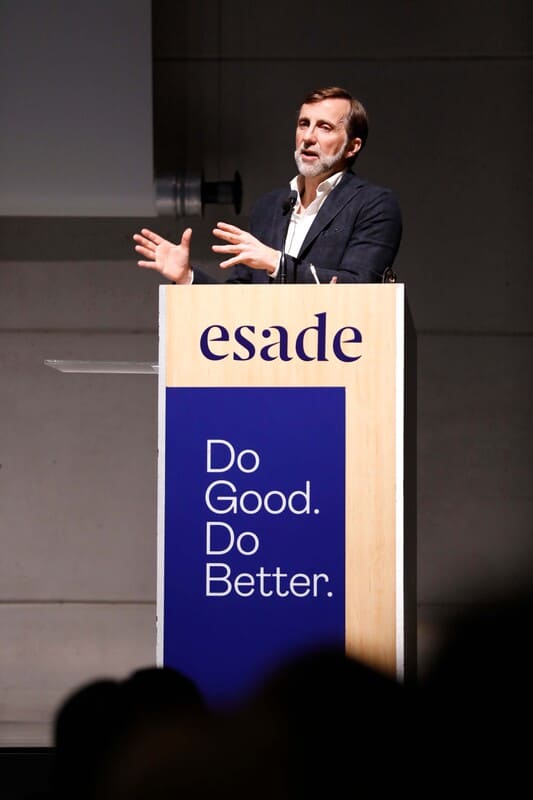
Create value. This is one of the most used expressions in the business and investment sector. Creating value can mean many things, which is why, this Wednesday, at the Matins Esade forum, Luis Seguí wanted to explain the vision that his firm, Miura Partners, has of value creation and another concept that always accompanies private equity: return on investment. According to the executive, "creating value is an art", and it is because it derives from the combination of multiple factors and the fact that each company is a unique case, which turns managers/investors into "tailors" whose main mission is to create "a custom suit" that allows the company to get the most out of it.
Traditionally, in this value creation, elements such as expansion, internationalization, talent management, innovation or market consolidation have been combined... but now "the strategic factor that makes companies more valuable" is sustainability. "We have completely turned this concept around, since, before, sustainability was associated with additional costs," highlighted the co-founder and CEO of Miura, an investment firm based in Barcelona that manages assets of 1.5 billion euros.
Seguí recalled that Miura was born in 2008 in the heat of the strong international expansion of private equity, but pointed out that "after ten years of success", in 2019 the nine partner owners of the firm agreed to emphasize three concepts that, since then, accompany their investments: purpose, legacy and impact. "It is no longer just about sales and results growth, but about how we do it and how we manage to generate that impact and that legacy," he explained.
This evolution has led Miura to implement a strategy to "go beyond returns" and to define a new investment model based on entering the capital of companies that allow improving people's health ---for example, with good nutrition---; empowering society and generating more prosperous communities ---betting, among other sectors, on education---; and contributing to the regeneration of the planet, with investees in the field of the circular economy and energy transition.
According to Seguí, "impact investments elevate the strategic value of companies", which is why they arouse much more interest despite the fact that their profitability may in some cases be lower than that of other companies that do not incorporate the impact model. "Companies with impact models are more valuable companies, not because they are more profitable, but because they are valued more by having a greater strategic value. The same company, but with an impact methodology, is worth much more because its strategic component is higher," he explained.
"Companies with impact models are more valuable companies, not because they are more profitable, but because they are valued more by having a greater strategic value"The CEO of Miura has admitted that this type of investment "requires patience", that is, require "more patient" capital that does not seek short-term profitability, since "it takes a long time to be able to obtain relevant data" that allows measuring the intended impact. In this vein, he has emphasized the importance of moving "from narrative to results" to demonstrate that this evolution makes sense. However, he has noted that investor interest "exists and is growing," and not only among large institutional funds, but also among family offices, who "are very eager to invest in impact, which is great news, because it shows that family investors are also sensitive to this evolution of the model."
In 2022, Miura Partners raised an impact fund totaling 150 million euros which, so far, has made three investments. Its portfolio companies are the Madrid-based company Tierra (creation of sustainable green spaces), and the Catalan companies GasN2 (gas generation and industrial refrigeration equipment) and Wikiloc, the geolocated hiking route platform. In total, since its inception, Miura has invested 3 billion euros in some 60 companies. Currently, its portfolio consists of 16 companies that last year achieved an aggregated turnover of 1.853 billion euros, triple that of a decade ago. Among them are restaurant companies such as Tragaluz and Saona and companies such as Citri&Co, Serpis, Indiba, Educaedu, Proclinic and the brokerage firm Sabseg.
Entrepreneurship is not for everyone
Luis Seguí began his professional career at the family business Paniker and gained experience at Arthur Andersen, a firm from which he moved to the Intercontinental hotel chain. Later, he moved to London, where he launched, together with other partners, his first entrepreneurial project: the data center company IP Powerhouse, which failed "for being 20 years ahead of the market." After that experience, he began working at Nazca Capital, where he "learned the trade" of investing in venture capital, until he decided in 2008 to re-enter entrepreneurship and launch his own firm with Juan Leach, the other founding partner of Miura.
"Entrepreneurship is not for everyone. I want to demystify entrepreneurship. Not being an entrepreneur is not bad, it's something you have to carry within; there are many successful people who have not started a business," Seguí reflected at the Esade business school. According to the executive, who cited a Harvard study, the ideal age to start a business is 45, although everything depends on "personal timing and the market." "You shouldn't rush, you have to feel prepared," he concluded.
Add The New Barcelona Post as your preferred Google source for free
Stay informed with the latest news.
