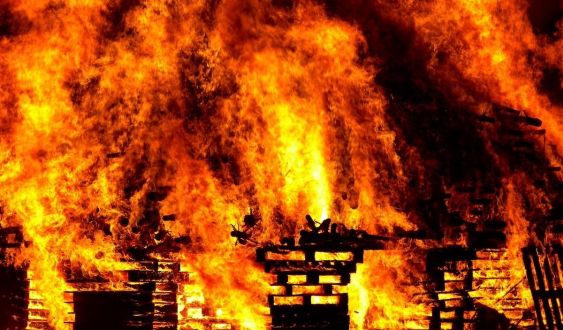
One of the things that pleases me most about Barcelona is its natural geographical limitation; two rivers, mountains, and the sea are the gifts that providence offered us in order to prevent our capital from becoming an unreachable megalopolis of delirious growth. The opposite of this glorious fact is what most worries me when I have forced myself to visit dreadful cities like Los Angeles, now a victim of the worst fire in its history, which is burning the suburbs of its mountains with a voracity from which not even Hollywood superheroes can save themselves. I must confess that I am a potential pyromaniac and the images of the city besieged by a curved line of fire advancing like a bel canto basso continuo have seemed to me of a terrifying beauty. The flames are not the worst; the most terrible thing is that the city itself has not developed any limits to contain the voracity of the fire.
Fire is terrifying, ultimately, because the city has committed the sin of emulating the infinitude of the landscape.The city is precisely the artifice that seeks to abandon and mock nature; due to this grace of modern technique,resulta un lugar que nunca debería verse asediado por el fuego. The Yankee imaginary is full of stories about neighborhoods and cities that have ended up in flames due to industrial stress and the voracity of capitalism, it is true (and my beloved Americans love it, because the fire becomes the perfect excuse to rebuild the city with more bricks and write novels about the capacity for overcoming of free men), but the flames are only tolerable if they come from some internal excess, from thehubrisof its own inhabitants. But that fire in Los Angeles, precisely because of the lack of any border framing the city, seems to come from afar to consume it and lower its self-esteem as if it were a simple bush, its houses, matches, and its cars, stones.
The fire is terrifying, ultimately, because the city has committed the sin of emulating the infinitude of the landscape. People flee in a hurry, but they don't know where to go, since the next hotel room could just be another stop where the fire would enjoy entertaining itself with mortals. Americans, who are the peak of efficiency in any matter, will end up putting out the flames, and filmmakers will return to their palaces as if nothing much had happened, because for something they have a lot of money stuffed into their ear holes; everything material is perfectly replaceable and there won't be much problem to buy those awful watercolors again with which they fill their horrifying dining rooms. But they won't easily get rid of the fear, because when non-citizen fire takes over the capacity of urban Prometheus, anyone goes to bed, no matter how much they have a home overflowing with golden beds. Fear, certainly, is changing sides.
From time to time, it's good to celebrate that we are minuscule, absolutely manageable and not very inclined to spectacleCities, for goodness sake, no longer fulfill the dream of being impenetrable places. In the eyes of the majority of the world's population, events like those in Los Angeles awaken an apparent solidarity. I prefer to be more honest and remember that, in the face of such catastrophes, most humans are like the soldier who prays for the bullet to hit his squadmate. In this case, seeing how hundreds of thousands of citizens flee Los Angeles as if they were war refugees, selfishness sprouts even more from my soul. Luckily, I insist, we live in a small town framed by the sea and four plateaus that don't even have enough strength to burn. From time to time, it's good to celebrate that we are tiny, absolutely manageable, and not very inclined to spectacle. Except for an isolated incident, like a smoky kitchen, here firefighters are only calendar fodder.
Add The New Barcelona Post as your preferred Google source for free
Stay informed with the latest news.
