Barcelona is already preparing for one of the brightest nights of the year with the new edition of Llum BCN, which this year will be the first major city event to welcome the World Capital of Architecture, conceived as a declaration of intent about the future of the metropolis. Between February 6 and 8, this festival will not only transform the urban landscape with its usual technological expertise, but will also tune into an institutional beat of global reach, acting as a starting gun.
This distinction, granted by UNESCO and the International Union of Architects, is not a mere honorary title, but the recognition of a city that recognizes its walls, pavements, squares, and corners as a living organism in constant transformation. This year, the festival abandons its usual concentration in Poblenou to reach each of the ten districts of the city, tracing a network that connects the periphery with the center and historical memory with digital avant-garde. It is a bold gesture that invites citizens to rediscover their own home under a new light, a light that questions the body, space, and time.
The welcome to this architectural capital will manifest itself, first of all, in an unprecedented gesture of visual unity with the simultaneous illumination of Barcelona's eight locations declared World Heritage Sites. These will be the Sagrada Familia, Casa Vicens, Casa Batlló, La Pedrera, Palau and Park Güell, Palau de la Música and the Sant Pau Modernist Site, all bathed in the blue color of UNESCO during the three nights of the event.
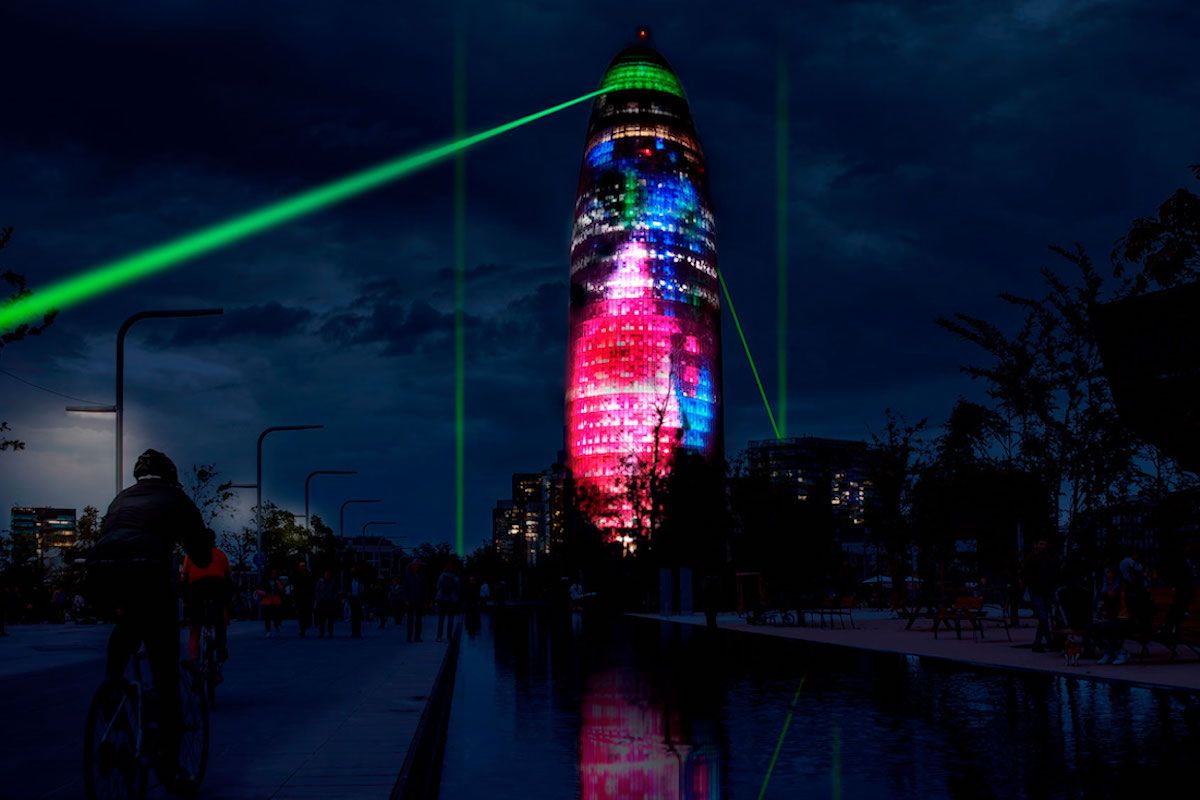
Like a lighthouse, this action highlights Barcelona's monumental richness while reminding us of the city's uniqueness in the international context, given that it is one of the few cities with such a high concentration of assets included in this list of excellence. This blue mosaic is the perfect backdrop for an itinerary that forces us to move and feel the city as a common space. For this reason, from The New Barcelona Post we propose a route for each day.
Inaugural Friday, from Born to Eixample
This tour is ideal for anyone who wants to capture the pulse of the opening, since many of the dance pieces and live music only coincide on this day. We propose starting our tour in the heart of Ciutat Vella, where past and present poetically collide. At the Born Centre de Cultura i Memòria, Toni Mira and the Brossa Quartet offer us the Imaginary walk, a piece where archaeology is not a static silence, but a vibrant stage. Through contemporary dance and live music, the ruins of Born recover an ephemeral voice, activating collective memory through body movement.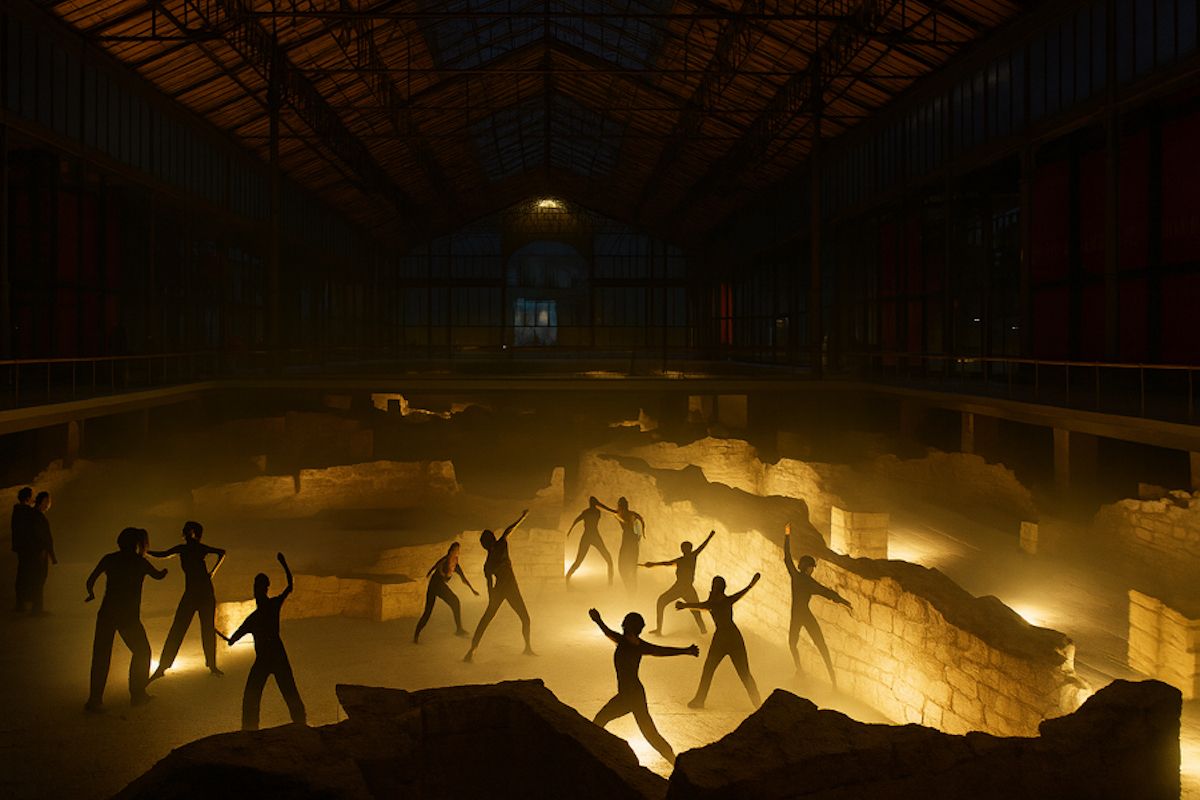
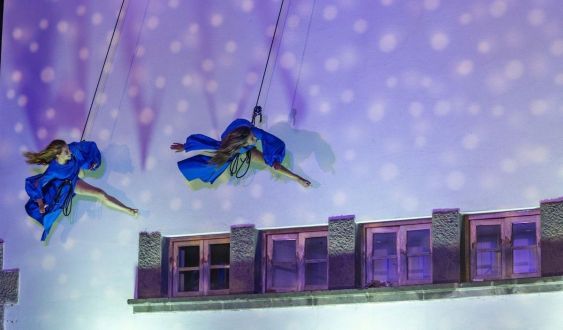
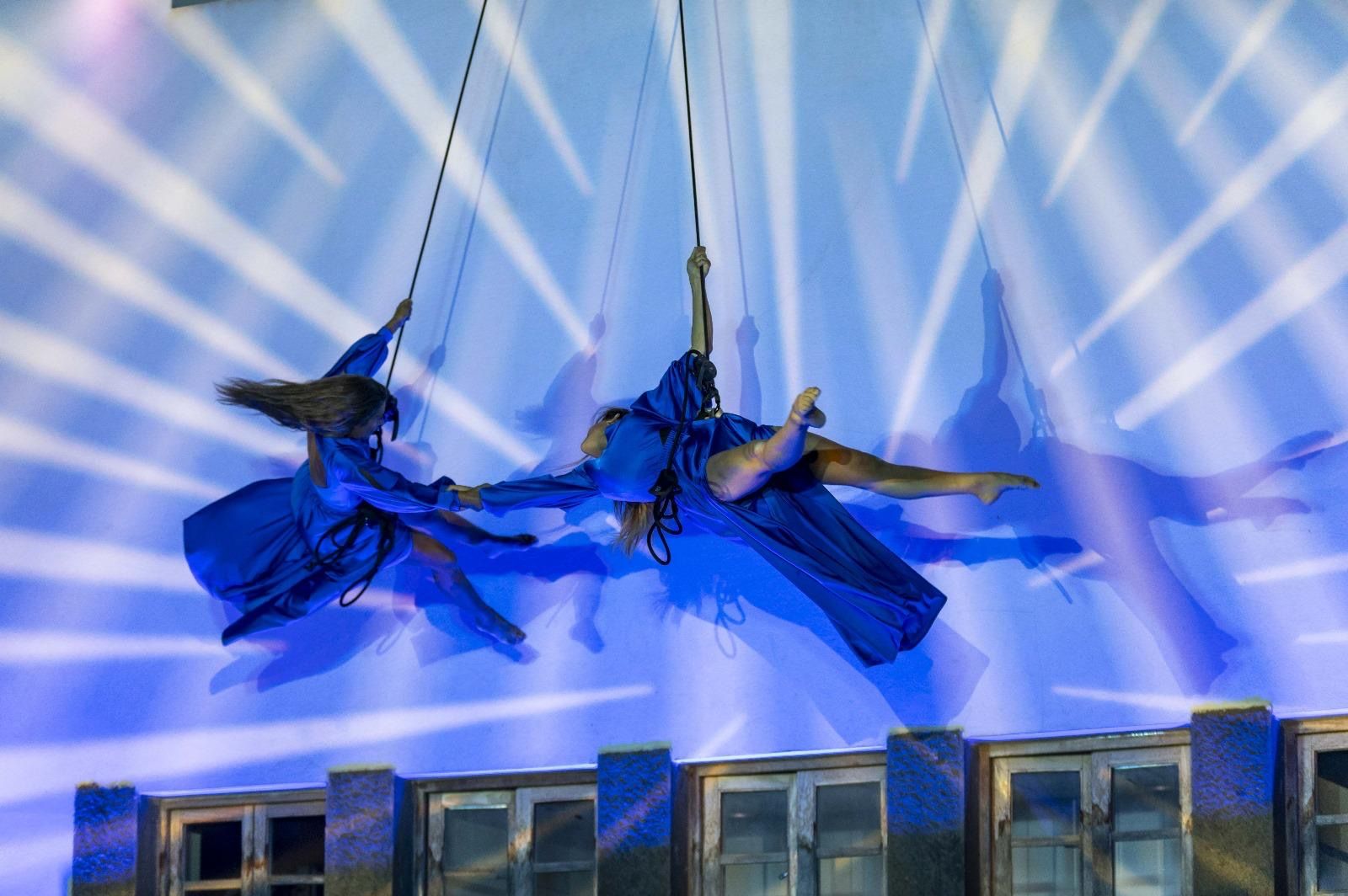
From here, logic leads us to trace the map back to the Eixample, specifically to Fort Pienc. In this hub of neighborhood life, the company Sacude Danza Allà on em miro i em veig, an intervention that transforms the library and the civic center into a space for reflection on the water cycle. Two female figures narrate to us, through a suspended choreography, the fragility of a drop that falls, flows, and evaporates, serving as a metaphor for our own life journey and the resistance of matter.
If we continue our path to the southwest, we arrive at Sants-Montjuic, at the Lleialtat Santsenca, a space that breathes working-class and cooperative history. Here, the collaboration between Bayona Studio, MID Studio, and the dancer Agnès Balfegó offers us a dual and immersive experience. On the one hand, the installation LxF immerses us in a luminous and sound storm inspired by natural elements, while the solo Eixos Live set shows us how the human body can be an invisible architecture capable of transcending any physical limit.
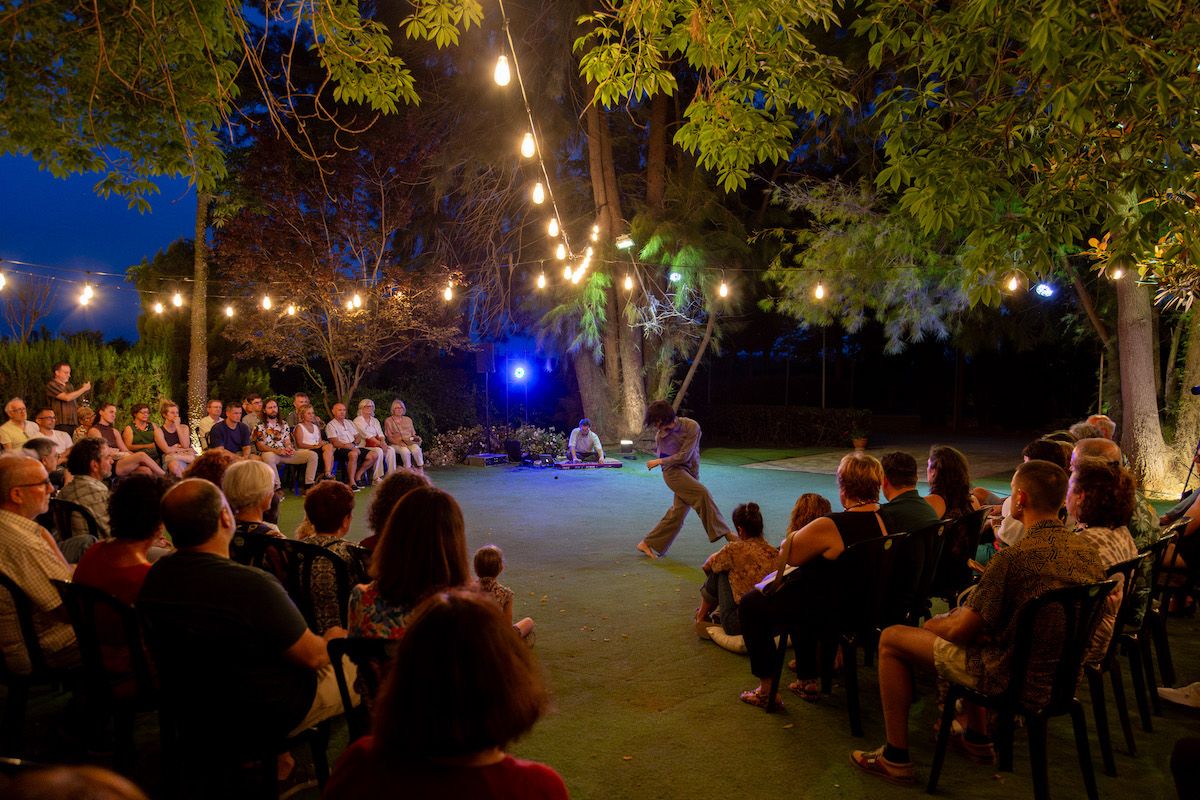
This same solo can be found again in Les Corts, at the Joan Oliver "Pere Quart" Civic Center, where it is paired with Persistence of times by Xavi Bové Studio, an installation of kinetic lights that, with almost surgical precision, reflects on how information persists in time and how collective memory is transmitted from generation to generation, as if each pulse of light were a neuron connecting the industrial past with the digital future.
Saturday of hidden treasures, from Sarrià-Sant Gervasi to Sant Andreu
This is an opportunity to visit spaces we don't normally see in this light (literally). High above the city, the tour holds one of this edition's most atmospheric gems for us in the Sarrià-Sant Gervasi district. The Depósito del Rei Martí becomes the setting for Interface, a proposal by Bayona and MID Studio that explores the threshold between what is visible and what is imagined. The use of smoke and light in this underground space creates a mutable landscape where the visitor, by walking along an incandescent walkway, ceases to be a mere spectator to become an integral part of the work. It is an experience that connects us with the hidden Barcelona, that which lies beneath our feet and which architecture allows us to inhabit.But the festival also has space for volumetric transformation and chromatic audacity. We move towards Horta-Guinardó, towards the Casa de les Altures which welcomes us with Altures de rosa, an intervention by Penique Productions that challenges our spatial perception. Through large monochrome plastic inflatables, the interior space is completely redefined, creating an atmosphere where light and texture are enveloped in a pink volume that forces us to look at architecture from an almost uterine perspective. This proposal is especially interesting because it can be visited during the day, allowing a different interaction with sunlight.
And to end the day, if we move towards Sant Andreu, the Canòdrom, now converted into the Ateneu d'Innovació Digital, hosts Equilibri de l'atzar by Xavi Bové Studio. Here, the kinetic intervention speaks to us of chaos that finds its dynamic order, a visual investigation that seems to mimic the very algorithms that define our contemporary era.
Sunday closing of neighborhoods, from Gràcia to Nou Barris
It's the big day for these two districts with large vertical format proposals. We start in Vila de Gràcia, where the facade of the Casa de la Vila transforms into a living compass with The Breathing of Time, where four aerial dancers from the Sacude company transform the Clock Tower into a breathing organism, reminding us that the city's time is also human time.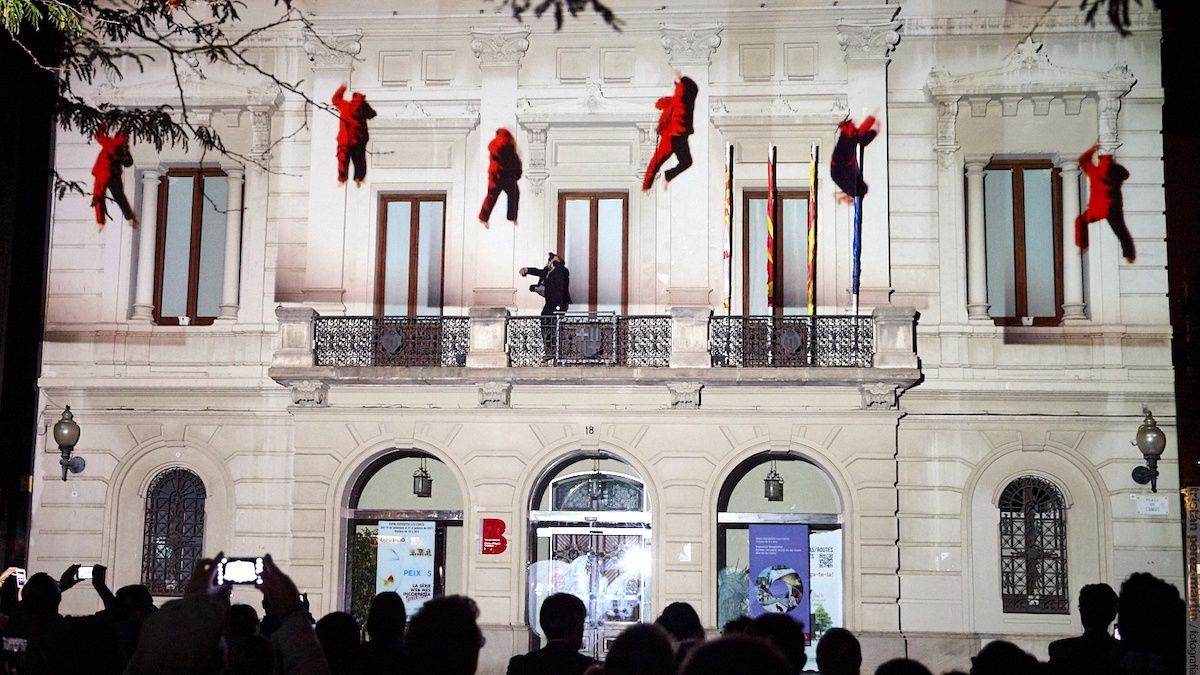
And if we move towards Nou Barris, in the Antic Institut Mental de la Santa Creu, Toni Mira once again takes center stage with Modulor. This work is a prodigy of synchronization that unites live dance with mapping, creating a play of mirrors between the real body and its digital projection, a perfect reflection on the human scale that Le Corbusier tried to fix in his architectural canons.
We have left aside the Barcelona History Museum Oliva Artés, in Sant Martí, which serves as a setting for Aüc, by Laia Estruch, which can be seen during the three days. This piece is perhaps one of the most enigmatic, as it recovers the "Pepper's Ghost" effect, a 16th-century illusionism technique that makes human figures appear suspended in the darkness. It is a perfect full circle, with the use of the oldest technology at the service of the most current sensibility, reminding us that architecture and light have always been our allies to generate optical miracles.
Llum BCN 2026 is configured in this edition not only as a three-night technology and light festival, but as the opening of a year where Barcelona is highlighted and recognized as the World Capital of Architecture. This proposed route invites us to walk, to look up searching for the UNESCO blue and to enter spaces that perhaps we thought we knew, but that light reveals to us as new.
These itineraries through the ten districts are proof that the city is not just a set of inert stones, but a living, participatory and constantly transforming space, where the artist's gaze and the architect's vision merge to offer us a kinder, more poetic and deeper version of the place where we live. It is, in short, an invitation to be part of a city that lights up to celebrate its own architectural essence and its projection towards the future.
Add The New Barcelona Post as your preferred Google source for free
Stay informed with the latest news.
