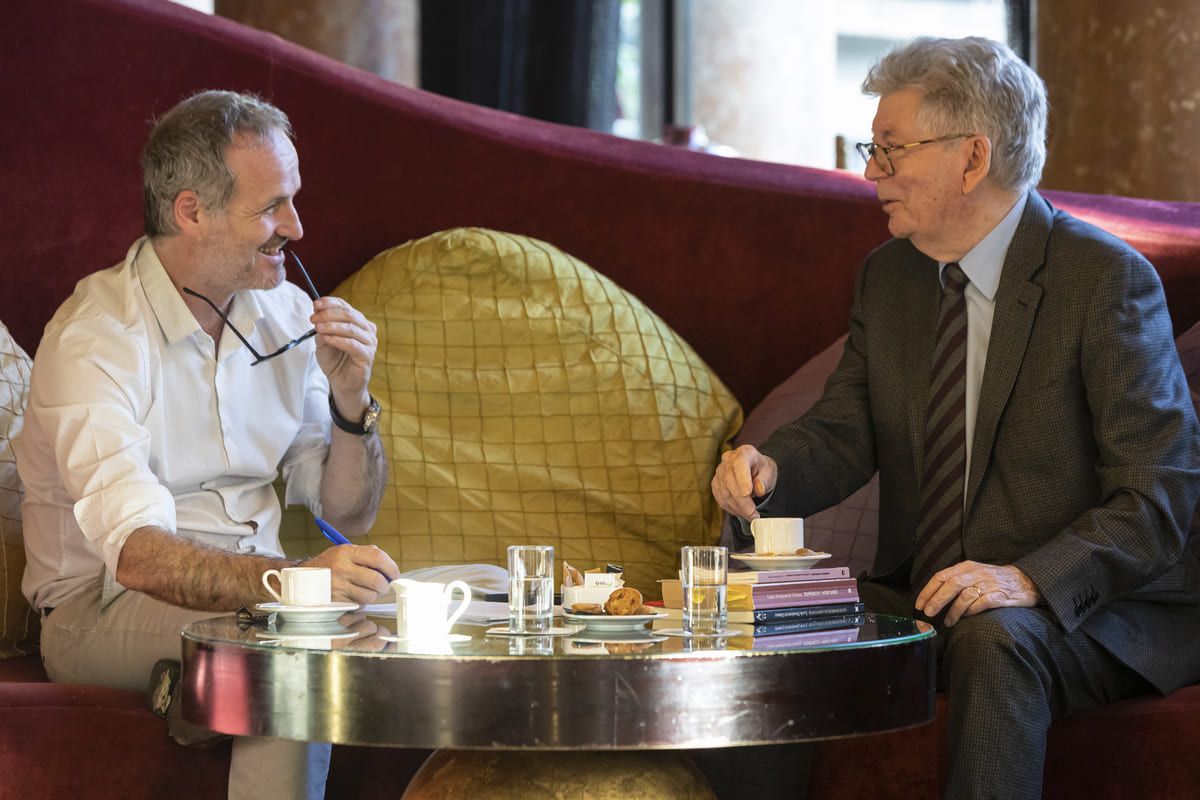
Lluís Domènech Girbau, great-grandson of the famous modernist architect, is also an architect (with a significant number of emblematic works in Barcelona) and is also a person deeply involved in the city. Founder of the B01 Arquitectos firm and member of the Board of the Associació Orféo Català, he has followed the Domènech i Montaner Year more closely than anyone and provides a review that is as analytical as it is informative. Fortunately, Domènech i Montaner does not run the risk of falling into oblivion: what he does run the risk of, however, is being simplified. Or misunderstood. No, it's not just about Modernism. It's about many more things. And, although the year has ended, the future continues.
--- How do you rate the Domènech i Montaner Year?
--- The aftertaste is more than good, it has finally been a much more effective year than I thought. I have discovered that, when you create a powerful pole of attraction, that pole radiates from other small or complementary poles. They spring up like mushrooms, and they all add up. I have received more than good feedback, like that from the director of the Museu d'Història de la Ciutat, Joan Roca, who despite the things that distance us told me "I didn't think you were so good." And I also didn't think Domènech i Montaner was an urban planner! That said: I have also discovered that public institutions are complicated. All of them, eh? Of all colors. The procedures, the difficulty in paying, the incomprehension for what you ask for, their changes of opinion… In contrast, private entities like the Palau de la Música or the Hospital de Sant Pau have been much more agile and flexible, and their intervention could be either financial or also in services (spaces, concerts, own initiatives…). Even the Hotel Casa Fuster, where we are meeting, held a New Year's Eve celebration inspired by Domènech, with a period menu, and has carried out specialized tours for visitors… And also the Eixample District, Casa Elizalde…
--- And outside Barcelona, right?
--- With Teresa Sala we replicated the pilgrimage he made throughout the Pyrenees (he on a donkey, us by car) to rediscover Catalan Romanesque. Vall de Boí, Vall d'Àneu, Montgrony, Sant Pere de Roda… In Sant Pere de Roda even the entire Orfeó went to sing!
--- And the message, has it been well transmitted?
--- In quantity and quality. Up to seven books have been published this year on the subject! And as for the content, everyone has been able to understand that he was a great architect, but also a normal citizen. Not a brilliant individual with ghosts and spirits like Gaudí, but a layman who worked hard. And who was lucky enough to have a good education. Although his father was rather humble, he took him to the San Fernando academy in Madrid, where, although he started a year as a civil engineer, he immediately wanted to make the leap to architecture.
--- Madrid was not much, at that time.
-- But they had the studies, the good studies, although quite reactionary. He had a professor, Rodríguez Ayuso…
--- Wow.
--- Yes, Rodríguez Ayuso, who made him do as a career project a photographic laboratory based on brick and glass. Not a church, or a conventional building, no: something modern as a photographic laboratory was then. This was very important, as was the fact of having had before, during his studies, the master Llorens i Barba, who had a whole theory developed on common sense. Domènech thus had very good tools to start working.
--- What is Catalan Modernism?
--- First of all, it is not one thing. You have to understand this. It is not a unitary movement, Gaudí is not Domènech i Montaner and Domènech i Montaner is not Puig i Cadafalch. When Domènech writes his famous article In search of a national architecture, in 1879, he speaks of his eclecticism: we have a history of Catalan architecture, and we must start from this history, but also from technology, from iron techniques, etc., and make a syntax out of this. Not a model: a syntax.
--- What does a syntax mean?
--- An architecture that introduces a change, but not by copying Gothic, for example, but by absorbing it and regurgitating it. Internalizing it, and then creating a code.
--- A style.
--- No, no, not a style: everything is style. I mean a language. For example, the facade of this Casa Fuster has a clear Venetian influence, but it is not explicit, it is subtle, it is assumed within its own language.
--- Therefore, Catalan Modernism…
--- Catalan Modernism is a cultural movement with a strong foundation in craftsmanship. Not in architecture: in arts and crafts, in artisans, who were of very high quality. There were also important centers in Brussels, Glasgow, Paris, but in Catalonia this was especially noticeable. Think that the artisans and industrialists who operated had a bourgeois social consideration, of a certain level, that is, they greeted architects as equals, with the same hats.
--- Masters.
--- Masters, exactly. And, without them, there would have been no architectural Modernism. For example, the muses of the Palau de la Música were just abstract dolls that Domènech provided to Eusebi Arnau or Lluís Bru. It was they who materialized them, gave them shape, a specific design. Or these capitals in the Casa Fuster living room, it was the artisans who materialized the flowers, the shields, the strange characters… Architects delegated to artisans! Gaudí delegates completely to Jujol, when the latter says "I've thought that…" Gaudí replies "go ahead, go ahead!". There was great understanding between architects and artisans.
--- And what is Domènech i Montaner's Modernism like?
--- It is an architecture that is, first of all, very functional, very useful, focused on service. But, in addition, through symbolism, this architecture contains an ideological message very related to Catalan identity. That is why it has an obsession with Romanesque (the Carolingian past, the roots of the country) and with heraldry. The shields connect with families, genealogical trees, again the roots. And, furthermore, Domènech distinguishes a lot between those commissions that are for professional survival and those others where he can give much more than the client himself wants. For example, the Palau: the Board was against his project, for being too expensive, but the president Joaquim Cabot believed in it and made it possible. Because he was cultured, and had traveled, he had references. Or, for example, the Hospital de Sant Pau: it was only supposed to be a hospital! But he creates a whole super-block of functionality and beauty, with the underground tunnels connecting the spaces…
--- Was Domènech against Cerdà?
--- Not at all. It surprises me that some say it: it doesn't go against it, it takes advantage of it and improves it! When he writes the article La reforma, he already talks about respecting both Cerdà and the old city: and making them converge. Hence that idea of, above the Cerdà plan, also proposing avenues and promenades that followed the path of ancient streams and trails. From there comes the idea of the Avenida Gaudí, for example, which does not go against Cerdà, but complements it. And that is not Domènech's idea, but Ferran Romeu's, who warns Domènech telling him that, if Gaudí was doing the Sagrada Família and he the Hospital de Sant Pau, perhaps it would be a good idea to unite them. And from that Domènech i Montaner synthesizes, incorporates Cerdà and the old city, improves Cerdà. Nothing about going against it.
--- Puig i Cadafalch, yes, he was against it.
--- Well, yes, but it was a very political issue: he was a councilor for the Lliga in the City Council, and it bothered him that there was an Eixample project imposed by Madrid. Apart from the fact that he was a very right-wing gentleman, while Cerdà is a kind of utopian socialist.
--- But Domènech i Montaner also leaves the Lliga.
--- This was due to disagreements with Cambó. He considered him too much of a social climber, too much of a "gentleman," and he didn't like that in 1904 he invited King Alfonso XIII to Barcelona. That's when he writes that article in the magazine Joventut: Fivellers de guardarropia, very much against Cambó and against people who go too much their own way. He saw that the Lliga was leaning heavily towards industrialists in the face of the workers' revolts of 1902, and he ends up writing to Prat de la Riba warning him that in this way the Lliga would lose what we now call centrality.
--- Does Sant Pau not defy Cerdà? It is tilted in the opposite direction.
--- It doesn't defy it: it complements it. It improves it, since it creates a kind of Superblock (a real one) that, while being autonomous, respects the grid and links the hospital with the city's framework. And then, there is that other urban project, that of the Avenida de Pere el Gran, in the current Avenida de la Catedral.
--- Why wasn't it done?
--- I don't know. Nobody bought it from him, I'm not clear either if it was a commission or his own initiative. It's from the year 1905, and it involved a great demolition of houses from the Cathedral square to La Boqueria. Like a kind of horizontal Vía Laietana, like a Gran Vía from below, to oxygenate traffic in the Gothic Quarter. And with a very majestic appearance, which could be seen, by the way, in the great exhibition we held at the College of Architects. He converted single-story blocks into large islands, where he even designated where there could be a hotel, a hospital, an auditorium, an industry…
--- Modernism was ridiculed in the subsequent era.
--- Novecentismo, yes. Evidently, fashions change, and they did change, but Eugeni d'Ors decided by decree that Modernism was over. And that from then on everything would be rationality, and balance, and common sense, and classicism… But at the same time that he was making all these theories, Barcelona was being bombed! The Novecentistas worked too much in vitro, everything from the Institut d'Estudis Catalans was very important and very good, but they forgot too much about social reality. And nature, our nature. It's not that Domènech didn't want to evolve, no: he himself told his students to do whatever they wanted, but to do it well. Now: artificiality never ends up working. We can say that Modernism has worked for us as a natural antidote between Cerdà's utopian socialism and the…
--- You can say it now, you can.
--- And the National Socialist tendencies, so to speak.
--- And a final question: what would Domènech i Montaner, the urban planner, say today about tactical urbanism or the Superblocks?
--- Firstly, it's too dystopian an exercise: he couldn't imagine the increase in traffic, the number of cars… But well, I will tell you one thing: Domènech i Montaner was an urbanite.
--- What do you mean?
--- That the city was the city, and is the city. In short, when he wanted to go to the countryside, he went to Canet.
Add The New Barcelona Post as your preferred Google source for free
Stay informed with the latest news.