More than two decades ago, Five for Fighting sang about having only 100 years to live, alone at a grand piano, set against a mountain landscape that seemed frozen in time. Few people, certainly, ever get to find out what a hundred years of life actually feels like. In Barcelona, though, 1,196 residents now have.
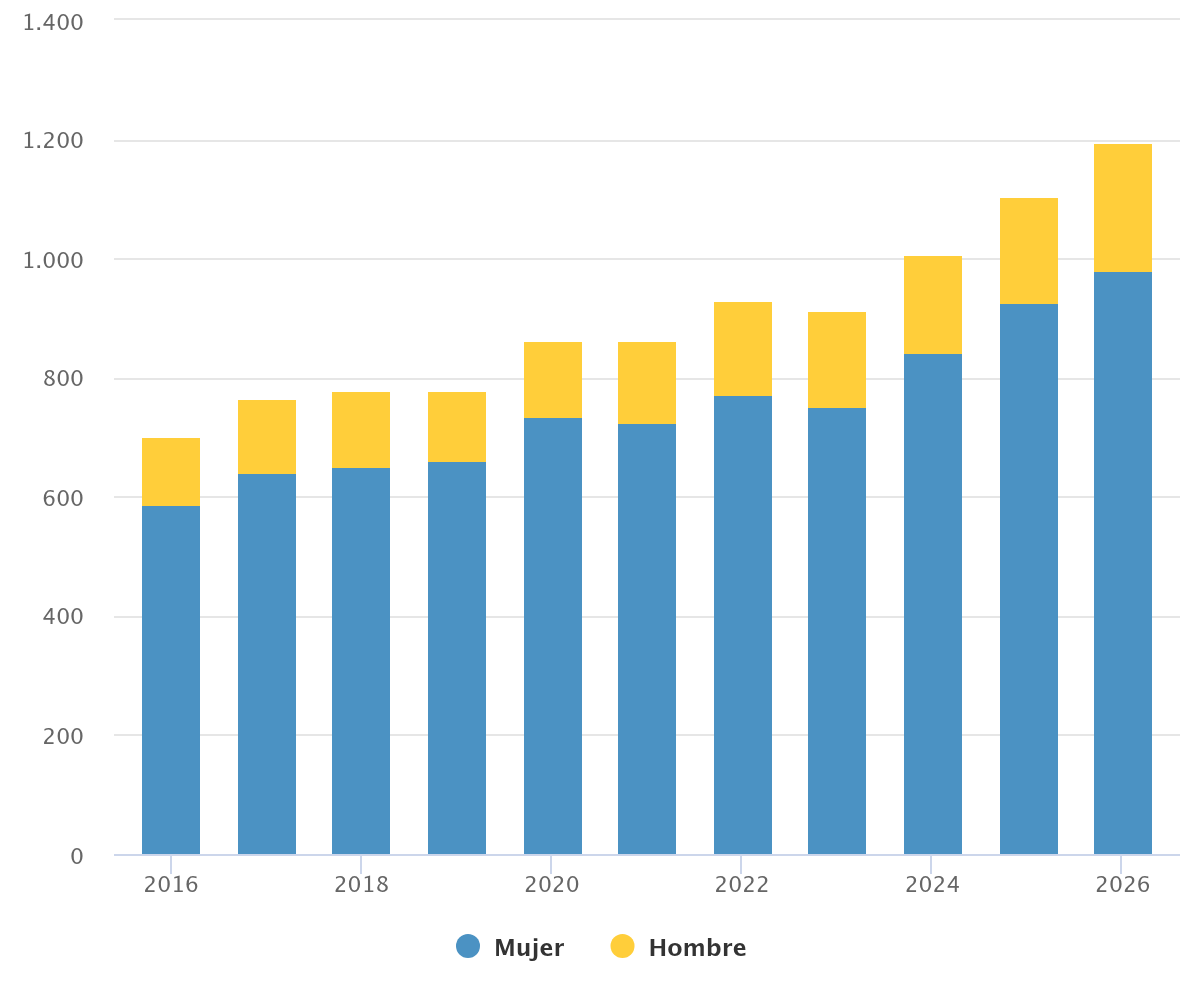
Reaching the century mark is still unusual, but a little less so each year. The number of centenarians in Barcelona has grown steadily over the past decade: from 700 in 2016 to 1,196 today, a rise of 71%. And it isn't a one-off record — with the sole exception of a slight dip during the pandemic, the city has set a new historic high every year.
This growth is part of a broader trend: we are living longer, thanks among other things to advances in medicine, nutrition, quality of life, and healthcare and social care. But these conditions, unfortunately, don't exist equally everywhere, so longevity isn't distributed evenly across the planet either. There are, in fact, specific places in the world where reaching 100 is particularly common. These are the so-called Blue Zones, regions identified for their exceptional concentration of centenarians, which have become something of a paradise for scientists hoping to uncover the secret of eternal life. Or, well, centenarian life.
The concept of Blue Zones originated in demographic studies of long-lived communities in Sardinia and was later popularised in relation to other regions. The best known is probably Okinawa, in Japan, where an extraordinary concentration of long-lived people has been observed for years. The list also includes Ikaria, in Greece; the Nicoya Peninsula, in Costa Rica; Loma Linda, in California; and the Barbagia region, in Sardinia.
Barcelona, obviously, is not a Blue Zone. But if the secret to longevity also has a geographical dimension, perhaps the city has its own small "Blue Zones" — or rather, its own blue barrios.
So where are these blue barrios? If we look at where the highest numbers of centenarians are concentrated, the map points clearly to certain areas of the city. Nova Esquerra de l'Eixample, Sant Gervasi-Galvany and Antiga Esquerra de l'Eixample are the neighbourhoods with the most residents aged 100 or over, followed by Dreta de l'Eixample, Sagrada Família, Sant Andreu and Poblenou.
It's no coincidence that the Eixample features so prominently on this list. In fact, this district alone was home to 241 centenarians in 2024, nearly one in five of all those living in Barcelona. Sant Gervasi-Sarrià also stands out, with 172. These are, then, some of the leading candidates for Barcelona's own map of blue barris.
There's another striking pattern in Barcelona's longevity map: women reach 100 far more often than men. According to the Oficina Municipal de Dades of the Ajuntament de Barcelona, of the 1,196 centenarians currently living in the city, 982 are women and just 214 are men. In other words, more than eight in ten of the city's centenarians are women.
Growth of Barcelona's centenarian population
This gap is repeated beyond Barcelona too. In Catalonia, according to the latest Idescat figures, there are 2,605 female centenarians compared with 534 male centenarians. The gap is so wide that, when it comes to living to 100, a man reaching that age is almost a statistical anomaly.
Nova Esquerra de l'Eixample, Sant Gervasi-Galvany and Antiga Esquerra de l'Eixample are the neighbourhoods with the most residents aged 100 or over
And what does turning 100 in Barcelona actually mean? It means having watched the city change almost beyond recognition. Someone reaching the century mark today was born around 1926, and has lived through the Republic, the Civil War and the dictatorship; has seen the arrival of democracy; has watched Barcelona transformed by the 1992 Olympic Games — a turning point for the city — and has seen it become one of Europe's great capitals.
They have also lived through a global pandemic, covid-19, nearly a century after they were born. A hundred years is a long time: long enough to see trams disappear, whole neighbourhoods change, the coastline transformed, the arrival of the internet and smartphones, and now, artificial intelligence entering our lives. In a sense, it means having lived several different Barcelonas within a single life.
Add The New Barcelona Post as your preferred Google source for free
Stay informed with the latest news.