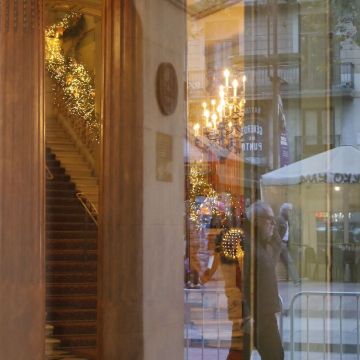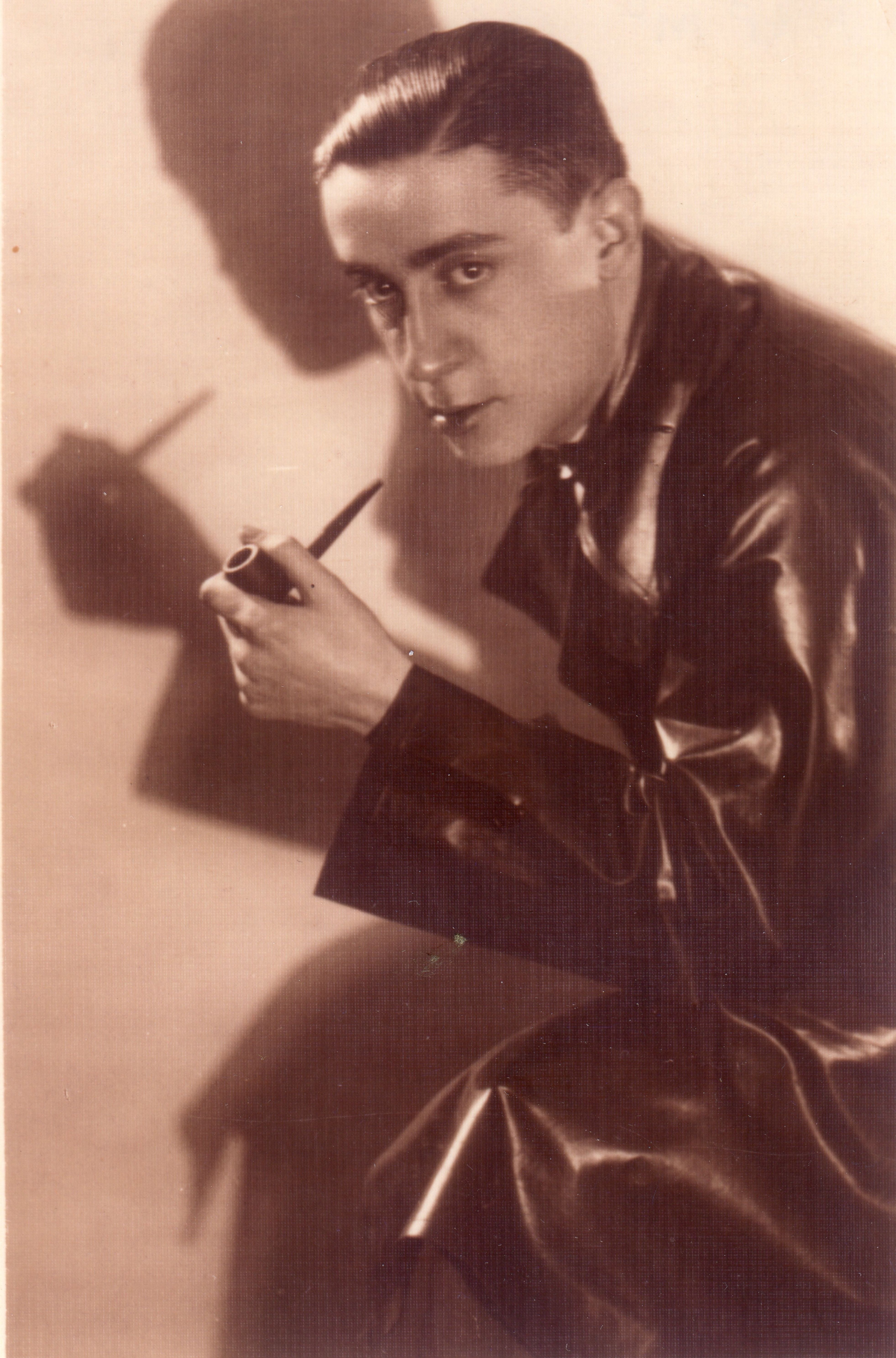
Self-taught, sharp, cultured, brave, critical, and Catalanist to the core, in little more than a decade-long career, Josep Maria Planes (Manresa, 1907 – Barcelona, 1936) was a champion of experiential journalism, sports reporting, humorous journalism, theater and film criticism, and investigative journalism in Barcelona between the 1920s and 1930s of the last century.
In 1931, at just 24 years old, he had already founded the magazine Imatges, in the image and likeness of the Parisian Vu; he had published cultural chronicles in important mastheads such as Mirador, directed the satirical weekly El Be Negre, was a popular debater at the Ateneu Barcelonès, and his name was beginning to stand out among the writers who signed in La Publicitat. His rise wasn't just fast, it was meteoric.
This August marks ninety years since a series of reports on the links between anarchism and common crime in Republican Barcelona cost him his life in a settling of scores that cut short a brilliant career that, in addition to chronicles and reports, also delved into theater. Before turning thirty, Josep Maria Planes died as a pioneer and, at the same time, the first fatal victim of investigative journalism done here.
On the afternoon of August 24, 1936
The journey has been brief. The dark Citroën C4, covered in a layer of dust and CNT-FAI slogans, stops in front of the building entrance, which is on Muntaner, near Plaza Adriano. A man waits there, poorly shaven, with a dirty beret and work clothes with various stains. He remains still and slightly bent under the suffocating heat.
— It's that balcony over there —he indicates with a hoarse voice, as four militiamen get out of the vehicle.
— That one? —one of them asks.
— That's the one, yes. He goes out there to smoke, at least once a day.
— And you say he's a priest? —the militiaman asks, while putting on his cap sideways, the red and black scarf tied around his neck despite the heatwave.
— With that marble face and those dark circles, he has to be —the other replies, subserviently.
The four newcomers enter the building entrance. Three go up the stairs, while one stays in front of the elevator to keep watch. They stealthily position themselves in front of the door. Faces peek out from other houses to see what's happening. None last more than a second. No neighbor wants to see, know, or say anything. No one wants to be remembered.
They call and, after a few seconds, their target opens for them. Pale as a full moon, dark circles under his eyes that seem painted, a prominent nose, a small mouth, and a gaze that is both sagacious and sad. Yes, the visitors think, with this face, he is most likely a priest.
He wears a silk dressing gown that matches this bourgeois Barcelona home. The one for which this man, whom they still haven't understood who he is, writes. The one that reads his articles and satires. The one that is about to lose him.
On a table, next to a pile of books, is his passport. One of the militiamen inspects it. The man trembles, scared. He knows very well what will happen next. He knows very well that, when they read his name, he will be sentenced. How many times have they warned him from the pages of Solidaridad Obrera. How many threats, how many promises to put him in his place, to silence him forever. They will know who he is, and there will be no tomorrow.
A few minutes later, he gets into the car with the militiamen, knowing that everything will probably end today. But, despite the fear that chills his insides, faithful to his hedonistic essence, Josep Maria Planes has dressed for the occasion. He wears an elegant pinstripe suit and a sky-blue silk shirt. If we have to leave —he told himself in a moment of dejected lucidity— let's do it with style.
— Are we going to Sant Elies? —he inquires, with a timid glimmer of hope.
— Shut up —the driver orders him, before starting the vehicle.
When they arrive at Rabassada a while later, the journalist sees the city stretching out below: a sea of lights shining under a twilight of orange tones, which dissolves into the bluish glimmers of an immobile Mediterranean. He observes that landscape well, Barcelona, this city loved with all his heart, lived to the last breath, walked to the last street, discussed in every last gathering and explained in a thousand and one chronicles. He knows it is the last time he will see it. It looks so beautiful, he thinks. And he smooths the lapel of his suit. He is going to die having done everything in journalism and without reaching thirty years of age. That's why, unable to avoid it, he cries.
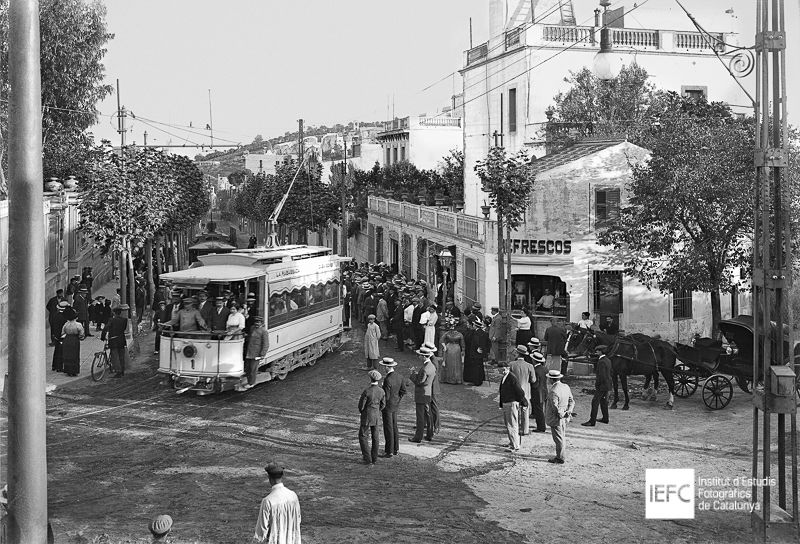
The Citroën stops near the remains of the old casino, where the most powerful men here gambled their fortunes and were capable of losing everything, even their lives, for that instant of intensity that an all-or-nothing bet can provide.
— I'll take care of this one alone —announces one of the militiamen, as he draws his Astra 6.35 automatic.
The three companions obey.
—Walk! —he orders the prisoner.
Planes walks clumsily for a few minutes. Enough to lose sight of the car and its three occupants. To know that he is going to die in the middle of this foliage that surrounds him, here, nowhere. In this corner where silence seems to have been made with the same lead as the bullets that bear his name.
— Stop!
The journalist turns around, hands raised, seized by a bestial tremor, tears flowing from his reddened eyes and the contours of his face rigid. Where is the disbelief, all the self-confidence of the man of the world who was on familiar terms with some of the most sophisticated European writers and lit up the gatherings at the Ateneu, drinking Cinzano and smoking Turkish tobacco while the pintxos of Barcelona's night treated him with deference?
The Astra points at the journalist's face. There is no time left even for a last breath. Words crowd in his head knowing that they will no longer be able to be uttered. That they will die before they are born. Almost like himself.
Seven bullets, fired one after another, take his left parietal bone with them and put an end to one of the most brilliant careers in the history of Catalan journalism.
The sensitive dandy who came from Manresa
"He was totally self-taught, he had no specific academic training nor did he come from an environment linked to literature. And that, I believe, has even more merit," reflects Jordi Finestres, journalist and biographer of Josep Maria Planes, author of the biography Set trets al periodisme a la Rabassada and curator of article editions: Planes esportives and Els gángsters de Barcelona.
He was born into the Planas family (he would Catalanize his surname to Planes once his journalistic career began), from the more rural Sant Mateu de Bages, and grew up in Manresa, the second to last of seven siblings. As a student, he is remembered as quite mediocre, although he showed a great intellectual curiosity from very early on. An avid reader, while still young he befriended local personalities such as the writer Vicenç Prat, the cartoonist Anselm Corrons, and Dr. Manuel Casanovas. At seventeen, he debuted as a journalist, signing sports and literary chronicles in the newspaper El Pla de Bages, and two years later, in 1926, he settled in Barcelona.
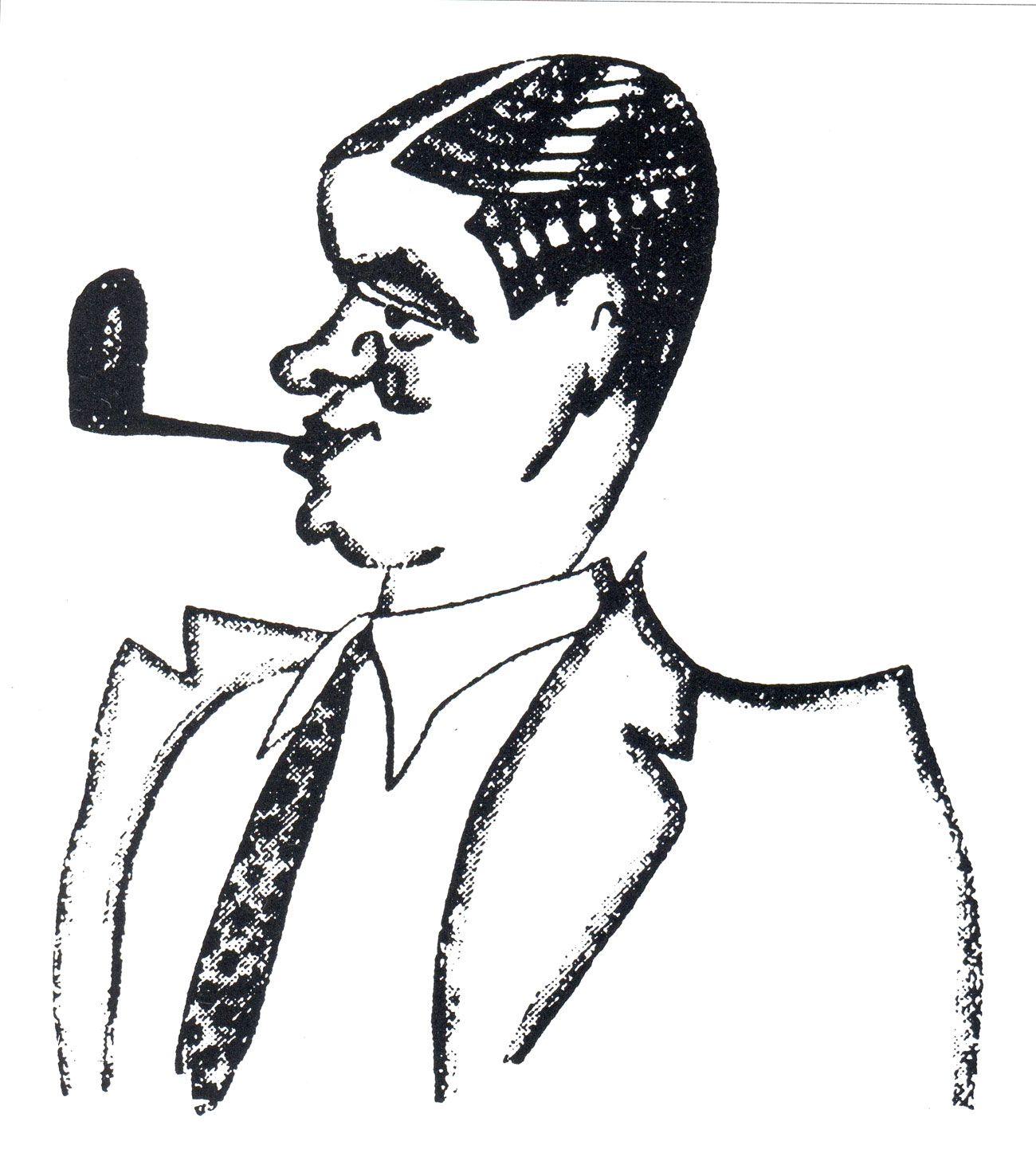
Here, a dizzying career begins where he burns through stages at full speed. Where he writes everything, tackles everything. Satire, reportage, opinion piece, chronicle, review, theater. "In a hurry to explain everything in a city where so many things were happening," Finestres describes. As if knowing that he would shine brightly for a very short time.
"We don't know how they met —the biographer continues—, but a bond of deep friendship and reciprocal admiration with Josep Maria de Sagarra was immediately created, who acted as his godfather and mentor." If journalism is, above all, a craft that takes time to learn and depends on good teachers, Planes surrounded himself with the best and understood all lessons at once. The Ateneu environment was his habitat: "Pla, Xammar, Sagarra…", enumerates Jordi Finestres, who emphasizes the insatiable appetite for modernity of that young man from Manresa who learned French and English, to the point of translating articles and plays, or acting as a guide for figures like Francis Carco or Henry de Montherlant during their visits to a Barcelona night that would end up reflected in his works. A night that Planes knew thoroughly.

"There is little information about his private life, and even less if we compare it with the enormity of the work he managed to develop in just over a decade," explains Finestres, who, however, vindicates Planes as "someone deeply sensitive, hardworking and dedicated to his work, something his friend Avel·lí Artís Gener, Tísner, emphasized a lot in the conversations we had in the 90s." If Planes' image was that of a frivolous dandy with a great capacity to write and explain his world, the truth is that behind his work there is a lot of effort, many hours of reading, writing and reflection, and a great desire to be good at what he does. To be the best.
It was also a matter of being in the right place at the right time. The journalist and professor Josep Maria Casasús would describe his work in the following terms: "The modernity of Planes' journalistic prose, functional, light and at the same time attractive and intentional, was in line with a whole professional climate of profound renewal in the Catalan press of his time." And it is that "you open the pages of any Catalan newspaper of the time, such as La Publicitat or La Veu de Catalunya, and you see signatures like Pla, Sentís or Soldevila, and it's an anthology of Catalan letters!" And one of those signatures, of course, is Planes'.
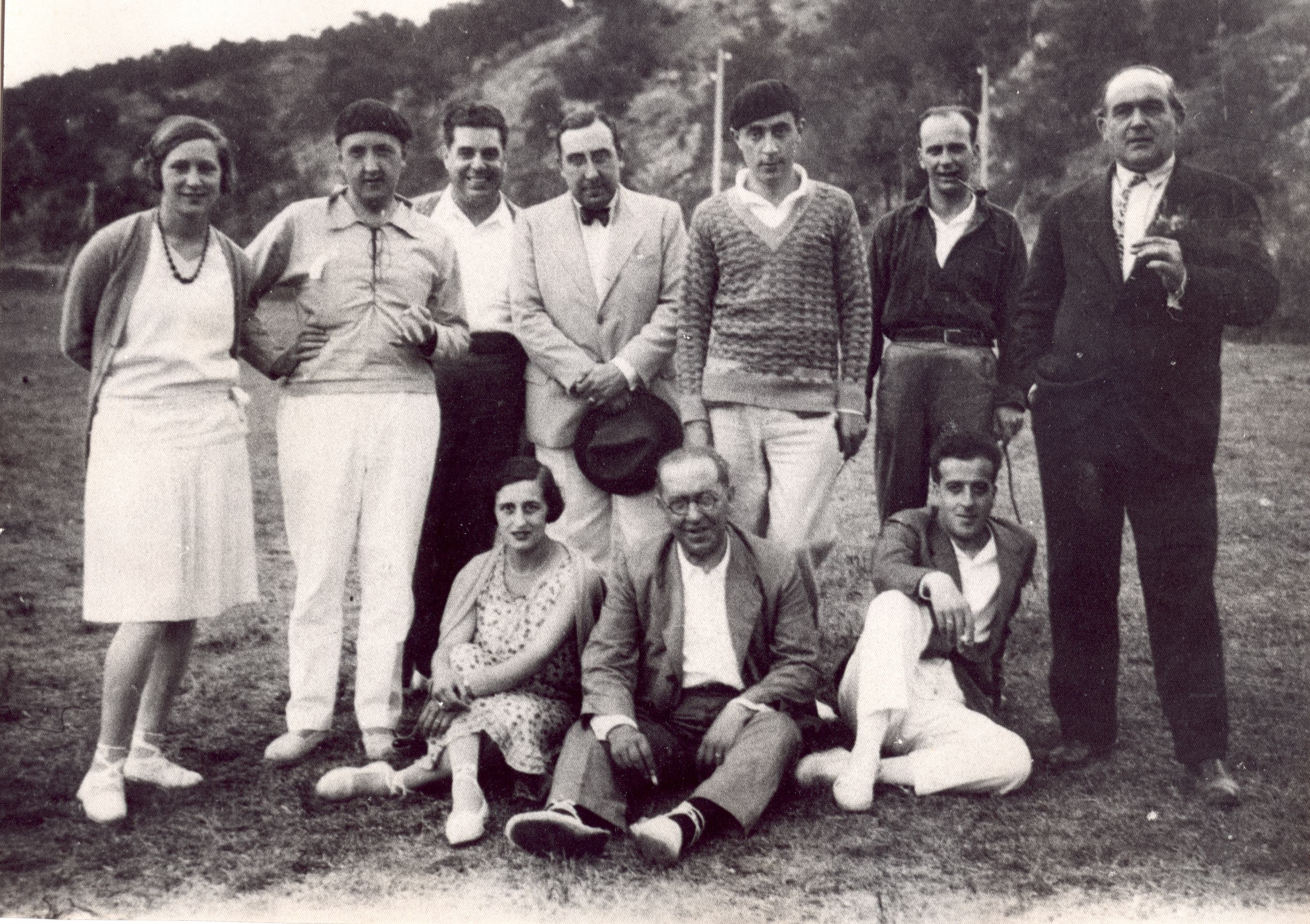
Nocturnity and treachery
When he arrives in Barcelona, Planes becomes the typical urban bon vivant, "we could say a posh person, although without the pejorative connotation of the term. But come on, the typical one who likes to live in a good apartment in Plaça Molina, wear nice clothes, eat in good restaurants, go out at night in Ciutat Vella to cabarets, to listen to Jazz...", explains Jordi Finestres.
The journalist crosses paths with Francisco Madrid, author of the essential Sangre en Atarazanas, Sebastià Gasch, author of Barcelona de nit, and with Domenec de Bellmunt, author of Les catacumbes de Barcelona or L'àngel bohemi. In the feverish, never-sleeping Barcelona of the 20s and 30s, these are just some names of experiential, social journalism, often narrated in the first person, that other names like Francisco Oliva or Ángel Zúñiga use to extol the city through more or less sensationalist books and reports.
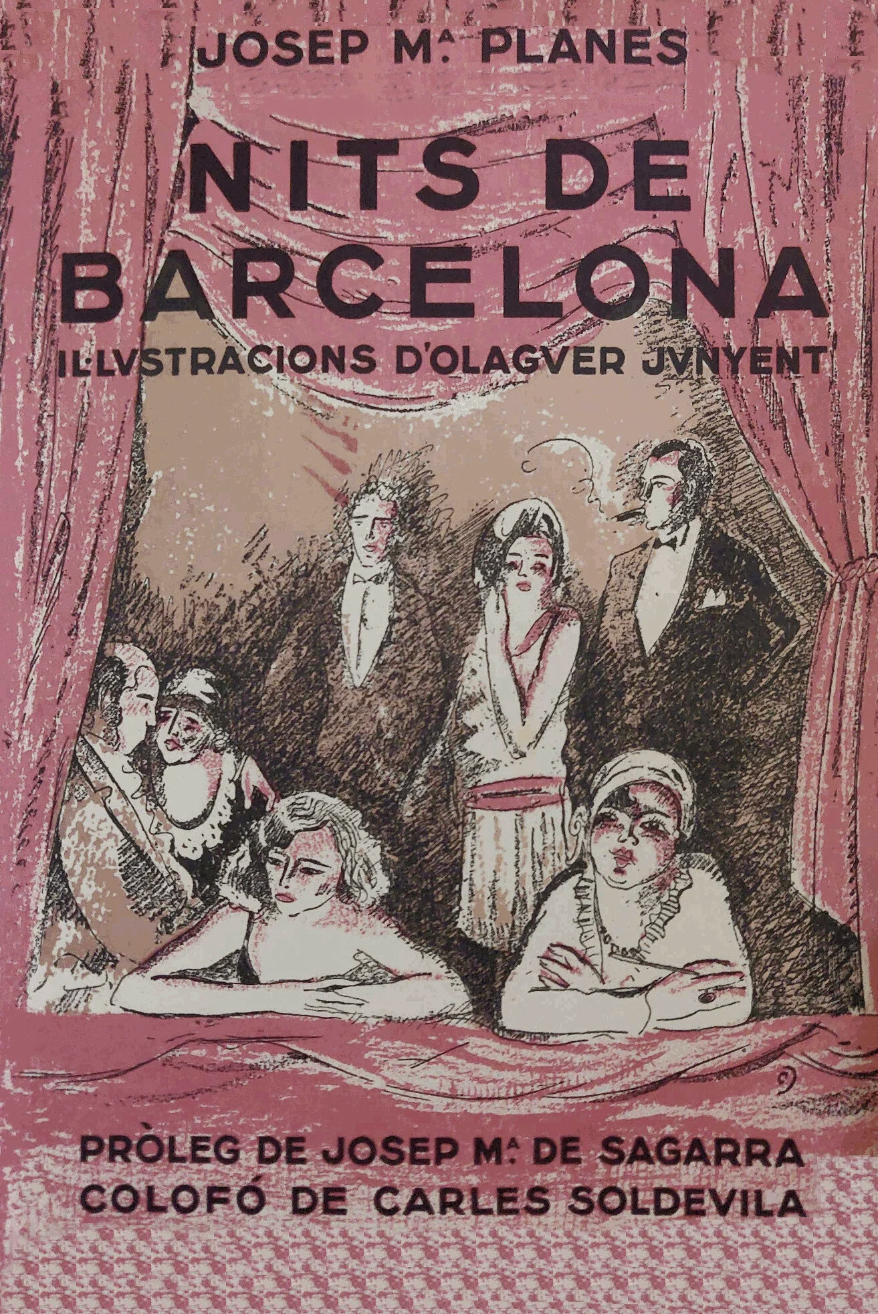
In this context, in 1931, a book compiles some chronicles that the journalist wrote about certain places in Barcelona's nightlife for various media outlets. With a prologue by Sagarra and an epilogue by Soldevila, and illustrations by Oleguer Junyent, Nits de Barcelona describes the people and essence of places like the Excelsior, the Café Catalán, the Grill del Ritz, La Criolla, the Bar Americano del Colón, or the Pompeya, among many others. And, to do so, he uses a surprisingly sober prose, almost as if what he was describing had nothing to do with him.
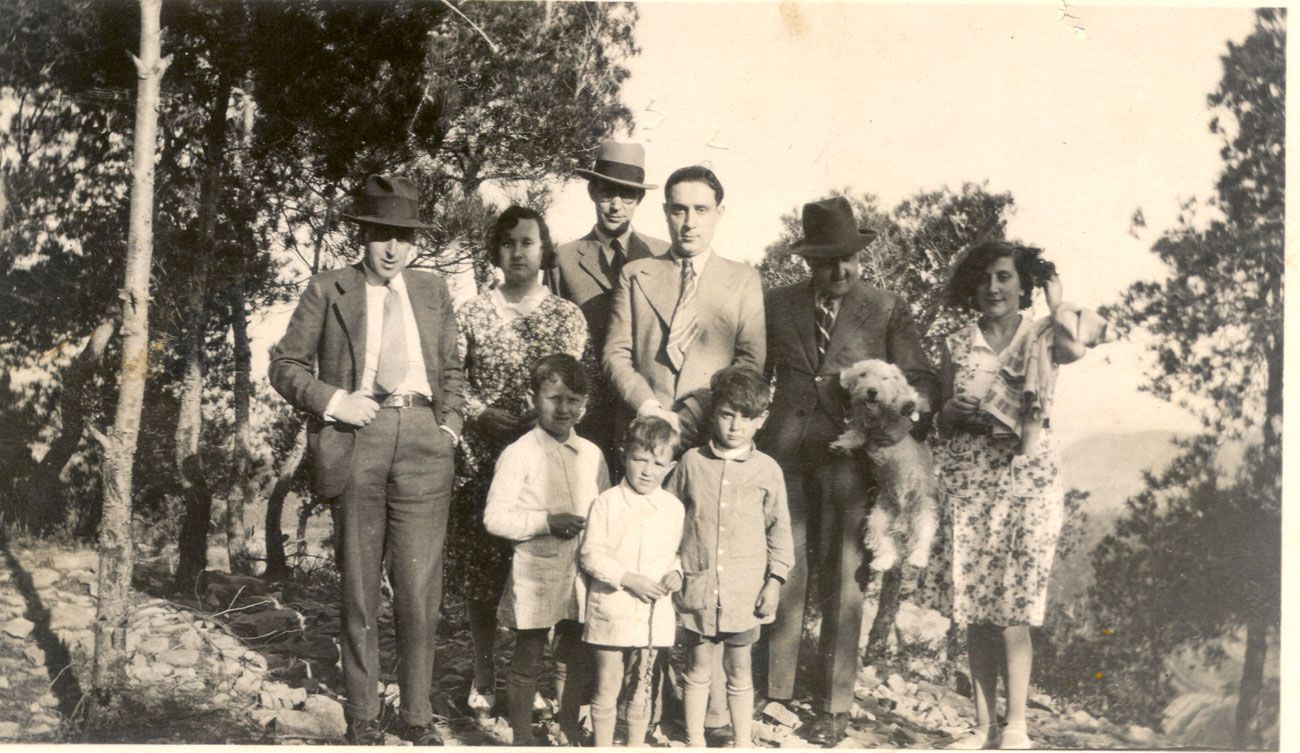
"It's more of an analysis, almost a dissection in which he positions himself as an observer who looks around, describing without excessive flourishes, with that humorous touch so characteristic of him. And he gives his opinion, but without getting involved. And, above all, he invents nothing. That's why, a century later, we are still talking about these chronicles," clarifies Finestres, who adds: "Reading Planes helps us a lot to understand and imagine that Barcelona, with all those desires for change, that hunger for freedom and, also, with all its contradictions, which also existed."
The truth that almost emerges in the theater
Between 1929 and 1933, Planes combined his role as a journalist at La Publicitat and director of the satirical weekly El Be Negre with writing and premiering several plays. He debuted in April 1930 at the Novetats with L'home que s'havia de morir, an ironic comedy indebted to Jardiel Poncela, a tone that marked his subsequent works: Qui l'ha vist i qui el veu!, also premiered at the Novetats in December of that year, and Un dinar fred, premiered in March 1932 at the Romea.
However, in January of the following year, he premiered what would be his last work, Amor, where he delves deeper into human nature. Perhaps this is his most personal work, the one that best reflects what this man, about whom we know almost nothing of his private life, has inside, beyond the fact that he shared an apartment with his partner, a Frenchwoman named Lilian, whose surname is even unknown and who, apparently, was a childhood summer friend re-encountered in Barcelona. In this fourth work, more than ever, he dares to show the world something of his soul. The place where, more than anywhere else, something of his intimate truth emerges.
"Amor is surely his deepest work. In the previous ones there is a touch of costumbrismo, of a brief, fast, and effective comedy. Here he covers more philosophical and existential themes," analyzes Finestres, who highlights other works by Planes as a Catalan translator of works such as Primera plana, by Ben Hecht and Charles MacArthur, or El crit del carrer, by Raymond Massey, in addition to a fifth unpublished work, Déu el va castigar, which was never premiered.
Marrying no one
If one consults sources related to certain political sensibilities, Josep Maria Planes often appears portrayed as a regime journalist, a hack domesticated by the Catalan bourgeoisie of his time, a talent at the service of certain patrons. With all the knowledge granted to him by having read, studied, and analyzed his work and life, Jordi Finestres categorically denies this. "And the irrefutable proof is El Be Negre, the satirical weekly and the great counter-chronicle medium of his time, which Planes directed and from which he and the newsroom gave everyone a hard time. No one was spared: Lerrouxism, Estat Català, Esquerra, the monarchy, the Lliga Regionalista, the church, the FAI, the CNT, fascism… No one!"
One cannot deny the political bias of the journalist, closely linked to Acció Catalana and, later, even without agreeing with Esquerra, loyal to Macià and Companys, framed within a center-left Catalanism "with which, however, he was also critical." The necessary journalistic virtue of knowing how to bite the hand that feeds you. "He had his sympathies and his ideology, of course, but what cannot be said is that he was a domesticated journalist or that he wrote at anyone's dictation —objects the biographer—. That is not true."
When the FAI executed the Badia brothers on Muntaner street, he was one of the journalists who most furiously attacked the anarchists, directly blaming them and initiating a journalistic feud with Solidaridad Obrera, from where he received insults and threats (which unfortunately would come true). "However, and in that context of categorical condemnation of the attack, he also confessed in an article that, with Miquel Badia, then chief of police, he had had many differences over the methods he employed."
Independent, attentive to everything that was happening nationally and internationally, having traveled to Paris and Berlin, where he saw with his own eyes how Nazism was macerating in the souls of Germans, Planes would predict not only the coup d'état and the Civil War that was going to destroy his country, but also the World War that was going to do the same with Europe. "That's why, at a given moment, he campaigned for the Left Front in the 1936 elections, knowing that any other alternative, such as Cambó's Lliga, could lead to fascism."
The gangsters of Barcelona
For Finestres, "Planes does not position himself so much against anarchism for a strictly ideological reason, but rather he is bothered that some elements, especially those coming from outside Catalonia, integrate into the ranks of the FAI and the CNT to commit crimes." In fact, in addition to a strong anti-fascism, he does not speak ill of figures like Layret or Seguí and does not condemn all unions as criminal associations, although he does warn that all the criminals he talks about in his reports are indeed linked, in one way or another, to anarchism.
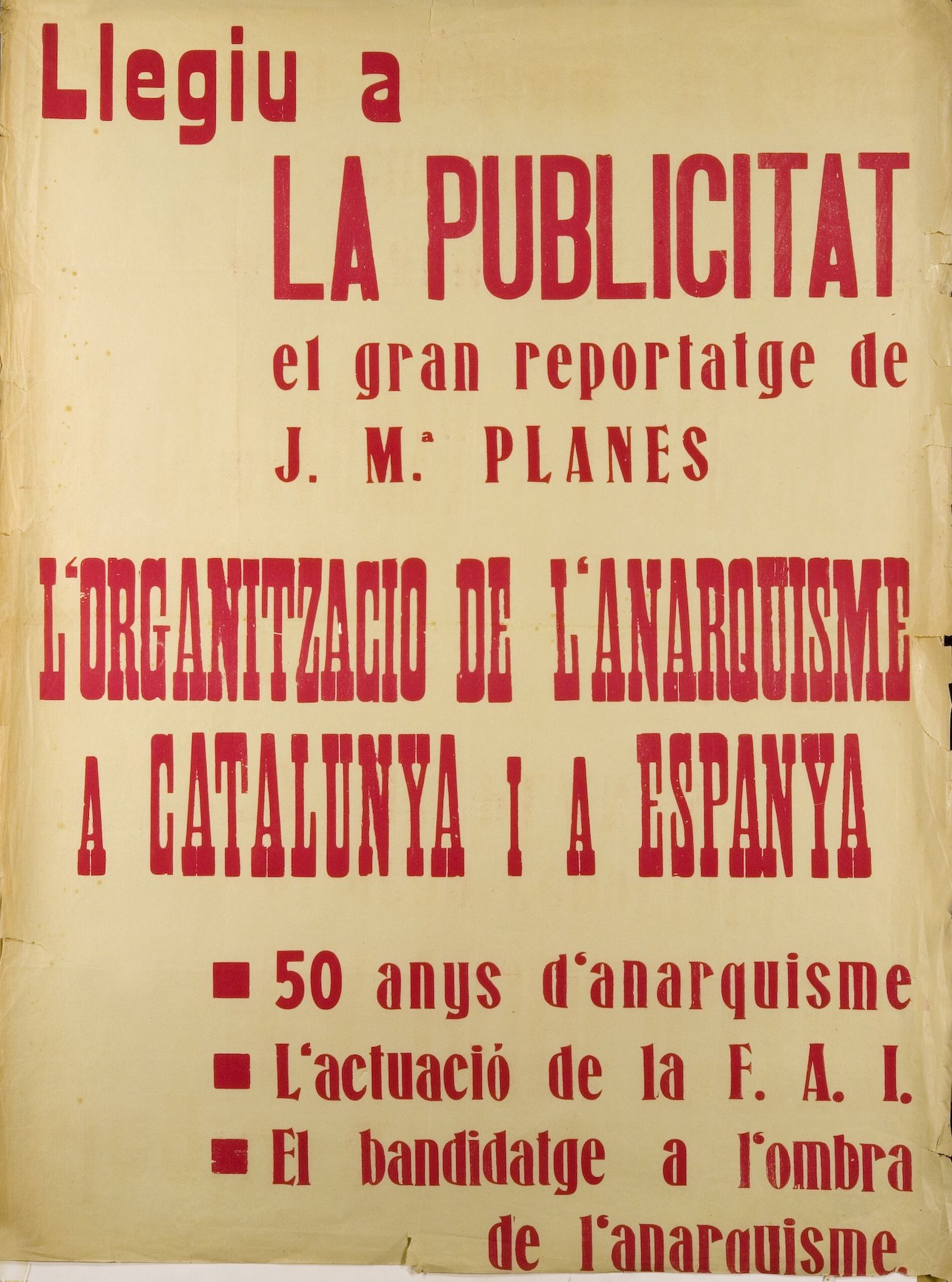
Between April and May 1934, he published eight reports in La Publicitat about Els gàngsters de Barcelona (The Gangsters of Barcelona), where he linked common criminals with the CNT/FAI. These were followed by another 22 on L'organització de l'anarquisme a Catalunya i Espanya (The Organization of Anarchism in Catalonia and Spain). These two series marked a before and after in the practice of investigative journalism in this country, of which Josep Maria Planes is a pioneer, along with Carles Sentís and Irene Polo. These reports, added to the articles of open denunciation against the FAI following the attack against the Badias, at the end of April 1936, would be what would put his name on the black list of the union that, four months later, would exact its revenge.
— But, who executed Planes that August afternoon in 1936?
Ninety years later, there are still many open questions, and almost no certainties. Almost. "There is no proof about who was the material author of the seven shots that ended Planes' life in La Rabassada, but I also have few doubts that, at least, Justo Bueno Pérez, the same one who had executed the Badias and had declared war on Planes, was involved," laments Jordi Finestres.
Sources consulted, linked to CNT and FAI, deny Bueno's direct involvement, although an anecdote by Tísner, who crossed paths with the anarchist on the Ebro front, suggests that he was very much aware. "Fundamentally, Bueno came to tell Tísner that, if they had found him too, he would have suffered the same fate as his colleague and friend Planes."
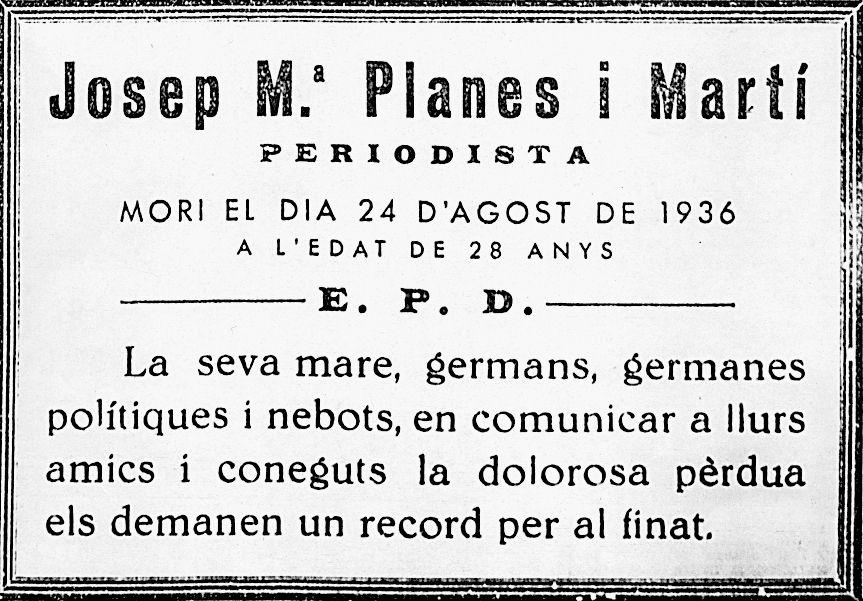
Josep Maria Planes was buried in the Sants cemetery on August 25, 1936, in a ceremony that was held almost secretly, in view of possible reprisals in that dense rear-guard atmosphere of the Civil War. A true pioneer in many fields was gone. A modern journalist, as young as the century that saw him born, grow, shine, and die prematurely in a Barcelona as colorful and magnetic as it was dangerous and bloody.
Add The New Barcelona Post as your preferred Google source for free
Stay informed with the latest news.