
Jordi Herreruela is the director of the Cruïlla Festival. As a child, his heart was divided between computer science and basketball, but music ended up winning the game. He said enough to machines and decided to dedicate himself to people.
In fact, his passion for music comes from a Catalanist and progressive school, and also from his older brother. He studied Telecommunications and Computer Science and began his career by making packages and diversifying risk with insurance. He was young and a heavy consumer of cultural shows. Now he dedicates himself body and soul to Cruïlla, which is "the reflection of Barcelona's creativity." A festival for people who don't go to festivals.
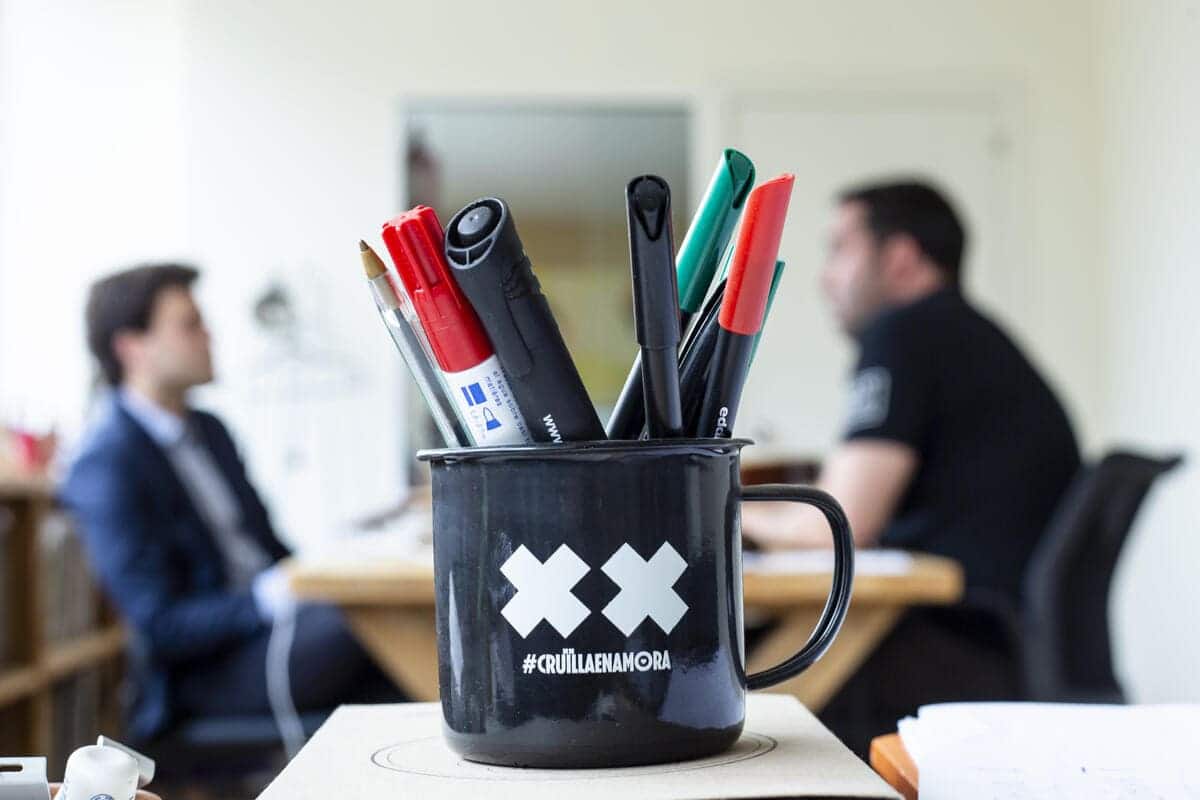
Herreruela is one of the twenty most prominent personalities in the live music industry in Europe, according to Pollstar magazine. Entering his office at 22@ is like experiencing the order and creative chaos of an authentic festival, recalling a very special moment with Ruben Blades' Patria.
Paraphrasing Pep Guardiola, Herreruela likes to get up ben d'hora, ben d'hora, to surf and watch the sun rise from Barcelona beach. In fact, his dream is to be "a surfer grandpa" in the company of family, partner, and friends.
Let's stop for a while and let the music play.
--- He studied Telecommunications and Computer Science.
--- It was vocational. As a child, I wanted a computer and started programming it. I had two hobbies: computer science and basketball. It's very complicated to make a living from sports in the long term. I chose computer science, finished my degree at the UPC, and found a scholarship to study Telecommunications in England. After many years focused on machines, I decided enough was enough.
--- Enough.
--- I wanted to interact with people and not with machines or binary codes. The Internet appeared just when I finished my degree.
--- He secured a job at Grupo Generali.
--- In the secondary market of reinsurance, like in The City of London. I made packages and diversified risk. I was young, I made a good living, and I was a heavy consumer of cultural shows.
--- Diversify and pool risk.
--- Insurance keeps the global economy stable. If there's a major claim, then your car or home premium goes up. Risk is being pooled, and this should be explained more because it's a spectacular social service.
"Insurance keeps the global economy stable. Pooling risk is a spectacular social service"
--- Where does your passion for music come from?
--- I went to the GEM School in Mataró, which was Catalanist and progressive. The artistic part was very developed. My older brother and I really like Rock and we often revisited the classics. It opened doors for me, musically. It doesn't happen to me as much now, but before, music was one of those few things that made my mind stop.
--- A kind of Reset?
--- There's a moment in some concerts where the singer transmits such energy that the music and emotions reach you unfiltered. You experience it, but your mind doesn't interpret it. Music is very irrational, and when I experience a moment like that, I can't stop smiling. It's like a kind of meditation where my mind doesn't work, but rather enjoys.
--- This is reminding me of Stendhal syndrome...
--- I wanted to live in that state permanently. I was a big consumer of musical activity and started meeting a lot of people who were dedicated to it. The moment arrived.
"It doesn't happen to me as much now, but before, music was one of those few things that made my mind stop"
--- The moment.
--- I preferred to dedicate myself to thousands of people having a good time rather than someone making more or less money somewhere in the world. I became an entrepreneur and we created different projects: Sala Clan, the Casas de la Música, the seed of the Cruïlla Festival... All the projects grew, but without structure or a single, clear general direction.
--- Project by project.
--- Each one went ahead with their project and mine was the Cruïlla Festival. At the end of 2015, we settled in Barcelona and the festival began to grow and develop from 2016 until it became what it is today.
--- What is the Cruïlla Festival today?
--- Barcelonian creativity. A reflection of the best city and the aspirational Barcelona that we sometimes don't see in the streets, but which also exists. First it was a music festival, and then comedy, art, or gastronomy arrived. To entertain and stimulate the public.
--- What is Barcelonian creativity like?
--- The clearest legacy Barcelona has is its creativity. It is what makes millions of people visit us every year. We often don't value it and take it too much for granted. Barça has been internationally recognized for playing more creatively than anyone, as well as the success of Catalan chefs. It is a common thread in our DNA and Cruïlla wants to highlight this identity.
"Barcelona's clearest legacy is its creativity. A reflection of the aspirational city that sometimes we don't see in the streets, but that also exists"
--- The identity of creativity.
--- This creativity is not always present in the city's major events. We should think about taking the step and incorporating creativity into everything we do. Cruïlla is a festival for people who don't go to festivals.
--- Festival for non-festival-goers.
--- The diverse and plural festival of the Doctor Music or Espárrago Rock era did not withstand the test of time well. It was a very uncomfortable experience and back then only people who were very music fans went to festivals. When streaming platforms appear, people listen to much more and varied music.
--- Musical revolution in streaming.
--- That changes the way people relate to artists. The opportunity arises to create a new festival model aimed at people who, without being big fans, listen to music every day, don't go to concerts, but might be interested in a festival. Cruïlla is a stimulus for creativity.
"Cruïlla is a stimulus for creativity and a festival for people who don't go to festivals"
--- What does Barcelona mean for Cruïlla and Cruïlla for Barcelona?
--- Barcelona represents Cruïlla's identity. In fact, the festival is called Cruïlla because it is a meeting point for people at all levels. We owe everything to Barcelona, the Metropolitan Area, and Catalonia. Barcelona has an identity of a cultural, diverse, and plural crossroads.
--- What makes it different?
--- 95% of the audience is local and you can meet many people you know without having arranged to meet them beforehand. It's like a street party with Jamiroquai, Placebo, Kylie Minogue or Rubén Blades. We showcase the best of the city's DNA and try to reflect what is happening in Barcelona.
--- What is happening in Barcelona?
--- There was a moment when we realized that something was happening with comedy and humor in Barcelona. Now we have also added illustration because it turns out there are Catalan illustrators in The New York Times, The Guardian or The New Yorker. We have spectacular potential, but people don't know who we are.
--- What pending tasks does the Catalan capital have?
--- The Barcelona City Council has conducted a study on how the city's brand is perceived worldwide. The result? Barcelona is known for Barça and then for its musical events, even before the Mobile World Congress or F1.
"Barcelona is known worldwide for Barça and for its musical events, even before the Mobile World Congress or F1"
--- Congratulations on your part.
--- The difference is that in these big events there is a public-private consortium, there is a significant financial contribution from the public sector, there is coordination of transport and advertising services... In contrast, musical events, we are a bit alone.
--- What should a 21st-century event have?
--- International projection is not just about attracting audiences from outside. 80% of the carbon footprint impact of a large event is the displacement of its attendees. Can we hold large events that are a global reference and where most of their attendees are local, and project the city for its creativity?
--- Very good question. Is it possible?
--- It is the future of large events. We are testing it, and it is a model where growth cannot be infinite. Our capacity limit is 25,000 people per day. We don't want to be the biggest, but we want to be the best, especially in user experience.
--- Have you ever considered changing cities?
--- We are experiencing an expansive process. Primavera is in Los Angeles or Chile, and Sónar holds editions in multiple cities and countries. We have expanded into Terra Alta and Penedès. [He laughs].
"Beyond Barcelona, there is a whole country rich in its culture, its products, its people, and its heritage that is not sufficiently known and that we want to help make visible"
--- Quite a declaration of intent.
--- Beyond Barcelona there is a whole country rich in its culture, its products, its people and its heritage that is not sufficiently known and that we want to help make visible. Culture scales poorly with the globalization of streaming platforms because algorithms overlook local cultural identity.
--- For business reasons?
--- Minority cultures are the majority in Europe. The next globalization in the world of culture involves identifying local regional identities that are a big business. I am obsessed with demonstrating that working for local culture can be a great business.
"I am obsessed with demonstrating that working for local culture can be a great business"
--- What is Cruïlla's relationship with the administration?
--- It's not easy. We feel alone. The local administration has not been close in recent years. In fact, our relationship involves asking for a subsidy of 50,000 euros for Cruïlla, but we pay more than 300,000 euros to BSM, which is the space manager. We prefer not to receive the subsidy and have an additional discount on the space.
--- Loneliness.
--- We feel alone when we manage the mobility of people going to and from Parc del Fòrum or when we carry out pilot projects for waste management and technological development. We feel alone regarding local politics. It's a shame. Barcelona en Comú changed the basis of the subsidies by adding sustainability or cultural diversity, which are things we feel very close to, but the fact is that we receive practically the same money. Different criteria, same contribution.
--- How important are innovation and technology at Cruïlla?
--- The goat pulls to the mountain. [He laughs]. We don't conceive anything without innovation processes. We are passionate about it. Although the cultural sector is not very accustomed to it, online entertainment manages audiences very carefully. Running a festival is building an ephemeral city that is assembled in 20 days and disassembled in 5.
--- What is this ephemeral city like?
--- It offers all services such as mobility, electronic payment, food, waste management, and infrastructure, among others. Everything but housing. We are an ideal space to carry out pilot tests that can be applied to society as a whole. Cruïlla is an ephemeral city of 30,000 people. We apply anti-terrorist controls at the festival entrance since the attacks on Las Ramblas, everyone wears a wristband with a chip, and we have a real-time data control center.
"The relationship with the administration? We asked for a subsidy of 50,000 euros for Cruïlla and we pay more than 300,000 euros to BSM, which is the space manager. We feel alone"
--- How did you experience the pandemic?
--- We wanted to be an ally with the health passport and help get out of confinement. The army was not the right team to set up field hospitals, but, on the other hand, we know how to set up ephemeral structures and make people feel good. It is a good example of how much festivals can be spaces that serve to test what can later be applied to society as a whole. This idea motivates me a lot.
--- Give me some more examples.
--- 5G, immersive reality, data, audience management... This year we will do the same with mobility and waste management. We want to be the first festival to be fully connected to the grid without fossil fuel generators. Music festivals are ideal spaces to test.
--- What is important when leading?
--- It has a lot to do with personal relationships. I lead a project trying to put myself at the service of the people who work. The limits of the structure are very fluid. The team takes on responsibilities, is reliable and committed. If we ever feel pressure, it's because it comes from outside. Sometimes it's hard for us to fit in with new people due to the business culture based on limits of responsibility or pressure for results.
--- Where does that pressure come from?
--- There are many external pressures, but there are no obstacles between colleagues. It's that sense of core. We do a Team Building every time we organize a big event. [He laughs]. They are very intense days, you live with all your colleagues and that unites us a lot.
--- A special memory of Cruïlla?
--- I have a very good memory of the last edition with Rubén Blades, who was the ideological engine of last year. During the confinement, I remembered a song I used to listen to as a teenager during the Cold War.
--- What did that song say?
--- The United States and Russia attacked each other with missiles, and citizens only had five minutes of life left on Earth. Ruben Blades' proposal is to dance collectively when the world ends.
--- Let them not take away what we've danced.
--- We wanted people to dance after the pandemic. Rubén Blades is a singer, musician, actor, politician, and a very curious person about everything that happens where he is. We met and talked about Barcelona, Catalonia, and Spain. The day he played at Cruïlla, he asked us for three more minutes.
--- Three more minutes?
--- He wanted to play one last song, which was Patria. It's an unofficial anthem of Panama created by him, and it played with a flag on the big screen. It was a very special moment because it represents someone who knows where he is, understands what is happening, and beyond being an artist, is also a person with spectacular intelligence. It was a very special moment for me.
"Rubén Blades' proposal is to dance collectively when the world ends. At the last Cruïlla, he played Patria with a senyera on the big screen. It was a very special moment for me"
--- The previous interviewee of Persona a Persona, Elena Massot, asks him the following questions:
--- Do you believe there are areas of citizens' lives that could improve by applying innovation and technology like that applied by the Cruïlla Festival?
--- Many. Some immersive musical experiences can be applied to the health sector. We have a problem with the emotional state of long-term ill adolescents, and we can contribute many things. Musical entertainment or culture could make perfect sense in dialysis rooms. We are innovating in waste management and mobility, and also in economic transactions and electronic payments. There will be many opportunities with the union of online and experiential cultural entertainment.
--- How is Barcelona positioned in the international scene from the point of view of music festivals?
--- Extraordinarily well. The city's legacy is creativity, and one of the clearest examples of this is everything that happens at music festivals. Cruïlla is an exhibition of Barcelona creativity, and festivals are much more than music. The city historically identifies with music, and both cities and countries seek new leadership in specific sectors. I don't quite understand why, but music is not being positioned when it is a leadership we already have and we only need to champion it.
--- Is there room for growth?
--- A lot. Music and football massively move people out of their homes to engage in an activity. However, many more people listen to music in their daily lives than people who watch football. There is a large audience that listens to music but does not go to musical events, and therefore, growth is double-digit every year. Venture capital and multi-country integrations have entered this sector.
"Why don't we also protect the structures or large events that are created by people from here?"
--- Is the entry of venture capital a threat or an opportunity?
--- It is a risk and an opportunity. The EU says that the creative industry is the third with the greatest potential in Europe after construction and beverages. The problem is that if someone from the creative industry seeks funding here, they don't find it, but Anglo-Saxon culture is very clear that investing in creative industries has a great impact on consumption habits, new brands, and external capital. If a car appears in a Hollywood movie, then many people want to buy it.
--- Once upon a time in Hollywood...
--- Here we don't have that tradition and, therefore, the financing of the creative industry comes from outside. This is an opportunity for growth, but also a risk when it comes to losing control of ownership. The question is not so much for entrepreneurs, but for politicians. What position do they have from politics in this regard?
--- You tell me...
--- Entrepreneurs make their decisions, but I would like to demonstrate that local national identity can be a great business and can scale in the globalized market of cultural entertainment. Minority cultures are the majority and must be respected not for a heritage issue, but for an economic one.
--- Do you have the support you need from the city? Is there a risk of losing positions as happened with Primavera?
--- There is no specific protection for music festivals. I remember a year when Sónar had to change its dates because a textile fair was coming to the city. Why don't we protect the property and activity of large events that are a flag and project the city to the world? Surely because it hasn't been explained enough, but now it's very clear. And now what do we do?
--- And now what do we do?
--- The Mobile World Congress has GSMA, which is an external business structure. The same happens with the America's Cup or Formula 1. Why don't we also protect the structures or large events that are created by people from here? Sometimes it's hard for us to treat those from here the same way as when we attract events from all over the world.
"If we had united Primavera Sound, Sonar, and Cruïlla, we would have had a group of Barcelona festivals leading the international race"
--- Those from here and those from there.
--- When we attract a big event from outside, it seems there's no conflict of interest, but when it's an event from here, then we remember that everyone must be treated equally. The people who organize events here end up selling a part of their business or directly lose control.
--- Is a merger a possibility?
--- If Primavera Sound, Sonar, and Cruïlla had united, then we would have had the financial capacity to expand worldwide and we would be a group with international development potential and we would be buying festivals all over the world. Everything controlled from here. But this didn't happen... We have a good relationship with practically everyone and there are times when we have worked together. We could have been a group of festivals from Barcelona leading the race to be a major international group, but there has been neither vision nor fundingSEVEN LIVES
- Reference: David Byrne
- Book: How Music works, by David Byrne
- Film: Manticora, by Carlos Vermut
- Song: Patria, by Ruben Blades
- Favorite spot: If you get up ben d'hora, ben d'hora (very early, very early) to surf, you're alone and you watch the sun rise in front of Xiringuito Escribà. This is life and it makes you change your mindset.
- Life motto: People evolve and are changing, and I don't find a life motto that accompanies me in this evolution.
- Dream: To learn and become a surfer grandpa in the company of my family, partner, and friends. To maintain affection and the family core. Such a balance allows you everything else.
Add The New Barcelona Post as your preferred Google source for free
Stay informed with the latest news.
