A night of rain, hoarse voices and soaked blazers. A night of awards, congratulations and speeches; of telling-offs and challenges highlighted from the lectern and taken on collectively. A night for putting non-conformism into action. A very Cecot night. The 31st Cecot Business Awards.
On Thursday, the Cecot employers’ association held its annual gathering at the Emma Vilarasau Theatre-Auditorium in Sant Cugat del Vallès, recognising companies, initiatives and career achievements that contribute to the country’s economic and social progress. The event brings together leading representatives from the business community, the economic sphere and public institutions, and the political and economic context is never irrelevant. Quite the opposite: this year, tensions were running high. With political tensions escalating, elections on the horizon, trade union mobilisation underway and a housing affordability crisis continuing to shape the daily lives of citizens and businesses alike, the evening also provided a forum to put outstanding challenges on the table and call for answers.
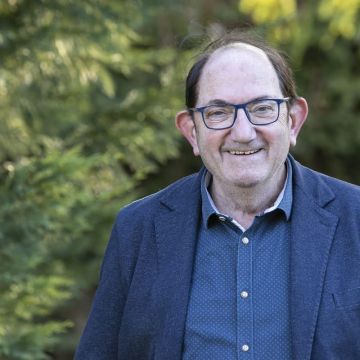
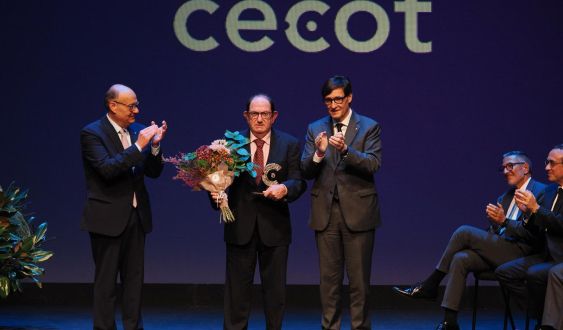
The evening also had its own protagonist: Joan Font i Fabregó, president of Bon Preu, who received the recognition for the Cecot Personality 2026 for his professional and business career.
Under the motto Nonconformity in action, the evening went beyond recognizing a job well done. The president of Cecot, Xavier Panés, took advantage of the Night's platform to demand another way of exercising leadership: less confrontation, more capacity to reach agreements and, above all, action that does not lose sight of values. "It's not enough to do it. You have to do it well," he summarized. An idea that ran through much of the night and also served to explain some of the novelties of this edition.
Xavier Panés: "It's not enough to do it. You have to do it well"
And in coherence with this desire to review and transform, Cecot has presented two internal novelties: a new voting process for the recognitions, through specialized commissions, and the IEP, a new brand that represents the evolution of Cecot Formació i Desenvolupament. The Night also had several winks to Reempresa, another expression of nonconformity in action: the will to find solutions for companies to continue existing, even when their owners reach the end of their business career.

Just two days before, some of the attendees at the gala were at the Palau de la Generalitat to celebrate the fifteen years of this business succession program, promoted by Cecot and Autoocupació with the support of the Generalitat. The balance of this decade and a half speaks for itself: more than 6,000 businesses have been able to continue their activity, more than 17,000 jobs have been preserved, and almost 340 million euros of induced investment have been generated. Another way to champion business: not just creating it, but preventing it from disappearing when the time comes to pass the baton.
Panés distributes the croutons: from the union strike to the degradation of political debate
Panés wanted to make it clear that nonconformity does not consist of questioning everything systematically, nor of burning everything in the name of a renewal that builds nothing. If last year the president of Cecot warned of the risks threatening the future sustainability of the welfare state, this year he has again focused on the country's structural problems, but with an added demand: moving from diagnosis to action. And doing so with values.
"We live in a world where confrontation, zero-sum, is on the rise, where old masks of hypocrisy are falling, where institutional disloyalty is growing and, ultimately, where we lose stability and predictability," he warned. Faced with this scenario, he advocated for the need to defend democratic values, the rule of law, and solid institutions, and warned against the temptation to present destruction as a form of progress. "Let's not lament the world as it is and let's activate the world as we want it to be," he proclaimed.
Panés: "Let's not lament the world as it is and let's activate the world as we want it to be"
The president of Cecot called for more strategic vision, political consensus, and self-esteem, as well as greater collaboration with businesses to build an economy capable of generating prosperity, quality employment, and sustaining future well-being. And he listed some of the pending issues: improving productivity, boosting innovation, addressing absenteeism, reviewing the elements that reduce tax competitiveness, and overcoming administrative slowness.
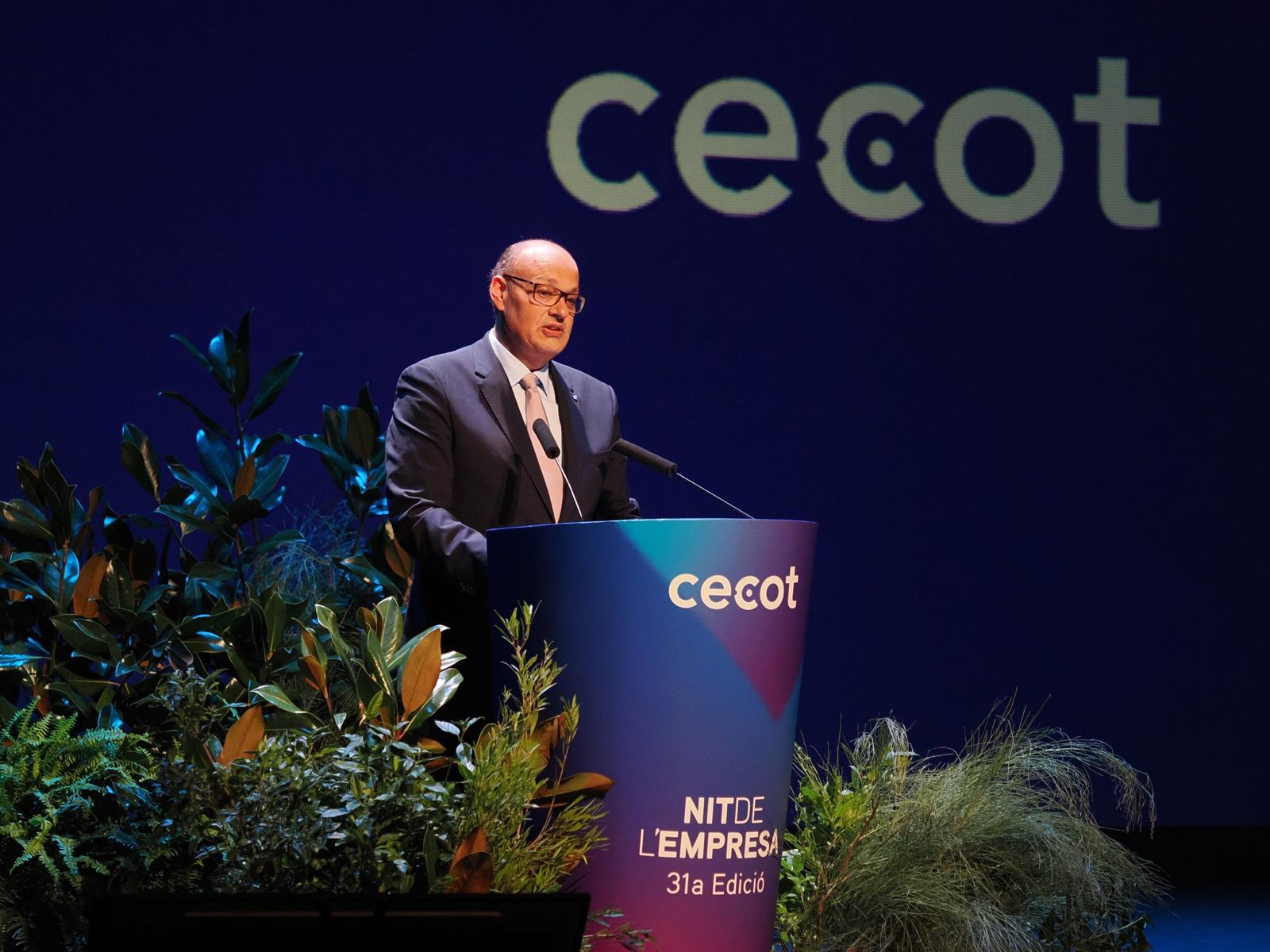
He has raised the tone both in housing and in infrastructures. Regarding housing, Panés has questioned policies that, he has defended, have generated legal insecurity, have discouraged the rental offer, and have made it difficult to build new constructions. And he has demanded that the Generalitat, the city councils, and the Spanish Government facilitate the conditions for companies to invest and build: "Entrepreneurs are ready! Give us the necessary scenario to invest and build."
But the housing criticisms were not only directed at public administrations; there were also some for the unions, with a question that resonated strongly in the auditorium: "Now, strike? Strike against whom?", he asked, questioning the sense of calling for mobilizations against companies in a context of increasing costs and difficulties in maintaining their viability. Panés recalled that 99% of the Catalan business fabric is made up of small and medium-sized enterprises and defended that improving the purchasing power of workers is a shared responsibility.
Panés: "Now, strike? Strike against whom?"
The most political interpellation, however, came when Panés focused on the degradation of public debate. With an electoral period on the horizon, he proposed to political leaders an exercise as simple as it is unusual: to publicly ask for respect for institutions and for the dignity of people, and to stop using insults and disqualifications against adversaries.
"Is this the price we are willing to pay to win an election?", he asked. And he concluded: "If we, the leaders of society, do this, what will be left for us to ask of those who trust us?" Thus, Panés advocated for a politics capable of seducing through conviction and arguments, and warned against hate speeches and false promises that offer miraculous solutions in exchange for attacking fundamental pillars of society, such as private property or social dialogue. The call for exemplary conduct, however, was not only addressed to politicians: it appealed to all those with responsibilities in society, including companies, entities, and civil society.
Joan Font: principles must also cost money
If Panés has challenged politics, administrations and unions, Joan Font has focused on what companies can do from within. The president of Bon Preu, who received the Cecot 2026 Personality award, took advantage of the award to share some of the keys to a career that began far from large supermarkets: helping out at his father's cod stall, at the weekly markets of Osona.
Born in Torelló in 1952, Font learned the trade of serving customers from a very young age. Later, after discovering other ways of selling food on his travels through Europe, he and his family promoted the first self-service store in Manlleu. He was only 22 years old when he had to convince his father to vouch for him at the bank to get the first loan. A story of perseverance and determination that has ended up becoming one of the most recognized business careers in the country.

But Font did not want to present his journey as an individual feat. In addition to extending the award to the professional teams that have accompanied the growth of Bon Preu, he also had a few words for Cristóbal Colón, founder of La Fageda, with whom he maintained a relationship of more than 35 years. And he did so with an anecdote that brought smiles to the audience.
When Colón presented him with the project of manufacturing yogurts in La Garrotxa, Font doubted that it could work. Competing with giants like Danone and Nestlé from a project that was just beginning seemed to him an almost impossible undertaking. "We will help you, but this will not work," he even told him. "One of the serious mistakes I made in my career," he admitted, with the complicity of someone who knows that, sometimes, nonconformity consists precisely in making possible what others consider unfeasible.
The anecdote served to introduce the lessons Font has drawn from his experience. For him, a company needs to have an explicit purpose, written values and, above all, to practice them. He also defended the need to generate positive economic results, attract talent and build committed teams. "Exemplary leadership is a sine qua non condition," he stated, before advocating for the promotion of young professionals who share the organization's values and a long-term perspective.
Font: "Businesspeople must explain ourselves more, inside and out"
Font also took advantage of the podium to assert the role of businesspeople in public debate: "Businesspeople must explain ourselves more, inside and out," he said. A phrase that connects directly with Panés' demand to recover the value of arguments and avoid confrontation.
Furthermore, he showed himself to be far from simple declarations of intent: his career is full of facts, actions, and not words. And so he quoted Albert Camus to remind that "principles are words and empty rhetoric as long as they don't cost money." It is when they have a cost, he came to say, that it is demonstrated whether one truly believes in what one defends. In part, these principles that cost money for Joan Font are the nonconformity in action of Cecot, the "doing things well" of Xavier Panés.
Thus, with this commitment, he presented two decisions that Bon Preu will "never" make: opening franchises with labor conditions it considers abusive or hiring self-employed delivery drivers to deliver orders. Instead, he advocated for hiring drivers, paying them the salary they are due, and assuming the cost of the service. Business responsibility is also measured by the practices one is willing to discard, even when other models may seem more profitable.

The president of Bon Preu concluded with a worried look at the future of Catalonia. The situation of railway infrastructures, he warned, is the result of years of lack of investment, and cannot be attributed solely to a specific government: "It is not a problem of one government or another, it is a problem for everyone," he defended. Font also called for more capacity to build housing and asked administrations not to stall the necessary initiatives to respond to demand.
Illa picks up the gauntlet: the economy is doing well, but life is getting more expensive
Panés' criticisms and Font's reflections have found part of a response in Salvador Illa's speech, and this is to be appreciated in a gala where a real dialogue between the business and political world is not always achieved. The President of the Generalitat has dedicated about 25 minutes to defending the situation of the Catalan and Spanish economy, outlining the Government's priorities, and addressing some of the main challenges that the business world had also pointed out – especially housing, which has taken up the most minutes –.
Illa began with a relatively optimistic reading of the economic situation. Catalonia and Spain, he argued, are evolving favorably in macroeconomic terms and generating employment, especially when compared to other European economies. But this positive evolution coexists with a problem that weighs increasingly heavily on families: the cost of living.
Thus, the President of the Generalitat has argued that Catalonia has the capacity to continue growing, but that it needs to face these challenges with a long-term perspective and with sufficient dimension to compete in an increasingly demanding international environment. And this scale, he stated, is Europe. The president has claimed the need for a stronger Europe and has warned that Catalonia cannot limit itself to asking for support from its partners: it must also contribute.
But the big immediate problem, he acknowledged, is housing. Illa has placed the number of homes Catalonia needs at 175,000 and has admitted that they cannot be built all at once. He has defended the need to expand supply, industrialize the construction sector, mobilize land, and simplify administrative procedures.

Beyond housing, Illa has advocated for the promotion of renewable energies, water autonomy, and mobility infrastructures. He has admitted that some transformations take years and that the pace of the Administration can be exasperating, but he has claimed that projects are moving forward. He has also placed training, talent attraction, and administrative simplification among the essential factors for improving competitiveness.
In the final part of the speech, the president echoed another of Panés' demands: the need to reduce confrontation and restore respect in public debate. He asked business owners not to position themselves against the Government, not to "put them all in the same bag," and defended that discrepancies can be expressed clearly without turning the interlocutor into an adversary. In fact, he assured that this is the policy and dialogue he practices, with other politicians and with companies and other institutions, such as Cecot, with whom he acknowledges a very good understanding and cooperation despite differences in criteria.
Companies, the true nonconformists
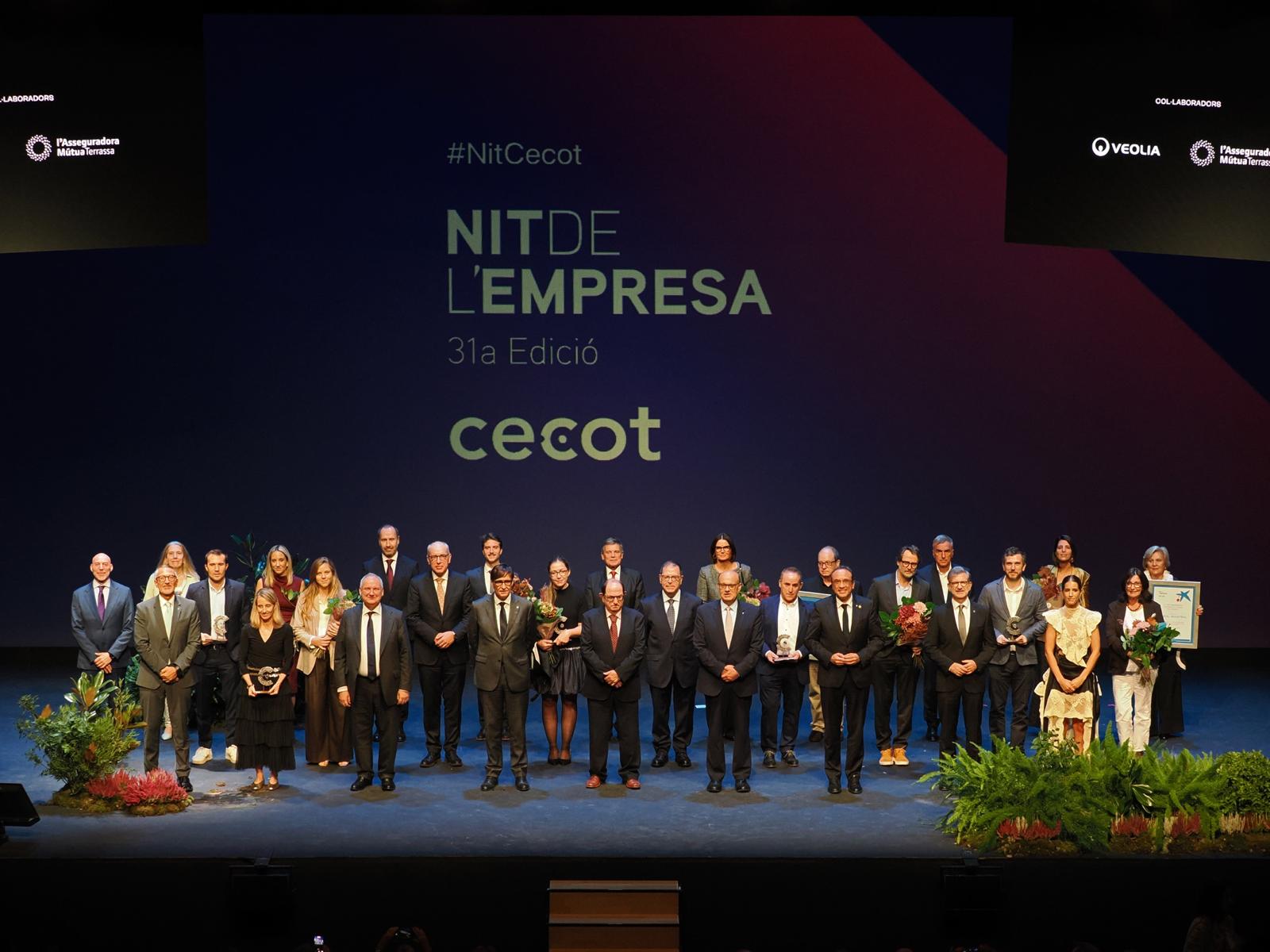
Beyond the speeches, the Business Night has recognized initiatives that exemplify different dimensions of business progress. The Cecot Awards for Business Progress 2026 have distinguished Roca Group, for energy efficiency and sustainability; Smilics, for digital transformation in industry; Columat, for digital transformation in services, and Culinarium, for innovative commerce.
Also recognized were Envio x Envio, as the best young business initiative; Anudal Industrial, with the 11th CaixaBank Award for Responsible SME; Viena, with the 9th Vítaly Award for Healthy Company; Grupo Zanini, for its commitment to talent management, and the Fundació Catalunya Cultura, for its collective contribution.
The employers' association also honored three centenary organizations: BJC | Fábrica Electrónica Josa, from Rubí, for its hundred years of activity; the Col·legi Oficial d’Agents Comercials de Terrassa, also for its centenary, and PR Stamp, from Sant Cugat, which celebrates 118 years of trajectory.
Marta Raventós, president of the Cecot Circle of Young Entrepreneurs, had summarized it with a phrase that permeated the entire evening: «Conformist people adapt to the world. Nonconformists transform it». See, question, propose, and act. Four steps that challenge companies, but also administrations, politics, civil society, and citizens.
Because nonconformity is not just pointing out what doesn't work, but taking responsibility for changing it, making decisions, and accepting the consequences. Transforming words – many of which were spoken from the podium this evening – into deeds. And not just doing it, but "doing it well."
Add The New Barcelona Post as your preferred Google source for free
Stay informed with the latest news.