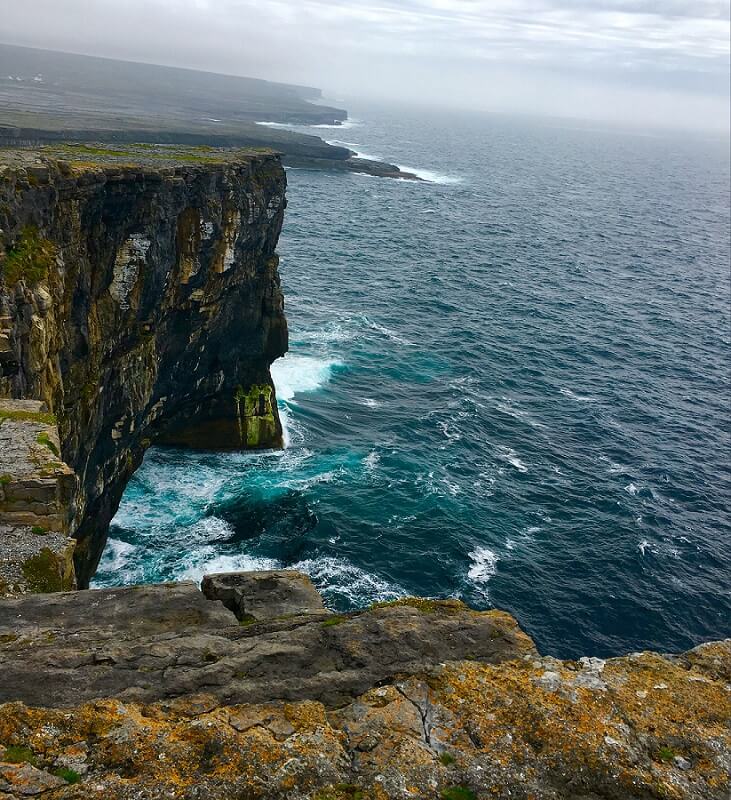
Ireland is an island tenaciously swept by easterly hurricanes, by the centuries-enigmatic howl of an annoying ocean. The country is very rainy, with full and well-oiled vegetation, without dust. The Irish green is a sedative, spontaneous green, it transmits tranquility.
I have boarded a bus that runs the route from Dublin north, to the border with Ulster, through Shane crossing the Boyne River, Ardee, and Carrickmacross. Along the way, very dense sheep, with black heads and very white, long wool, graze in the enclosures. And dairy cows, some copper-colored, but mostly mottled in dark and light. With their heads down, they cut the meadow with an insect's voracity.
If there weren't so many hours worked in the fields, in the forest, if there weren't herds grazing in the meadows, Ireland's oceanic humidity would return this land, in a few years, to its primitive jungle exuberance. On the edges of the paths, in the gardens, green unites with purplish wisterias and the thorny, flowering hawthorn, of a faded white.
Now that it is spring, the rapeseed flower, fodder for livestock (from which biofuel is also made), blooms with a very vivid yellow. Large expanses of yellow and green colonize the hills. All colors that occur naturally, strange as it may seem, never hinder each other, never hurt the eye.
The interior of the island is of an elemental and depopulated rurality, with no other history than the periodic irruption of invaders. Or with no more novelty than the rhythmic wheel of insubstantial hours. Village girls still wave as the bus passes.
I'm going to a friend's house in County Monaghan. Already near Clones, on the border with Northern Ireland, the bus slows down as it passes through a village and the driver throws the newspaper package out the window. While eternity consolidates, surprise is ephemeral and flies by.
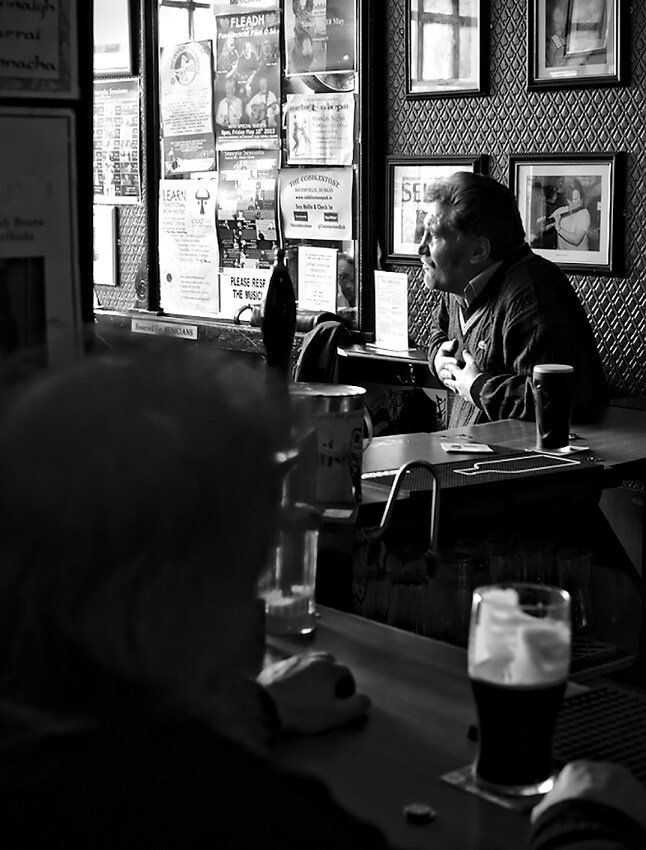
Clones is a passing village, with no people on the street. At the roadside, I wait in the pub for them to pick me up. It's a dimly lit den, with years and years of crusts. When my eyes get used to the darkness, I identify two silent beer drinkers at the bar. We strike up a conversation with the TV's background voice.
The pub is a crypt where one can meet others, get out of oneself by consuming one kind of alcohol or anotherA few days ago it was Saint Patrick's Day, the feast of Ireland's patron saint. On one wall there is a dartboard, with yellow and black stripes, and photographs of musical idols. Squeezed bottles, stools and, by dusk, the shouting that is easy to imagine. But also, a remarkable thing to say, the piggy banks for collecting resources for the missions: The missionary sisters of our Lady of the Sacred Heart or Misiones dominicanas en honor a San Martín, and Pallotine Fathers missions East Africa & South America, which are presented with the slogan the love of Christ urges us on.
In Ireland, it can be said that a pub culture has been incubated. It is the refuge and meeting place, the public confessional and the chapel of concelebration. The semi-darkness creates the ideal atmosphere for this idea of introspection. The pub is a crypt where one can meet others, leave oneself by consuming one kind or another of alcohol. Drinking makes a man. Thus, without fuss, an Irish slogan could read. And that is because the incitement to alcoholic consumption, like so many other things, is justified in terms of the spirit of transcending the immediate world. Drinking makes a man among men, it opens us to others, to a higher dimension. And if he who does not drink is a loner, it is because he wants nothing to do with others and because he closes himself off.
The name of the pub Diamond seems somewhat ambivalent to me. I have read others equally or more enigmatic and suggestive: The red parrot, The golden triangle, The cat and cage. They are closed boxes, which excite the curiosity of the snoop we all carry within. We advance through forests at dusk, when the owl is already blowing.
In Ireland there is a land anchored in the foundations and a wind that laminates it and turns it into dust. This struggle between flesh and spirit has transcended all manifestations of human life in this relatively small Atlantic territoryThe abundance of pastures makes the beef from this country a delicate and tasty delicacy. And cheese production is of great interest here. Now it's spring and good weather is coming. But the rains always arrive, sooner or later. The cold, around these parts, perhaps is not as determining as the darkness, this night that in the winter months begins so early, frozen, sad, unending.
In Ireland there is a land anchored in its foundations and a wind that laminates it and turns it into dust. This struggle between flesh and spirit has transcended all manifestations of human life in this relatively small Atlantic territory. Perhaps that explains why bank robberies are -or have been- so frequent on the island, as they exaggerate to me. It seems that it is -or has been- a very widespread, common hobby. In the souls of the assailants, they tell me, perhaps there is a dark attraction to the foundations. When they withdraw from people's sight and hide, the thieves' revenge is posed as a restitution of things in their place, which is the surface of the world.
It is the same spirit that animates missionaries and tinkers, the gypsy tinkers, those impenitent wanderers. Both perhaps have inherited that transhumant instinct from the Celtic peoples. Or from shepherds. That is why Dublin is still famous today for the wool trade. Also for cotton and silk.
This island was a Finisterre. For medieval people, all human pilgrimage on earth ended here. It was in Ireland where the sun's journey through the territory of the West ended.
Add The New Barcelona Post as your preferred Google source for free
Stay informed with the latest news.