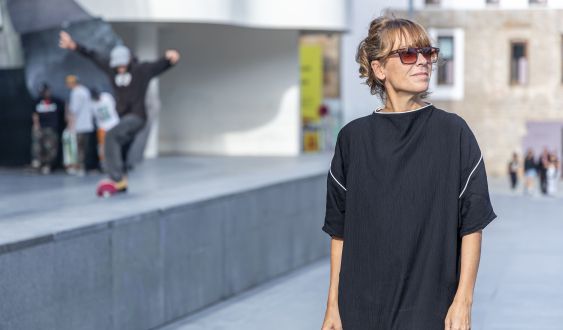
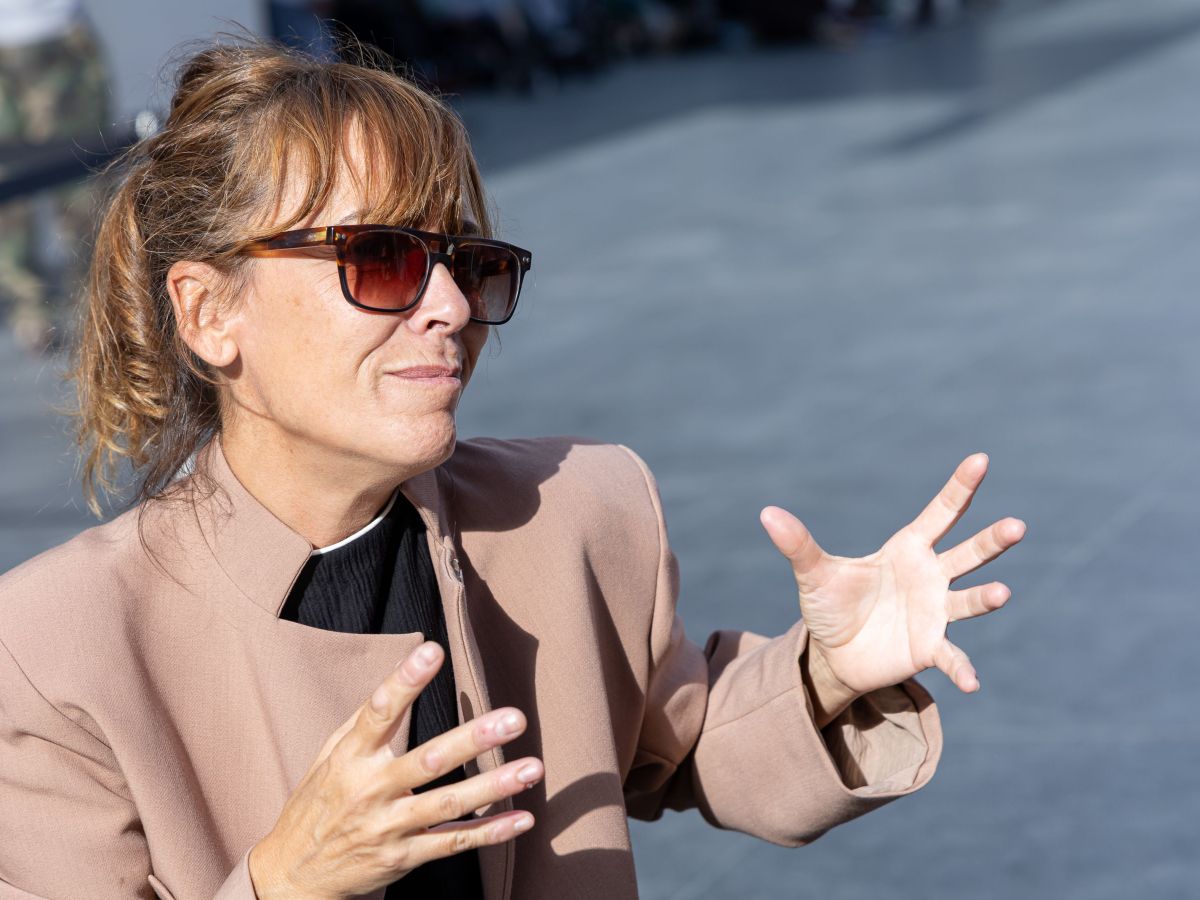
She debuted on the Gaudí catwalk in 2004, inspired by Bergman's film Persona. More than twenty years later, Txell Miras remains faithful to this creative periphery from which she understands fashion as a language that draws from cinema, fine arts, dance, and literature.
As she herself has confessed to us, her style has been influenced by the conceptual aesthetics of Belgian and Japanese creators (with Rei Kawakubo and Martin Margiela as guiding lights), but she has her own authentic voice that operates outside the mainstream.
Txell Miras has combined authorial creation with large-scale projects for institutions such as the Orfeó Català or the America's Cup because, for her, clothing is a tool for thinking and a mirror of society.
— In 2004, you debuted as a designer on the Gaudí catwalk, more than 20 years ago. How has this journey been? Have you changed much since then or do you remain faithful to the line of your beginnings?
— In essence, I remain quite faithful. The brand is quite recognizable. But I would say that I have evolved. I suppose age has made me more pragmatic. I have prioritized comfort more than perhaps aesthetics or conceptualism. I have maintained the concept in what are the fashion shows, but the street collections, the commercialization of the collections, I have made them more real.
— And in that first catwalk show, you presented a collection inspired by Bergman's Persona. Why? What did that film have?
— It's one of my favorite films. I would say there is always this search for oneself, for fears, for finding oneself, for silence, for who we are... It's a film about many questions and few answers. It's a search. And my work is always this search.
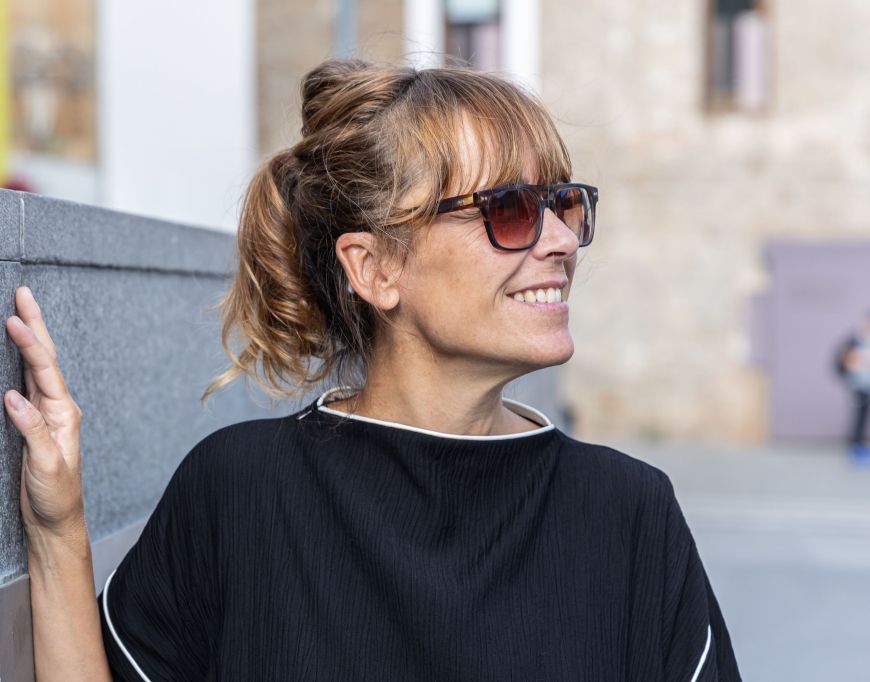
— Your way of relating fashion to other arts is a constant. In fact, in your presentations you play with literature, music, photography... Why?
— In the end, it's about communicating and expressing. I don't like to marry myself to just one discipline, I find it absurd. And I believe that, moreover, they can coexist; they can mix with each other and much more interesting things emerge. Language is much richer when disciplines draw from one another.
Language is much richer when disciplines draw from one another.
— And what are these presentations like?
— Within what would encompass fashion, which is my territory, there has been illustration, poetry, music, collaboration with audiovisual artists, cinema... Alba Corral, for example, made some projections of the illustrations she does digitally and then we translated them into the collection. The illustrations I make have been applied to the t-shirts that were then sold.
— How do you think your training in plastic arts has influenced your conception of fashion?
— I believe that studying Fine Arts has influenced above all for this conceptualism. So that there is a message, a concept, and that clothes serve us as one more tool, like clay for the sculptor, to build. I would also say that my facet as a dancer has helped me to know the body.
May clothes serve us as one more tool, like clay for the sculptor.
— How would you define your style when designing?
It is a modernity that prioritizes details, quality, but also this going further, experimenting with forms. Pattern making is very important, the quality of the fabric, the material, and then this essence that I don't know what I put into it, but that people recognize me for. It's my own voice, but I couldn't explain exactly what voice it is.
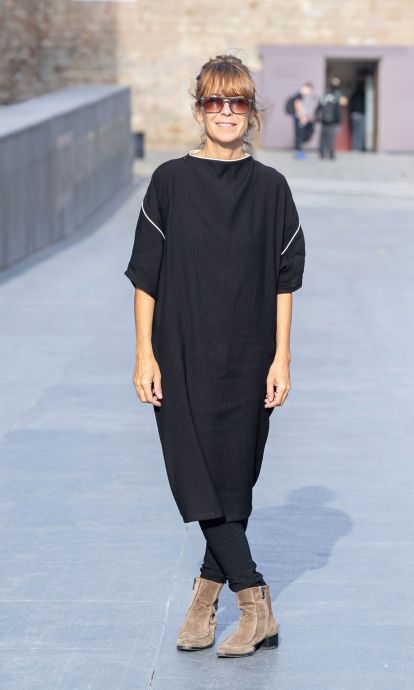
— In your designs, you opt for deconstructing the silhouette, adding layers and volumes. Why did you make this choice?
— At first I put a lot of volume, but now I would say I have been removing it. I am looking for minimalism, but without giving up experimentation. With volume, but without overdoing it. Everything is periods...
— Where do you think your style comes from? Do you have any influence that has marked you?
— When I finished Fine Arts and started doing clothing design at La Llotja, there I discovered the Belgians and the Japanese. It was a great discovery; for me they were comparable to Marcel Duchamp or all the conceptual artists I liked in the art world. I said: "Wow, here in fashion they are also artists." The thing is that the discipline is different. But my most direct influences are Rei Kawakubo, who in volumes and forms is the architect of fashion, and then Martin Margiela, who for me would be Marcel Duchamp, the conceptualist of fashion.
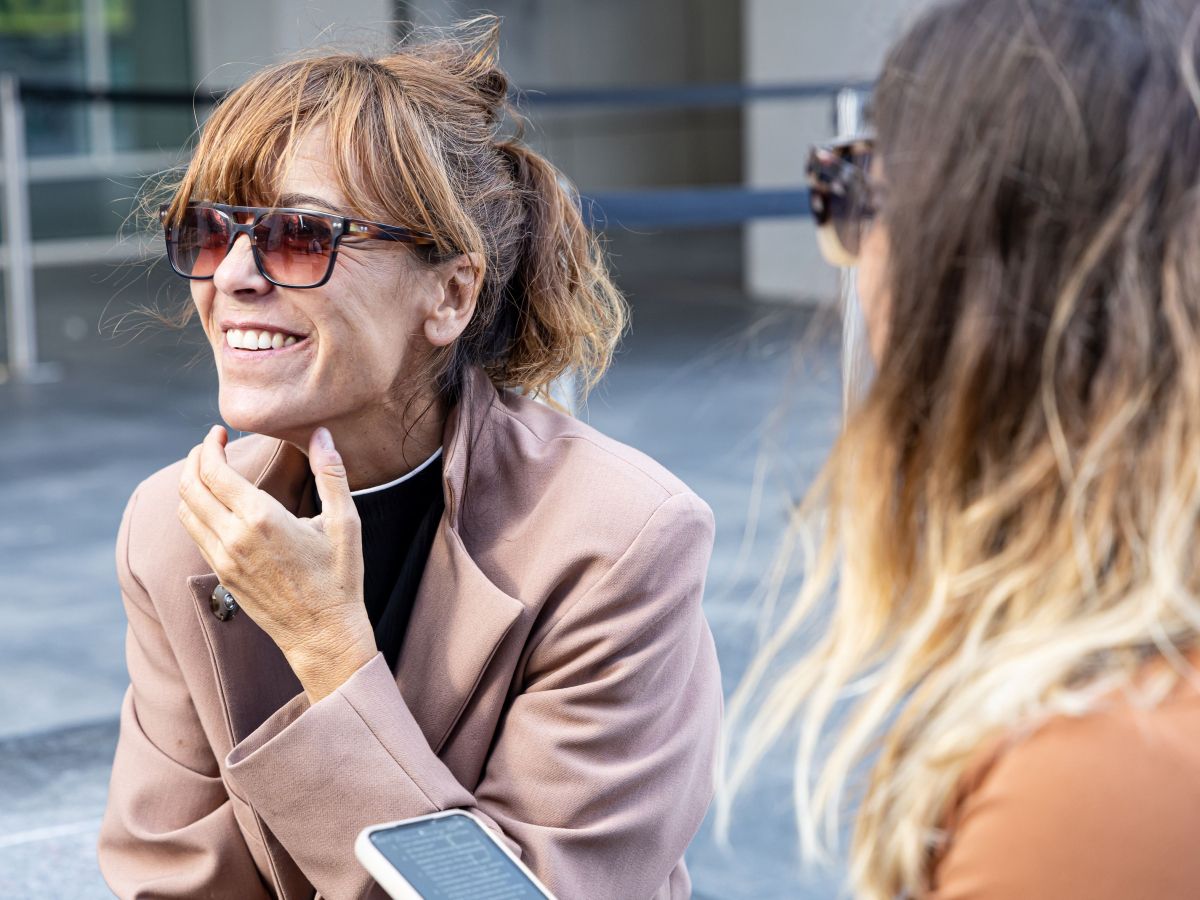
— Fashion today is obsessed with a very specific and unreal body type. How do you see this obsession and how do you try to give space to other bodies when you design?
— I believe that we are precisely at a moment when more space is being given. There is more variety of bodies on the runways, in advertising, brands are betting on this diversity of skin color, of shapes... I think it is a moment when we can be quite satisfied with all that has been fought for until now.

However, beauty standards have always existed; they seek this because we all have in mind a standard that we want to follow. And fighting against that is impossible and I would tell you that it has much more to do with how we are as a society. If in our society we have this diversity, it will be seen in fashion; if it is not there, fashion does not reflect it, because in the end fashion is a reflection of who we are. Not everything is dictated by fashion; we have more importance and more voice than we think.
Not everything is dictated by fashion; we have more importance and more voice than we think.
— But nowadays it seems that extreme thinness is back in fashion...
— It is true that it is constantly a struggle not to create stereotypes, even though we are the ones who seek them. And when they have already been created or we get tired of them, in one way or another we look for the opposite.
— In these years you've been in fashion, what have you been seeing?
— In the 90s, those models were skeletal, sticks..., a fashion where the woman was very masculine at heart, but feminine in terms of shapes. Then we moved to curves, exuberance, volumes, and now it seems we are returning a bit to the other extreme. But that's how we are in the end, it's a constant balance.

— And who do you think sets these trends? If fashion doesn't set them, who do you think does?
— Society. Because when we have already achieved something, we look for the opposite. It's a bit like politics: we go from one extreme to the other.
— And looking at fashion right now, what is the industry trend you connect with the least?
— Clearly, I would say fast fashion, the one that treats the craft as if it were an empty and purely aesthetic product. For me, fashion has to be other things. It doesn't have to be exclusive or for the elites, but it does have to be for people who have a certain interest in giving importance to what they put on their body and what speaks of them. Because clothes, in the end, speak of oneself and of the image you want to give to others; they say much more than we think.
Clothes, in the end, speak of oneself and of the image you want to give to others; they say much more than we think.
— What do you think of Shein?
— We have to consider what values we are giving to the new generations, what is happening. And not only that: fashion sometimes is a reflection of many things that come from deeper inside. It's something to think about.
— Fashion as communication?
— Totally. And it is a mirror of what we are as a society. It has always been throughout history. When there have been austere times, fashion has been austere. When there have been much more frivolous times, that's when fashion has been more frivolous and more over the top. It says a lot about how we are as a society, they are very intertwined.
(Fashion) is a mirror of what we are as a society.
— And now that everyone talks about sustainability, how do you fight against "buy and throw away" from author design?
— Sustainability is also a trap. It's the current trend. But nothing is sustainable. We should stop consuming, and that won't happen. Then it can be more sustainable or less sustainable. It is true that with this Vinted thing (people exchanging clothes) it seems like it should be more sustainable, but in the end, we always go overboard and end up spoiling it. Because people wear that sweater twice and want another one, and it's not that you've given that same sweater more life, but rather you change the person; if before one person wore it 20 times, now what we do is constantly move transport, and that's not sustainable either. I think we should value clothes more; have the sensitivity to buy a piece that perhaps costs a little more, but you love it, you take care of it, and you don't need to buy so much.
Nothing is sustainable. We should stop consuming, and that won't happen.
— And with so much old clothes and waste that we accumulate, what role does the fashion industry play in slowing down this pace?
— I believe that in the end there must be laws, because if there aren't any, it's impossible. We small ones can keep saying that we do responsible production, but it's impossible to fight against such a wild market. If governments don't set the guidelines, it's impossible. And giving responsibility to the consumer seems unfair to me, because the consumer is played with through advertising and subliminal messages that sell you happiness dressed as a product. I believe that governments are the ones who should regulate the market.
— In your beginnings, fashion had a different rhythm. Do you prefer the sector from before or do you find interesting things in the current landscape?
— I think that since I started, the pace has been increasing at a very heavy speed, and we are reaching a point where we are saturated. People don't know if they are seeing pre-collections or collections. And the fact that luxury has also seen its turnover decrease indicates that something is happening, and we should learn to slow down and go at a slower pace. I've been seeing it for a couple of years now: let's go back to doing things well, to giving importance to small details and not to producing and producing collections one after another that you don't even know what you've seen. I think globalization in this aspect is collapsing us.
We should learn to slow down and go at a slower pace.
— I understand that this urgency to go fast is dictated by social media.
— Totally. It's all immediate. When a collection is presented, people want it now, but it has to be produced, it's not delivered immediately. Before, it was magazines that went to the fashion shows, and the press took the photos and didn't show them until the clothes arrived in stores.
Now everything is very fast. That's why in the end everything is more about brand image, there are more celebrities at the fashion shows, there's more competition... Clothes have lost their meaning and value; what matters more is which actresses wear them or who sells them on social media. I hope this stops and we go back, because I always believe in this balance: when we reach one extreme, we go back to the other. And so, constantly.
Clothes have lost their meaning and value; what matters more is which actresses wear them or who sells them on social media.
— How do you think social media influences the fashion sector?
— Absolutely. In fact, fashion shows in Paris have changed: everything is made and designed for social media.
— Do you work with any influencer or lifestyle person?
— No. I'm quite anti. I love people who wear my clothes and value them. I also follow some people on social media, but I always like it to be someone I can admire or who brings something to me. The concept of dressing just to dress or to show looks purely for aesthetics, I don't understand it.
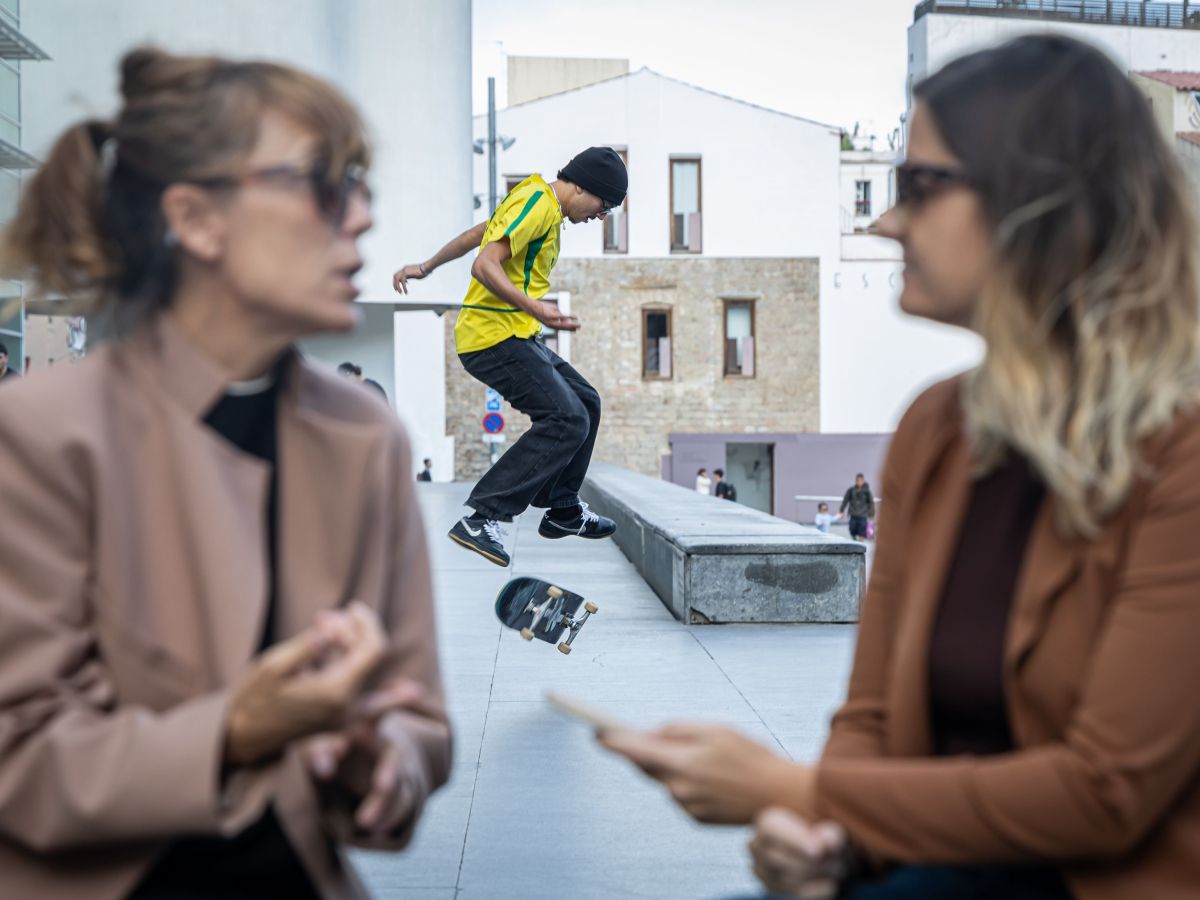
— More than once you've been associated with Belgian or Japanese aesthetics, which tend to be more intellectual and less about display. Have you ever felt a bit strange within the fashion scene here?
— When I started it was a bit of a surprise, and that played in my favor, I think. There was very little culture here of everything that was happening outside in a more alternative way. It was an embryo from which a lot of fashion came later. Being a bit on the periphery suits me: I go to the audience I go to, I don't pretend to reach the big masses, and not out of elitism, but because I do what I do and it reaches whoever it reaches. I've been able to set it up well, I reach the people I need to reach and I can do what I want.
— And how do you do marketing, nowadays?
— I would tell you it's a lot of word of mouth and small format. Sometimes you don't need to make a lot of noise. If you want to create a big company with many employees, yes, but I believe a lot in small businesses and that there is room for everyone, with many different voices rather than few and very big ones. With globalization, everyone ends up doing the same thing and we end up saturated. I prefer to maintain my personality and have a small, but authentic voice.
I prefer to maintain my personality and have a small, but authentic voice.
— You have done very intimate things, like drawing pain or desire directly on canvas in Cadaqués, and at the same time you have dressed the Orfeó Català or the America's Cup. How do you manage not to lose your attitude when working with large institutions?
— When I have worked with large institutions, they have come looking for me because they like my style. Logically, you adapt to the needs of each show, but they were looking for my essence, so I haven't found it difficult. It was more complicated in the case of the Orfeó, which had 400 singers, with many bodies and many tastes... It was a very big challenge, but very satisfactory.

— You have also used your fashion shows to question power or hierarchy. Have you ever felt that someone in the sector was uncomfortable with your message?
— If someone was uncomfortable, I don't care. On the contrary, sometimes I do things precisely to shake things up. If someone feels alluded to, it will be for a reason.
Sometimes I do things precisely to shake things up. If someone feels alluded to, it will be for a reason.
— In the collection Descorsetant you talked about the physical oppression of corsets, but also about social oppression. What are the invisible corsets that today's society puts on us?
— We are at a time when we capitulate thinking we are free, and that is the worst. Many times I see how they manipulate us unconsciously and on top of that we think they don't.
— How do you think the world of fashion relates to society?
— It's a mirror, even if there are people who say: «Fashion doesn't interest me, I'm anti-fashion». The way you dress and position yourself as anti-fashion, you are already positioning yourself. Because we dress, and it's the image we project. And not only with clothes, but with the way you move, speak, do your hair... You communicate about yourself, about society and about yourself as an individual.
We are at a moment where we capitulate thinking we are free, and that is the worst.
— How do you see the future of fashion?
— I don't want to think about it too much or be defeatist. Sometimes I think that pushing things to the limit makes the essences re-emerge: creativity, craftsmanship, unique things, value. It may work in our favor or it may not.
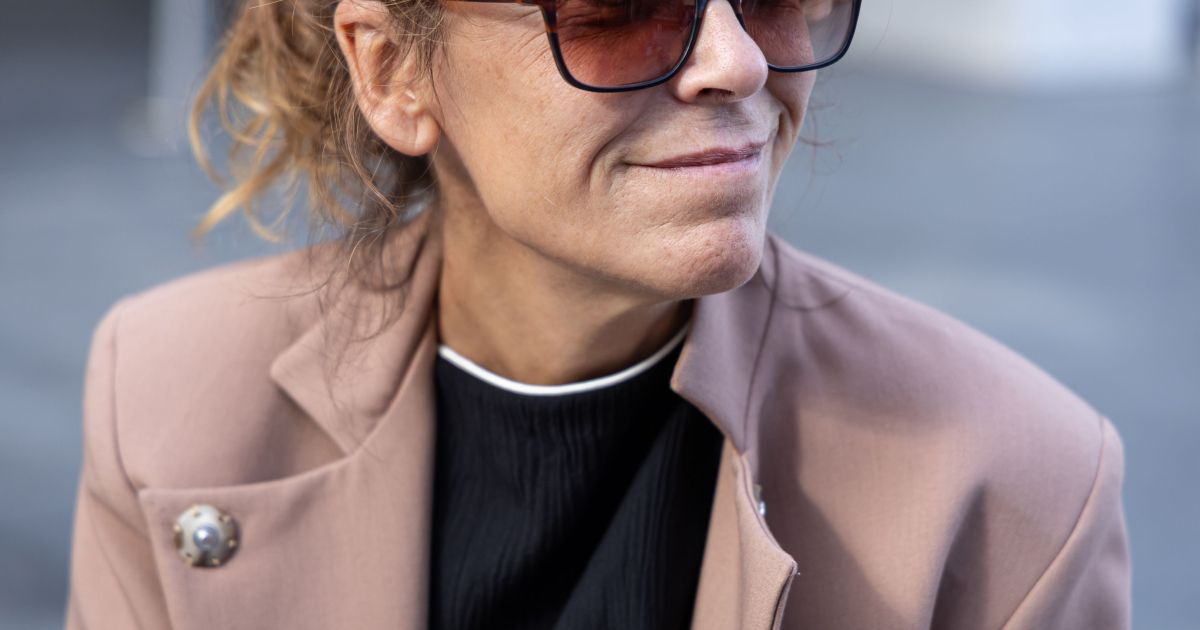
— Has AI entered the world of fashion?
— In my case, no, but it's easy for it to enter. Surely in much more functional things it already is: with pattern making, digital design, making hybrids or trend analysis. But these are databases. The original and authentic creator has a long way to go. Digital design can be a well-used tool, as other techniques were. It will depend on how we use it.
— What do you think will be seen at 080? What will be the trends?
— I think 080 in Barcelona is quite eclectic. Consolidated brands coexist with young people starting out. When I started at Gaudí, I really liked that Toni Miró, Armand Basi, Victorio & Lucchino were there... Being next to them when you're starting out is what gives you the opportunity to make a name for yourself. This marriage between new and consolidated voices is what it should be.

— What do you take away from current fashion?
— I connect with the fact that fashion is another tool for thinking. In the end, it's also thought and creation, and I stick with designers who understand it that way.
I connect with the fact that fashion is another tool for thinking.
— Are there synergies among designer authors?
— Few. In my time, with Josep Abril or Míriam Ponsa, we formed a strong group. Many talented people have had to leave because the market is difficult and maintaining the creative and commercial aspects at the same time is complicated.
— Have you ever considered quitting?
— I thought so, yes. At first I worked in Milan and commuted, and that allowed me to endure the beginnings, which are very hard. I always tell students to go work for others before setting up their own project, to have financial stability that allows them to take risks. Now I haven't thought about quitting for a long time. I also try to do different things: fashion alone suffocates me. I did an exhibition in Cadaqués, now I'm doing narrative courses at the Ateneu; everything feeds back into itself.
— And how was the exhibition in Cadaqués?
I did an exhibition at Galeria H2O and from there the idea arose to adapt it for Cadaqués. It was called El desig simplificat en una llàgrima (Desire Simplified in a Tear). It's a phrase adapted from Clarice Lispector. She says that pain is tiring and a tear simplifies it; I adapted it to "desire simplified in a tear."
Fashion is an industry; it is not art.
— And finally: what is fashion to you?
— I always say that fashion is an industry; it is not art. But as in any macro industry, original, artistic, and creative things can emerge in the peripheries. I place myself in that gap.
Add The New Barcelona Post as your preferred Google source for free
Stay informed with the latest news.