
Much poetry has been written after Auschwitz (in fact, more verses than ever) and man has survived practically unscathed the most abject wounds caused by his own cruelty. Narcissists that we are, we believe we live in an era of collapse – we have no shortage of reasons, such as the climate crisis or the phantasmagoric return of genocide in Ukraine and Gaza – but we often forget that humanity has suffered historical cataclysms that far exceed a present, ours, which still has very high doses of comfort. Whether our fear is justified or not, the apparent cruelty of this delirious time forces us to rethink what affected philosophers call "the human condition," which is nothing more than grappling with individual contingency from what we feel is inhuman. For all this metaphysical bother, the exhibition What humanity? is news of the highest transcendence.
I ask museums and their initiatives – exactly as I do with books and people in general – to force me to think and, if possible, to reflect on the ideas that generate the most discomfort for me. This art exhibition at the MNAC achieves this, and it must be said from the outset that we are facing a first-world exhibition and that the goal is the main merit of its curator, Àlex Mitrani. Our art historian, curator of the modern sector at the museum, has conceived a splendid symphony of works that goes from the aftermath of our (in)Civil War and the carnage of the 1940s to the digestion of the respective tragedies, four lustrums later. In summary: Mitrani has perpetrated an exemplary task, which could be proudly displayed in any room of the best museums on the planet and, in turn, places Catalan art at the same thoughtful-aesthetic level as its contemporaneity.
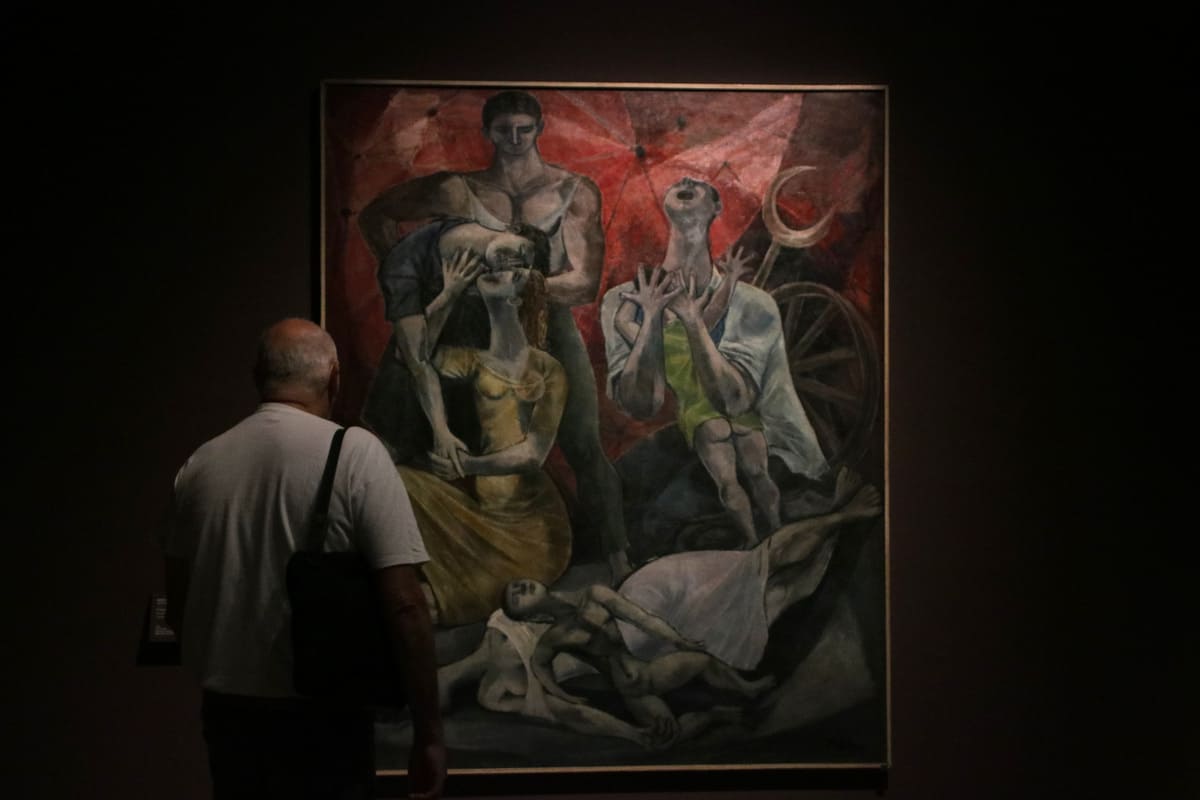
The walk through the inhuman begins from the most capillary point in the representation of the figure of the post-apocalyptic being (the visitor will discover that the most illustrious novelist in our history also mastered the brush wonderfully) to continue delving into the raw reproduction of the disaster through the anonymous children of Cuixart, the beautiful dead shells of Pere Gastó and the chill of the dying zombies, embraced in the darkness, of Armand Cardona. Rarely had the letter 'n' of the MNAC been justified with such force, since Quina humanitat? will reveal the immense pictorial skill of artists from our countries who are unknown to most inhabitants of the tribe (splendid creators who, I insist, are on the same level as unknown masterpieces such as Andrej Wróblewski's Execució amb noi, an oil on canvas that chills the blood).
Mitrani has perpetrated an exemplary task, which could be proudly displayed in any room of the best museums on the planet and, in turn, places Catalan art at the same thoughtful-aesthetic level of its contemporaneityThe most radically beastly version of the path reaches the nakedly explicit forms of human monstrosity. Mitrani very well re-links the image of man sacrificed by his own in the crucifixion of the Nazarene (the clue is obvious in the initial quote from Joan Sales that leads us to Uncertain Glory, but also, that we are well-read people, to the work of Kazantzakis). It will perhaps be the stretch of the road that most impresses the visitor, but I applaud precisely its subsequent reverse, where our guide places us before the works that re-imagine the human figure when tears have run dry and the individual is left only with exile. Here, of course, the infected prisoners of our genius Ponç and the precious disillusioned families of Guinovart prevail (although to this servant, with too sentimental a soul, the Silence from Alicante-born Juana Francés, L'Estació of the Tortosa-born Guansé and the Philosopher from Narotzky).
Who knows if, still struck by the inhumanity of this path and so much dose of pain, the expository coda with Miró's hope and the escapism of the sixties, seemed to me an unnecessary addition to the exhibition, although I perfectly understand that after a boxing match someone might need a little water. But well, all this doesn't matter, because the important thing is to urge you to run to the MNAC to enjoy an exhibition that, if it were in the MOMA halls, would cause a real exodus of snobs to Manhattan. It's not necessary, believe me; just go up four stairs and rush into the halls of a museum where Pepe Serra and company are doing things very well (I wish the country's musical facilities had half the artistic ambition and commitment to Catalan heritage that the MNAC has, but that's another story). So, delve into the realm of the inhuman.
And, since we're at it, a small coda. The MNAC does not need any apostle to refound or rethink it. Basically, it asks for more resources and for the kindness of letting the people who already work there do so in peace and quiet. We understand each other, I suppose.
Add The New Barcelona Post as your preferred Google source for free
Stay informed with the latest news.