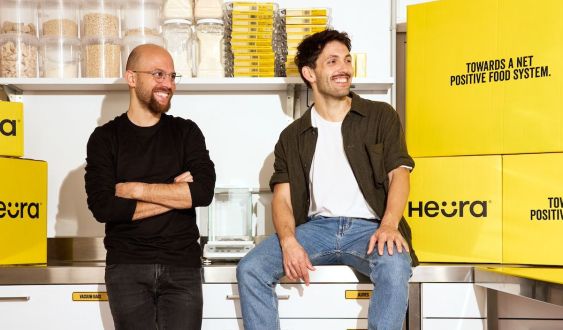
Understanding how food proteins interact to create nutritionally complete and sustainable plant-based meat products. This is the main task of Heura's laboratory team, which is developing new formulas to advance plant-based food, which aims to establish itself not as an alternative to meat, but as its successor.
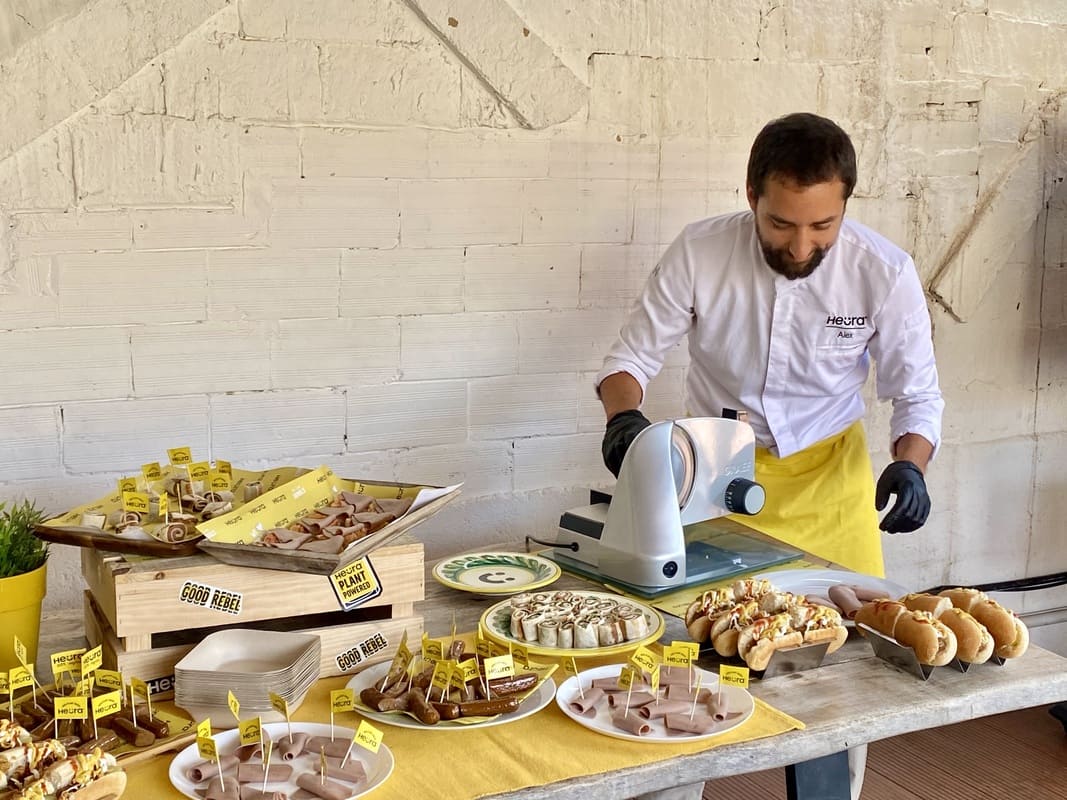
Based on this laboratory work, the company founded by Marc Coloma and Bernat Añaños registered its first patent last year: a pioneering food processing technology that imitates meat products such as sweet ham with plant protein. After this first patent, the startup plans to register six more in the coming months. "New worlds and new simple solutions to big problems are constantly opening up," says Añaños. The company closed 2023 with a turnover of 38.3 million euros, and with the forecast of reaching profitability in 2026.
Now, Heura is considering selling this technology to third-party companies. "We are immersed in conversations with different actors in the food industry, so that our technology contributes to others launching 100% plant-based products that reach further and more people," defends Añaños a few meters from the laboratory at Heura's headquarters. Upstairs, the kitchen where new products are formulated and made and recipes are created with them is located.
Precisely to bring the laboratory and kitchen closer together, the startup is moving from the Eixample to its new headquarters in 22@, where it will have more space and, above all, a larger laboratory better interconnected with the rest of the facilities, where nearly a hundred people of 21 nationalities work. "Having a mission attracts professionals who seek to generate an impact, and being in Barcelona facilitates it," according to Añaños: "Barcelona is very well positioned and, added to the mission, it is a good showcase for attracting talent."
Precisely generating this impact is what Añaños was looking for before immersing herself in the Heura project. After having resided in London for a volunteer program, Añaños moved to China, where she discovered the world of startups, "their fast pace and the impact they could generate." But then she achieved what was then her goal: to work in the European Parliament, in the field of communication. The institution interested her precisely because of its impact on progress, but she was struck by the change of pace compared to the speed of startups. "Then I thought I could generate impact from other spaces," and she arrived at Barcelona Activa.
It was there that she met Coloma, who came from activism and had the will to change the food system. Añaños, already a vegetarian then, joined his determination, and there began two years during which they started to analyze projects carried out by universities and technological and research centers, but which had not reached the industry, and other products they were testing, especially among their close circle: "At first, we were very hackers, now we have an internal team of cracks."
Heura focuses on achieving profitability, something it expects to achieve by early 2026 in all markets in which it operatesNow, Heura has 14 products on the market manufactured in Spain and Holland, and is a leader in Spain in the segment of foods made with vegetable protein, with a 26% market share. In addition, the company has increased its sales by 63% in its international markets,located mainly in Southern Europe, especially in France, Italy, and Portugal, in addition to Spain: "If we are able to penetrate the homes of these four countries, we will be able to enter any country, because food in Southern Europe is like a religion."
In addition to focusing on these four markets, Heura is focused on achieving profitability, something it expects to achieve by early 2026 in all markets where it operates. The company, which closed in February a 40 million round led by the Dutch multinational Upfield, also counts among its shareholders recognized figures from various fields, such as footballers Sergi Busquets and Sergio Roberto, basketball player Ricky Rubio, and presenter and comedian David Broncano.
The startup, which has no acquisitions planned but does not rule out this possibility if it can increase its impact, wants to continue reaching the menus and recipes of more households, also through strategies such as placing its product on supermarket meat shelves, and introducing itself into school menus. In this sense, according to Añaños, "the success is having created a brand and a product that is not consumed only by those who are already aware that there is a problem and a challenge, but also by those who are starting to want to reduce their meat consumption."
Add The New Barcelona Post as your preferred Google source for free
Stay informed with the latest news.
