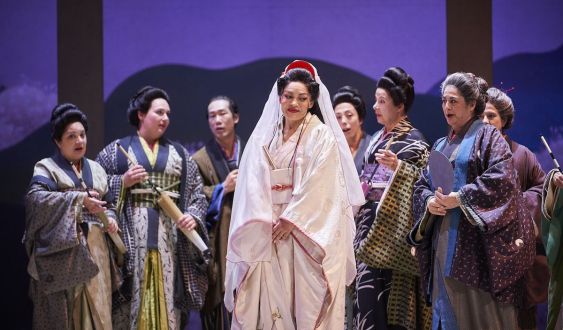
In this chronicle, the repertoire, which is variable, features (the young Japanese woman as Cio-Cio-San) soprano Saioa Hernández, who I can already say maintains the tour de force at a good level throughout the performance and becomes a very remarkable interpretive verisimilitude. You already know the story: a satrap American naval officer deceives a young (illegally young) Japanese woman by marrying her and promising her prosperity and stability, and the rest of the work is her waiting while he leaves, promising to return. She even converts to Christianity, trusting that in the United States divorce (poor thing) is punished, while he takes advantage of the Japanese legal laxity in matrimonial terms. That is to say: for him, an adventure. For her, eternal love.
This plot unfolds, in the Liceu 2024 version, on a stage with typical Japanese panels (shoji) that rise and fall like blinds, and behind them pass both the landscape and the arrival and departure of the characters, and evidently, in the distance and only as an idea in our imagination, a ship that never arrives and that one day (very late, after more than two years) finally arrives. Austere, direct set design, without spectacular effects: not even a simple chair. All attention falls on the performance of the interpreters and the execution of the melodies, which at first offer, as marked by Puccini's libretto, a couple of nods to the American anthem. The oriental touches are less noticeable, but a space is made between the composer's bel canto impulse, and the costumes accompany with rigorous historical accuracy. As for the satrap, tenor Fabio Sartori also reveals a surprising verisimilitude and even at some point we end up liking him. He and the young Japanese woman will end up rising, at the end of the first act, in a Volgatemi bene that makes one forget all the deception or that confers an extraordinary beauty to the deception. Puccini achieves this: we know it's all a lie, but we learn how a lie is sublimated in the form of love. Of music.
A few moments of pause to highlight the installation by Antoni Tàpies that the Liceu has provided for cava drinkers in the Saló dels Miralls, in this year commemorating the hundredth anniversary of his birth. Let it not escape us, artistic director Víctor García de Gomar seems to tell us. Well: and the butterflies, stuck to the mirrors, do not escape us either. All this as a prelude to the awaited showpiece aria of the entire work, Un bel dí vedremo, sung after two years of waiting while the maid Suzuki (notable Teresa Iervolino) tries to convince her that she should not get her hopes up. Puccini's ability is admirable to prolong the theme of illusion, of faith, of waiting, in a kind of homage to those who do not lose hope that elevates Cio-Cio-San, the great dreamer, to the absolute victor of a plot where in fact she loses absolutely everything.
The entire audience leaves the theater wondering if it was necessary, if it was really necessary for the son of Cio-Cio-San and the satrap Pinkerton, sadistically baptized with the name Dolore, to remain blindfolded and waving an American flag while his mother takes her own life with a knife. Ruined, deceived, replaced by another woman (yes, the cowardly Pinkerton appears with an accessory), humiliated and having renounced her own culture and beliefs... but as we said, in the end, the absolute victor. The beauty of believing in something, of trusting in something. They stick the needle in you because they will never have your wings.
Add The New Barcelona Post as your preferred Google source for free
Stay informed with the latest news.
