
In the same way that there are places in Barcelona that symbolize and embody the unfading beauty of our city (and may each fellow citizen fill the void in the parenthesis with their favorite spot), most capitals in the world have their cursed spaces, masterpieces of a museum of persistent blunders that, no matter what works or star architects one promotes or proposes, will remain burdened by ineffectiveness and ugliness for ever and ever. This is the case with Les Glòries, an unfortunate square that, despite the completion of recent works under the Colau administration, continues to be a source of traffic jams and discomfort for all the people who enter Barcelona in the morning with the very noble intention of working (a location that our brilliant Cerdà, orchestrator of the Eixample as a grid of urban highways, already envisioned as the city's second center and a hub for attracting foreign vehicles towards the center).
Last week, while I was spending time at the Can Basté discussion group (and thanks to the honest voice of the City Council's Mobility and Infrastructure manager, Manuel Valdés López), the listeners and I discovered that the paralyzing works at Glòries (thirteen years and three mayors) had not aimed to improve traffic entry into the city. Indeed, as the sincere Valdés recalled, the Square (which had three to four entry lanes) remains essentially inoperative as a vehicle container during peak hours for the simple reason that, upon arrival at Gran Via (exit 207, Bach de Roda/Poblenou), cars only have two lanes and one bus lane. The existence of this trio of paths, in effect, seems more unmovable than the sacred throne of the Moreneta, and as long as the entrance to Barcelona is bottlenecked, Gran Via and the shortcuts for hot-headed speed demons from Bilbao or Llacuna will remain collapsed.
That said, Mayor Colau has positioned herself very clearly and brilliantly on the matter, and I write the adverbs without a hint of irony. Basically, the mayor has limited herself to reminding that for her, like any good politician, what is important is the people who vote for her and that the redefinition of Glòries is certainly "a solution for the 30,000 residents, among them 3,500 children, who are experiencing a radical rebirth." Thanks to the first tunnel that buried the road, Colau said in Can Cuní, "the noise dropped in a very important way, 11 decibels, a very noticeable decrease; in Glòries everyone comments that now you can hear the silence and one can converse peacefully." As patient readers of La Punyalada know, yours truly is a Taliban of quietude, and, if our mayor has given peace and whisper to the residents of Glòries, no outsider from the neighborhood will come to dispute it, and even less so when Colau is perhaps the only politician in the country who, like it or not, applies the government plans for which she was voted.
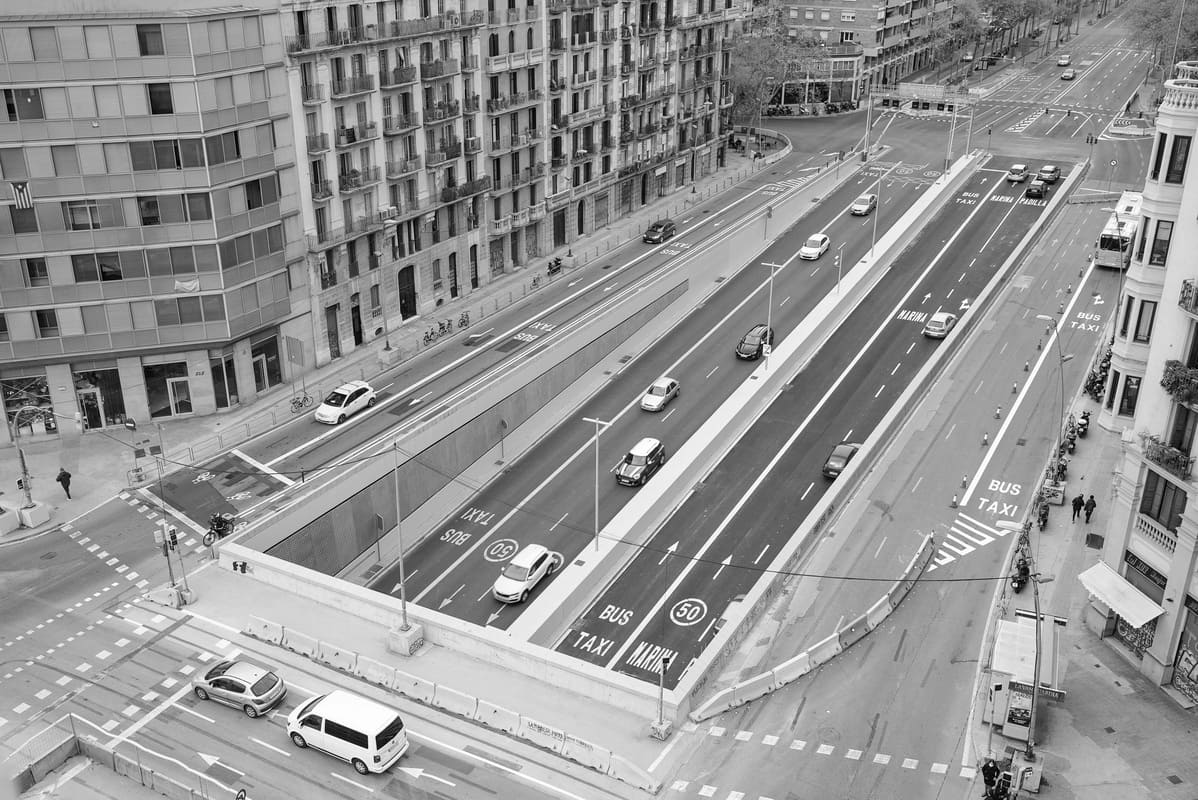
With some irony, the mayor also recalled that traffic problems in the Plaza only occur during peak hours (one didn't need to be Kierkegaard to know that) and, in that too she is right, that the responsibility for traffic does not fall solely on the City Council, but also on neighboring municipalities. That said, the mayor stated that her acquaintances from Maresme are delighted with the invention because the buses have reduced the journey by about five minutes. I regret to disagree on this point, as I am lucky enough to sleep daily (in a totally consensual and free way, she says) with a beautiful and lovely "capgrossa" who, sniffing around in today's La Punyalada, reminds that, although the time reduction may be true, the frequency of buses on the Maresme line is highly insufficient and that arriving early in Barcelona means getting up at disco hours.
Yours truly is a Taliban of quietude, and, if our mayor has given peace and whisper to the residents of Glòries, no outsider from the neighborhood will come to dispute itAll of this is not the responsibility of the mayor and Colau acts saintly, I insist, focusing attention on the health of the lungs of the residents of Glòries and therefore it is normal for her to claim the splendid basketball courts and the wonderful picnic areas where the inhabitants of the square can go to gobble down a sandwich. In this sense, and as always happens,the mayor has shown extreme skill in turning Glòries into a symbol of the uncontaminated cityand human-oriented that puts it directly in tension with Western globalization as it has been understood until now. It doesn't matter that the majority of workers, students, and other animals who enter the city crammed into buses are middle or working class. Colau is a genius of symbols; that the square is the place of tension of a global frustration between those who want to breathe and those who want to step on the gas is, ultimately, her best work.
Whoever seeks, therefore, a place of efficiency in terms of mobility, should go elsewhere or have the kindness to shut their mouth and get up even earlier. And whoever wants the Gran Vía with more than three lanes, should paint it at home with colors. The progressivism of Barcelona has always been a brilliant thing, I affirm.
Add The New Barcelona Post as your preferred Google source for free
Stay informed with the latest news.