
What has happened, what is happening at the National Library with El zoo de vidre, is difficult to describe. But one can start by saying that it has a beautiful, moving, and meaningful appearance. This time La Perla 29 has drawn on its scenic hypersensitivity and has shown why it is a guarantee of very high quality in the theatrical landscape of our city: call it Broggi DNA ("everything is beautiful"), call it a house brand, what happens in that Gothic nave is of a perfection to which we are little accustomed and which we should begin to consider a rare privilege. Going to see El zoo de vidre (The Glass Menagerie, by Tennessee Williams) these days in Barcelona is to feel exactly in the place in the world where everyone should be. It doesn't seem so, at first, I admit: a family, an era, a situation... but what they have in store for us, what slowly emerges like an exhibition of precious figures, is one of those that are not forgotten.
Well, yes: Clara Moraleda has a large part of the responsibility. And I explain myself: the story is of increasing pathos, conditioned by the circumstances of an impoverished American family after the 1929 crash, trying to save their dignity as best they can. Specifically, to save the future of young Tom and Laura: the first, a lost cause who wants to be a poet but must work in a warehouse to support the family; she, a dreamy and lame girl whom her mother is determined to find a suitor for. In fact, the suitor is the great plot thread of the play: that magical being, totally unknown, but who nevertheless seems destined to save the family's future. A play that was Tennessee Williams' response against the exaggerated realism of the dramaturgy of his time, treating the plot with a rhythm more akin to that of memory (capricious, unpredictable) than to reality.
And it is in this context that La Perla 29 casts Roger Torns as Tom, narrating the story and acting a bit like the jinx of the play, and David Anguera as the suitor (highly seductive, cruelly seductive), but it also casts Laura Conejero as the mother (hyperbolic, excessive, suffering, controlling, desperate, impeccable) and, above all, Clara Moraleda as Laura: fragile like her glass zoo, adorable, surprising, expressive, naive, inconsolable, absolutely wonderful to the point that Williams seems to have thought of Moraleda for that role. And forgive me if I don't have more words right now.
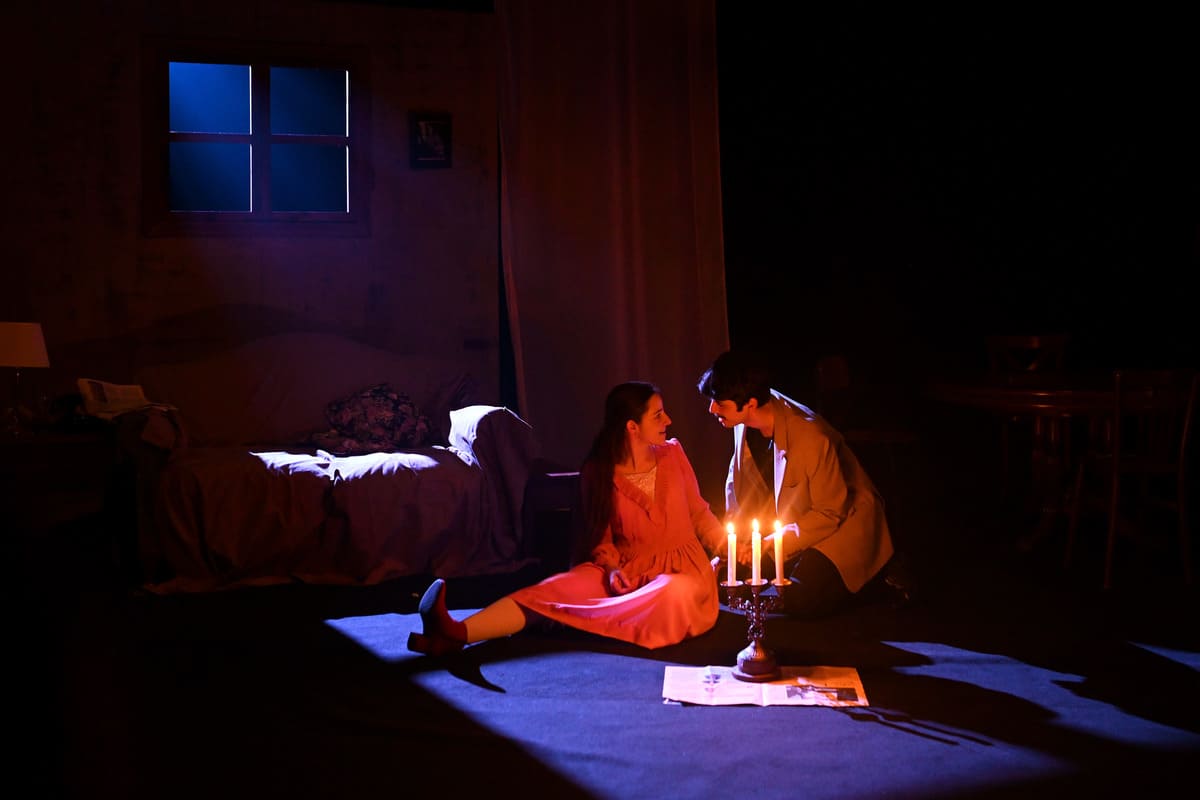
The piano music (very centrally Amapola), along with that of the record player (a variety of nostalgic bittersweetness) sublimates this general, deep, and sharp touching of the soul like acupuncture, which evidently owes its drama to the text, but largely to the careful selection of details with which the "perlas" always treat us. The candelabra light that, at a given moment, takes everything away; the mother's histrionic laugh just after identifying herself in each phone call; the costumes as perfectly set in the 30s as the actors' gestures and poses; Clara's, Laura's, open mouth, looking out the window as if saying what have they done to me, what has life done to me, but what are they doing to me; the simple centrality of the glass figures, the curtain that shakes when the storm arrives, the presentation of the play with a brilliant initial license from the supposed narrator, the street in the background that is there, but isn't, the disappointment, the world collapsing, again the open mouth of poor Clara. Laura.
In short, a formidable staging for an elegant text and a pathetic background, half a portrait of Saint Louis and the era, half a portrait of everything we would be capable of doing to get a family ahead. How cheaply we can give ourselves away, what face despair has, what form a nosedive of the spirit can take. The show displays a delicious and balanced mix between dignity and indignity that, in a simple hour and a half, humanizes the air and the furniture and stones of the Gothic nave. You return home like a glass figure with a broken horn, or with an open mouth, or with an open and broken soul, and feeling lucky not to be able to forgive it ever.
Add The New Barcelona Post as your preferred Google source for free
Stay informed with the latest news.
