[dropcap letter="A"]
ntoni Gaudí, the great architect, was a simple man, a man of the earth. His grandparents made boilers, stills, bells. They came from an ancient tradition of metal casting. And he inherited this wisdom in the treatment of volumes. Because the most important thing about Gaudí is that he reproduced in architectural volumes what was his childhood paradise: nature in its pristine state.
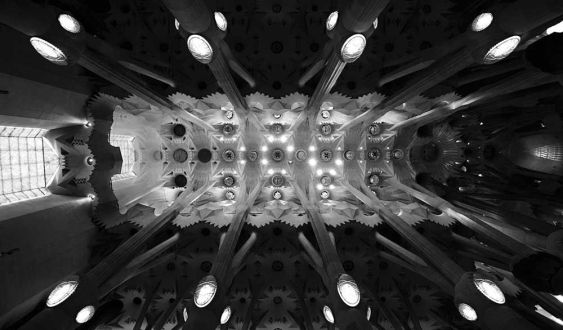
All his work is a marvel. Very plastic, very photogenic. That's why the camera loves him so much. Park Güell, Casa Batlló, La Pedrera, the Sagrada Familia, have prompted millions and millions of photographs. Gaudí's work, if you look closely, is full of well-resolved details, of creative discoveries. "Original –he himself said- is to return to the origin".
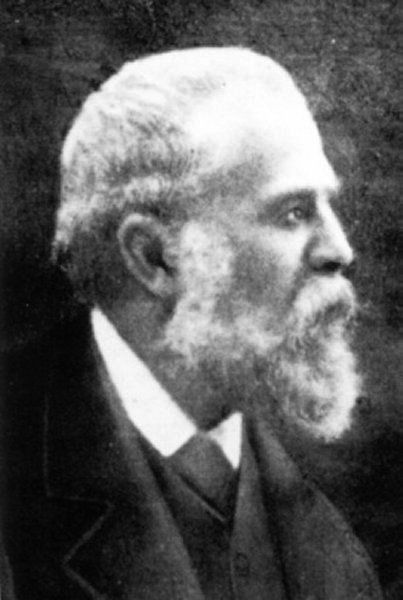
Gaudí mastered not only volumes and forms but also the harmonic relationship between volumes and forms. And numbers, geometry: the old Pythagorean tradition. He defined himself as a geometer. There are links of analogy between "geometry", "generation" and "genius". The Greek prefix "geo" refers us to "Gaea" or Earth -and to its homonym Demeter, the generative goddess par excellence.
In Gaudí's work there are no straight lines because he himself considered that they do not occur in nature. But this may not be entirely accurate. Because the enigmatic crystallizations of minerals underground cannot be ignored. "I am a geometer, which means synthetic" -he himself declared. Or "architecture is the first archi, that is, the first guiding principle".
He is being studied very recently from scientific positivism. But much more than a technician, the architect Gaudí is an artist. He mastered materials like a scientist, transformed them like a creator. Much more than the exact measure of his multiform realizations, we should be interested in his mysterious creative genius, that impulse of the spirit that makes him so special.
Gaudí would not be understood without traditional popular religiosity. Or without the artisanal spirit of his ancestors and his collaborators (the morality of well-done work, common sense, practical sense, the sense of reality as it is). Without this, his meticulous way of doing things, and his full availability as a collaborator of the Almighty in the -human- recreation of His Work, would not be understood.
Gaudí reveres nature and observes the evolutionary process in all its forms, mineral, vegetable or animal. There is in Gaudí the deepest sense of a direct connection between the hands of the artisan and cosmic consciousness. Everything in Gaudí is presented in communion with this transcendent reality. Beyond the accessory aspects, this is what is most decisive in his creative process.
And the light, always the Mediterranean light that, with an inclination of 45 degrees, "gives harmony to the forms -as he himself said-, since it is neither horizontal nor vertical". This light that comes down to us as if from the side of a square is the light that brings nuances, that illuminates the details. While zenithal light, which falls plumb, characteristic of the tropics, gives a world of lights and shadows, of black and white, dual. And boreal light, which comes from the horizon, submerges visible reality in a nebula, in a ghostly confusion.
One could speak of a "Gaudí paradigm": of a way of understanding architecture -and design, and art in general- consisting of seeking -and finding- harmony with nature. And not separating oneself or imposing a point of artificiality on it. Because, to express something in a different, original, innovative way, one must first have perceived something that is not a simple projection of what is already known to us.
To innovate, to renew, to invent (and Gaudí does it constantly) one must place oneself at the zero point of experience, know how to dispense with the interferences of the routine. Not comfortably repeating what is already known but seeking new ways. Isn't that what, above all, the contemporary artist has done? Twentieth-century art cannot be explained without a persistent process of unlearning.
In Barcelona there are splendid examples of the genius of this wonderful architect. All the work of this genius, great architect and at the same time great sculptor, is like an enigmatic forest of images, a labyrinth in which perhaps we can find keys to the knowledge of the most authentic human nature. Because, more than an aesthetic experience, admiring Gaudí's work can also be, as he himself would have wanted, a spiritual experience.
Add The New Barcelona Post as your preferred Google source for free
Stay informed with the latest news.