Torre Bellesguard: The dragon that watches and explains Barcelona
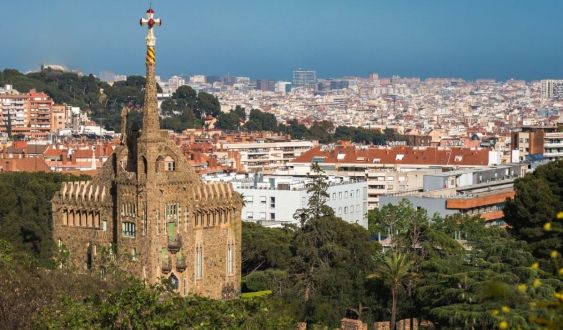
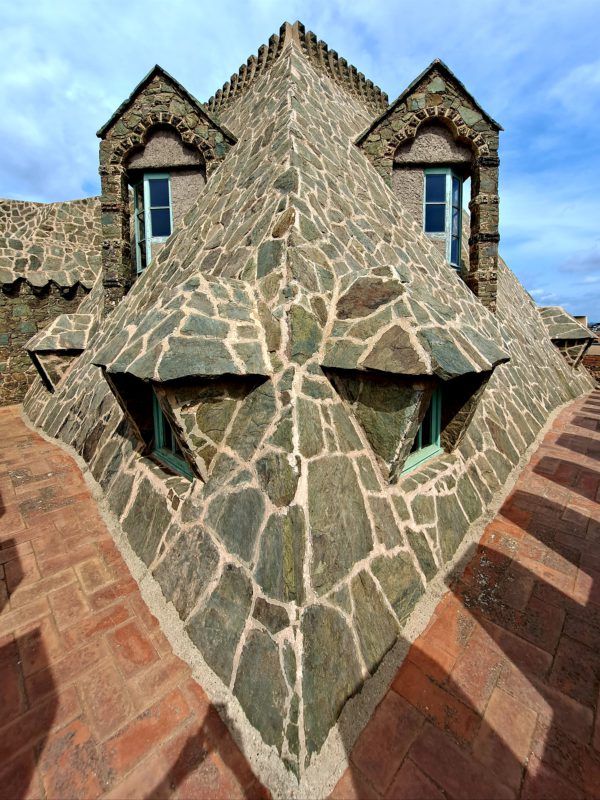
The tour through Gaudí's invisible city begins at Torre Bellesguard, which, true to its name, offers one of the most privileged panoramic views of Barcelona. From the dragon's head that crowns the building —a drawing subtly suggested thanks to its windows— the gaze extends from the Fórum to Montjuïc. The terrace is an almost magical space, from where Gaudí's dragon seems to watch over the entire city. But it is not the only reason that makes Bellesguard an essential place to understand the architect: it is, probably, his most personal work. It is the only building in which the modernist genius worked completely alone, without the help of collaborators, and where his spirit seems to permeate every stone and every detail.
"What makes Gaudí unique?" asks Fernando Garcés, historian and guide of Torre Bellesguard. "Probably his obsession with details." And here, in every stone, in every decorative element, in every line, this genius has left a living testimony of the history of Catalonia. The space where Torre Bellesguard stands —built between 1900 and 1909 by commission of Jaume Figueras— accumulates, no more and no less, 2,000 years of history. The archaeological remains found show that, since the times of the Iberians, this area has always been inhabited.
But the key historical period for the estate and for understanding the details that Gaudí hides in its decoration dates back to medieval times, to the 15th century. Bellesguard was, on the one hand, the residence of King Martí I l'Humà —where the monarch died without descendants— and, on the other, a temporary residence of Benedict XIII, better known as Pope Luna. The death of Martí I without heirs marked a decisive point in the history of Catalonia: after the Compromise of Caspe, the Castilian Fernando de Trastámara was chosen as the new monarch, putting an end to the Catalan dynasty.

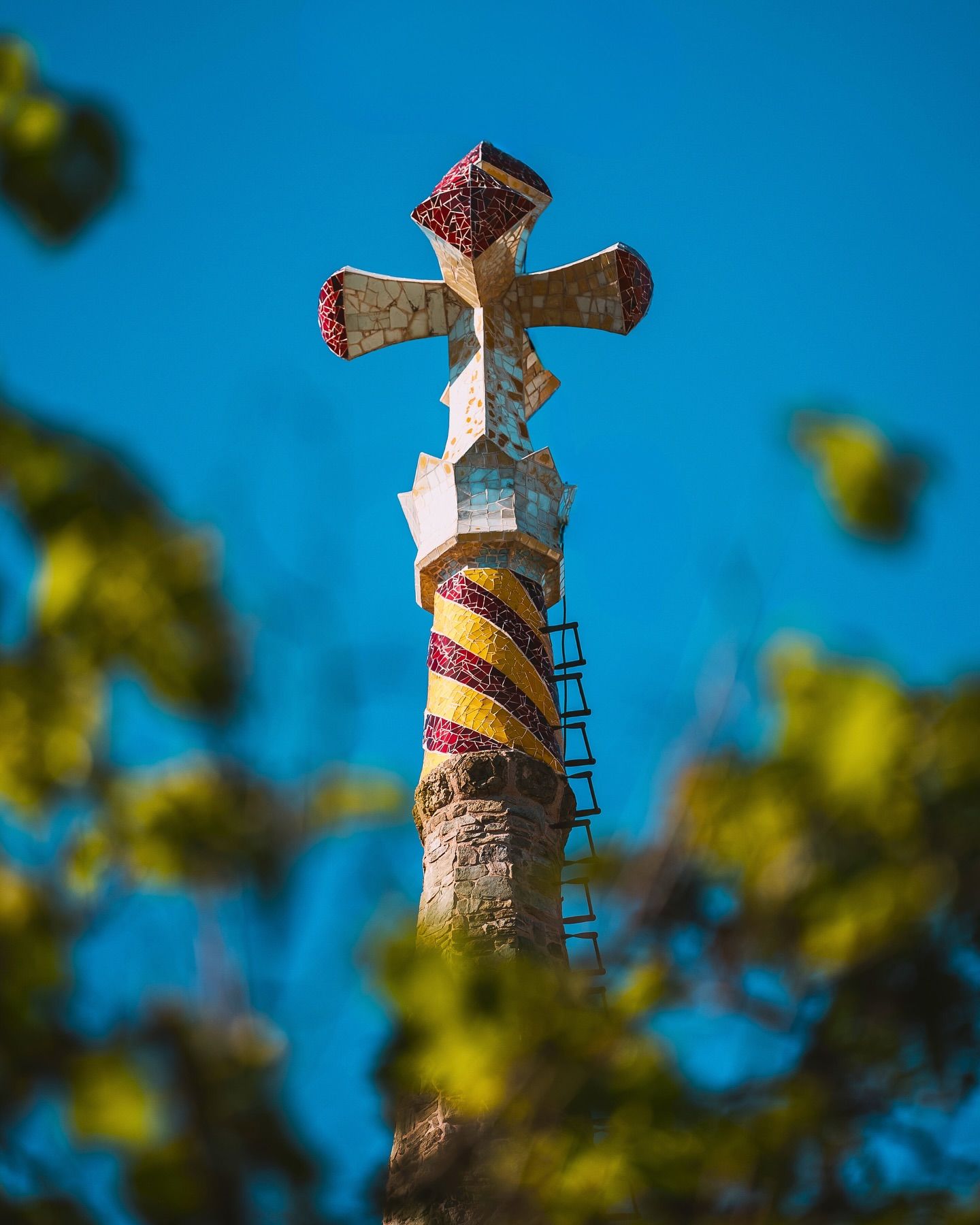
It is precisely this history that the modernist architect explores in the Bellesguard Tower. The building does not hide its medieval past, but rather exposes it and dialogues with it, preserving medieval vestiges in the courtyard, as well as giving the tower a sober medieval appearance with slate as the main material. At the same time, it renders homage to Catalonia and its history in every detail. In the mosaics of the benches on the entrance facade, for example, a yellow "M" appears, referring to Martí I l'Humà and his wife, Margarita de Prades, but also to Mary, the Virgin. In Bellesguard, as in all of Gaudí's work, historical and religious symbolism harmoniously merge. Likewise, the tower is crowned with a long pinnacle that incorporates the senyera in a helical shape —a motif that remained hidden during the Francoist era—.
Despite its sober exterior, modernist details flourish inside: a wrought-iron lamp with stained glass illuminates the hall, while the interior mosaics, in addition to those referring to the history of the Crown of Aragon, display floral and geometric motifs. And, naturally, the dragon is not missing: beyond the rooftop, a representation of the legend of Sant Jordi greets visitors with a message full of meaning: "Déu vos guard" (God keep you).
The architectural (and theological) lessons of the genius at the Teresian College
And with this message, Gaudí welcomes and bids us farewell, and the route continues to the Teresian College. At first glance, the building seems discreet, integrated into the routine of the children and families who access it every day to grow and learn. But beyond the lessons taught between classrooms and corridors, the college is, in itself, a master class in architecture and theology: here Gaudí develops techniques and symbolisms that would be essential for his later works.
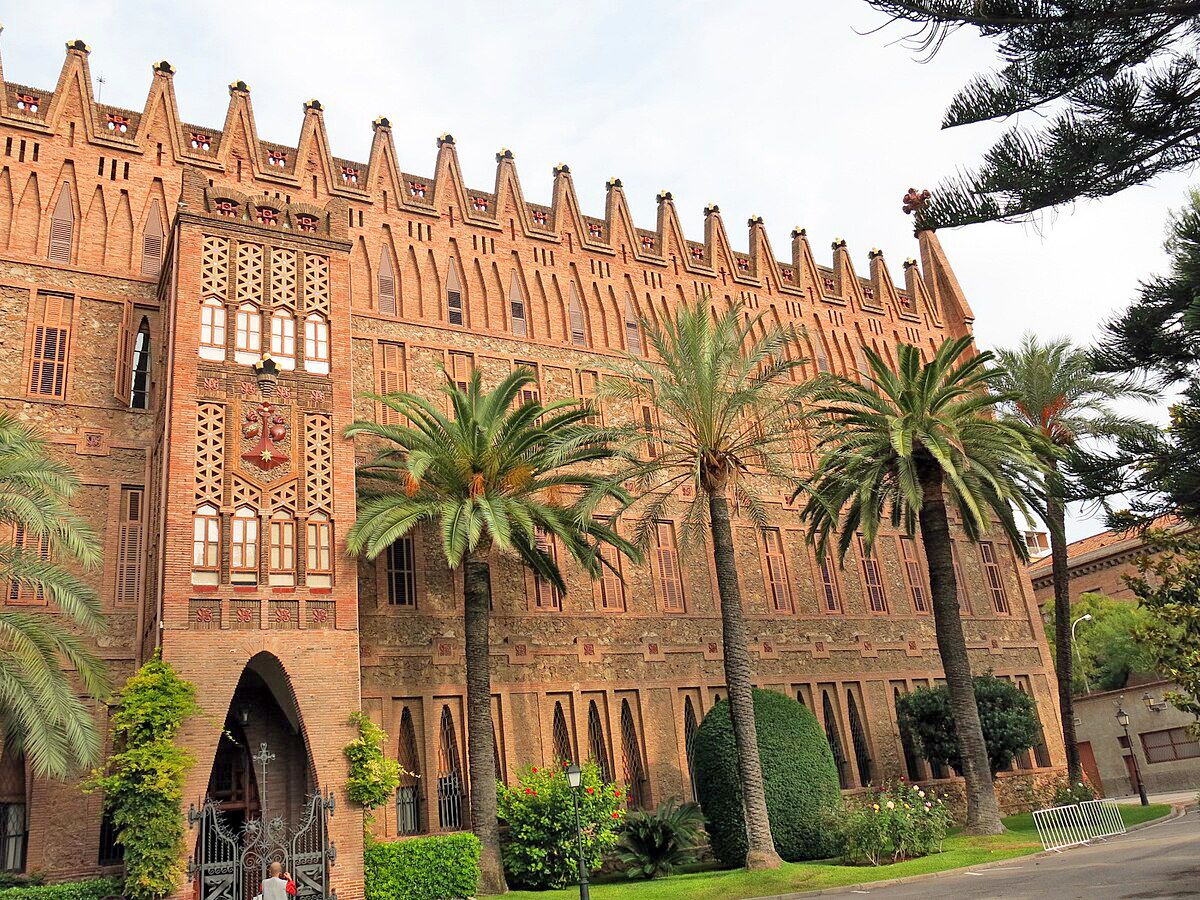
The Teresian College, where Gaudí intervened.
Projected by Gaudí starting in 1888, coinciding with the construction of the crypt of the Sagrada Familia and his consolidation as a recognized architect, the Colegio de las Teresianas starts from an initial project by Joan Pons i Trabal, which the architect transforms into a neo-Gothic castle with a double function: convent and school. Its castle shape, worked with simple materials such as brick and stone —reflecting the Teresian nuns' vow of poverty— has a deeply theological meaning. It is inspired by The Interior Castle, by Saint Teresa of Jesus, which describes the soul as an interior castle guided by God on its journey towards the spiritual center.
The long, secluded corridors invite introspection, while natural light floods every corner of the building, because, according to Gaudí himself, "glory is light; light gives joy, and joy is the happiness of the spirit." Light is God, and, therefore, it must pass through the entire convent, conceived as a cloister with an interior garden. This white space constantly changes according to the influence of daylight, and it is where Gaudí applies parabolic arches, a revolutionary load-bearing system that eliminates the need for pillars and columns, and which he had already experimented with in the Cooperativa La Obrera Mataronense, perfecting it in later works such as Casa Batlló.
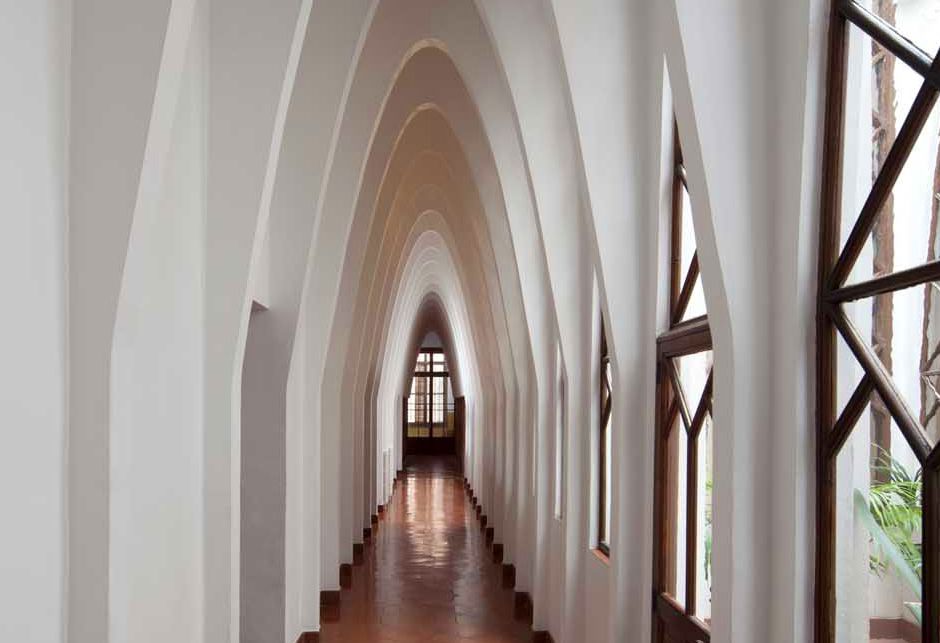
The interior cloister of the Colegio de las Teresianas, where Gaudí applies the technique of parabolic arches.
In the heart of this "interior castle", a forest of white and brick columns converges in an apparently unfinished column, currently crowned by a sculpture of Christ, added later. But this seemingly unfinished column hides a theological message: everyone can find God according to their own perspective and conviction, without the need to define His image.
Another of the most iconic elements of the building are the four-armed crosses, visible on the corner towers and in various details of the facade. Beyond their function as a religious symbol —with the cypress flower representing resurrection—, the cross is also an architectural seed: Gaudí explores here its symbolic and structural strength, which he would later reuse in so many other works. In the Sagrada Familia, for example, the four-armed cross of the Tower of Jesus will allow the temple to become the tallest religious building in Europe. All these details remain hidden in a building closed to the public due to its function as a convent and school, but this route reveals them, showing the seed of Gaudí's architectural talent.

Güell Pavilions: an ode to literature and nature
If Bellesguard is an open book of history and the Teresian College is one of theology, the Güell Pavilions are, without a doubt, a tribute to literature and the Renaixença.And, above all, to Jacint Verdaguer. Built between 1884 and 1887, they represent Eusebi Güell's first major commission to Gaudí, a key patron who would mark the architect's entire subsequent career. In this space, not only is a style consolidated, but a relationship of trust and complicity is established that would allow Gaudí to explore ideas and forms thatlater they would define works such as Parc Güell, Casa Batlló or Palau Güell.This is, perhaps, the least known period of Gaudí's life: far from the classic image with a beard and thick jacket, the young architect appears asan authentic dandy,frequenting the Liceu, moving among intellectuals like Verdaguer —whom he met thanks to the Güell family— and smoking cigars as a symbol of elegance. In this period, Güell commissioned him to build his summer house, full of amenities, where Gaudí developedan architectural language that already anticipates the architect's extraordinary modernist universe.
The most emblematic element of these pavilions is the carriage gate, presided over by an imposing wrought iron dragon with its mouth wide open. This figure represents Ladon, the guardian dragon of the Garden of the Hesperides, which Jacint Verdaguer narrates in the poem L'Atlàntida. The dragon's posture is inspired by the constellation Draco, where, according to legend, Ladon was immortalized for having defended the golden oranges of the garden.
But not only the dragon captures attention: the gatekeeper's house —the only pavilion restored and visitable on this new guided route— reveals essential elements to understand Gaudí's architectural language. Its roof is covered with an incipient trencadís technique, key in modernist work, which the architect invents to be able to work mosaic on curved surfaces. In fact, the Güell pavilions are not only a school of Gaudí's artistic language, but also the place where the Gaudí Chair of the UPC begins, which today leads the activities of the Gaudí Year, in homage to the centenary of the genius's death.

Flowers, dragons and ornamentation throughout the city
Beyond these emblematic works, Gaudí left his mark in unexpected corners of Barcelona, even in buildings that were never built —such as the fountain in Plaza Catalunya, which the new immersive exhibition created by MediaPro for the Gaudí Year will allow us to discover— or that have not been preserved.Following the dragon's gaze, from the animal that watches over the city from the Bellesguard Tower, one can reach the heart of the Palau Reial, where this mythological being, built in wrought iron, is the protagonist of the so-called Hercules Fountain. But in the Catalan capital it is possible to find Gaudí's legacy even looking at the sky: in the lampposts of Plaça Reial and Pla de Palau,designed when he had barely graduated, where essential characteristics of his language already appear, such as vegetal and floral ornamentation with ivy leaves. Two snakes and a winged helmet crown the lampposts, in allusion to the god Mercury, the Roman deity of commerce, an activity with which Barcelona identified itself at that time.
These small details, almost hidden among the daily traffic, recall how Gaudí managed to transform the entire city into a living museum of modernism and innovation, where every stone, line, detail, and ray of light conceals a particular symbolism about his vision of the world.
Add The New Barcelona Post as your preferred Google source for free
Stay informed with the latest news.
