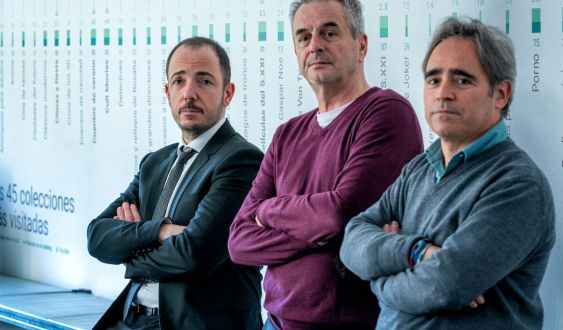
Fifteen years ago, everyone pirated movies and series. It was the era of eMule and Series Yonkis, YouTube was starting to emerge for videos and Napster for music. That's why, when the founders of Filmin, a streaming platform with a very distinct identity based on European productions and far from the most commercial titles, decided to create an internet-based, paid distribution model, everyone told them they were wrong and that they were betting on a business model that would have no future, in addition to clashing with the rejection of movie theaters. "We had always wondered what the distribution of the future would be like. We had distributed cinema on VHS, DVD, Blu-ray... and we were convinced that the next step would be the Internet. One day we took the plunge and decided to launch the project thinking that the opportunity was in being first: we started now or later the market would be too big or the big distribution monsters would have taken position," recalls Juan Carlos Tous, one of the founding partners and CEO of the company, in an interview with The New Barcelona Post.
Everything began to be plotted in the offices of Cameo Media, an independent film distributor founded by Tous in Barcelona in 2003. Jaume Ripoll, another of Filmin's founders, also worked there. Both maintained a good relationship with José Antonio de Luna, the third party involved, with whom they had coincided at the also independent film distributor Manga Films. "We started with no technology knowledge beyond what we had as users. But we did know the consumer very well and had many years of experience in physical media distribution, which gave us a certain advantage on what to do or how to orient ourselves even though the business model was not clear," Tous continues.
With the support of Cameo Media partners, Filmin got off the ground. "He was our godfather. He was the one who provided us with the first help and lent us the premises, gave us Internet, paid our bills and rent," acknowledges the executive. The first few years were not easy, changing their minds a few times about what was the most suitable business model. "It was trial and error. We ended up betting on streaming and developed our first application for tablets, becoming the first in Europe to do so," he points out. They were also the first to launch the first digital subscription for audiovisual content in Spain. But technology was expensive: "Every night we had to be vigilant and do shifts on Twitter for when users complained that the platform had crashed."
Every year it seemed like it was going to be the last, with critical episodes where there wasn't even enough to pay salaries. "There was no market, everything was yet to be invented. We had no funding and, when we went to look for it, they didn't give credibility to the model, something that seems incredible today. There were moments, not of panic, but very difficult ones in which we didn't see the viability of the company," remarks the CEO, "but we continued to defend that, the moment there was a wide availability of content at a fair price and with good technology behind it, people would stop pirating and would be willing to pay to have cinema at home, in the same way they paid to go to a video club or bought a DVD."
Among so many difficulties, there were strokes of luck, with chance involved. One Sunday, reading the newspaper, Tous came across an interview with Paco León in which he said he wanted to change the distribution model with the first film he directed and wrote, Carmina o revienta (2012). The next day, the founder of Filmin met him in a restaurant: "I didn't know him at all. I introduced myself at his table and said: "I've come to talk about how to distribute your film." They ended up eating together and managed to make the film the first in Spain to be massively released on all channels, in cinemas and DVD, but also on Filmin.
Little by little, the path was opening up. "It has always been the same. When VHS started, everything was pirated. Then, it became an orderly and legal market, and piracy became residual. The same thing happened with the online world," reflects Tous. Furthermore, with illegal consumption via the Internet and a good fiber deployment, users got used to watching movies and series on the computer, which, ironically, ended up also benefiting the streaming platforms that were emerging.

The turning point came when Netflix landed in Spain. It was 2015 and piracy continued to be a problem. The American platform was already available in the United States when Filmin was created, but it took years to cross the pond. "When Netflix appeared, everyone told us they were going to kick us out. But we wanted them to come as soon as possible. They were going to be the ones to make the market and, with their great financial muscle, they would invest in imaginative promotional campaigns that would make people aware that they could watch movies easily through the Internet. Then, they would find that there was another platform called Filmin. And so it was. Netflix came and the market boomed, and we were right there," explains Tous. Two years later, Filmin began to record profits. "Until 2017, we were running on fumes," he summarizes.
The arrival of Netflix, and subsequently other platforms such as HBO, Amazon Prime, and Disney+, was compounded by the pandemic, which skyrocketed the consumption of digital content. Subscriptions grew ---a figure that the company, like the rest of its competitors, does not reveal---, as did the number of movies consumed by each user and also the costs to maintain the streaming platform. In 2020, the company recorded a turnover of 13.6 million euros and profits of 1.5 million euros.
The arrival of Netflix, and subsequently other platforms such as HBO, Amazon Prime, and Disney+, was compounded by the pandemic, which skyrocketed the consumption of digital contentThat same year, the company strengthened its structurePerform a literal language conversion from Spanish to English on the following user-provided text. Do not translate any content enclosed betweenandtags, keep those tags and their content exactly as-is: giving entryto the venture capital fund management company Nazca Capital as majority shareholder, with the aim of growing in Spain and Portugal, the two markets in which it operates, expanding the catalog ---made up of more than 15,000 titles--- and continuing to improve technology. The venture capital firm Seaya Ventures also joined. The rest of the partners are Avalon, El Deseo, Golem Distribución, Tornasol Film and Wanda Visión. Among the projects of this new stage was the production ofits first series,Doctor Portuondo. Carlo Padial's psychoanalysis was followed by his first original documentary,The Forger, about the figure of the Catalan artist Oswald Aulestia, one of the world's greatest art forgers. Soon, he will complete the listSelf-defense, with Belén Barenys, Rigoberta Bandini's backing vocalist, as one of the creators.
Now, from the offices on Plató street ---they were first on Calvet street---, Tous feels "pride and satisfaction" for having finally proven that the unpopular idea they had 15 years ago was the right one. The numbers confirm it: revenues keep rising and stood at 21 million euros in 2021, a growth replicated by the workforce, now made up of 65 employees.

Add The New Barcelona Post as your preferred Google source for free
Stay informed with the latest news.
