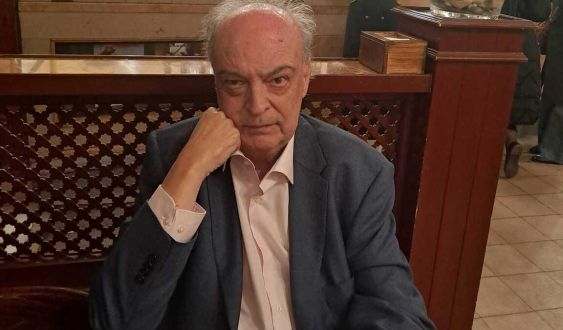
"I combined my Journalism studies with Law, although I didn't want to be a lawyer. One day I accompanied a friend from university to a job interview at Garbo magazine, and there I met Elisenda Nadal, director of Fotogramas. Some time later, in the summer, I ran into Elisenda in some galleries in Platja d'Aro and she told me she was looking for someone to replace Olga Spiegel and asked if I was interested in joining the film magazine. That's how I started professionally dedicating myself to journalism and that saved me from being a lawyer." The writer Enrique Vila-Matas explains this anecdote from when he was 18, and a concatenation of small coincidences led him to embark on a path that has made him one of the most read, applauded, awarded, and translated authors (37 languages, no less) in our literary environment.
"If Elisenda had passed through that gallery in Platja d'Aro five minutes later, everything would have been different," he reasons, savoring a café con leche and a glass of water after having devoured a combo platter, a taste reminiscent of his frequent visits to the city's first American cafés, like the mythical Kansas.
"Disappearance is always present in everything I write because it is equivalent to the act of not being, or ceasing to be, but also to the possibility of being able to appear at any moment," a vision that underpins the shyness that surrounds his person. The desire to be able to disappear, to become invisible when the situation or fears require it, to be and not to be, letting situations pass through a soul and body capable of volatilizing and rematerializing at the opportune moment. If there is one.
The same shyness for which he drank for many years in his "attempt to exhaust the night of Barcelona" until, in 2006, "after having more than exhausted it," he banished spirits from his daily life. And he quotes Francis Scott Fitzgerald, "who, when he stopped drinking, became shy."
"I change a lot and, at the same time, I always seem the same," he asserts when defining himself. He thinks for a few moments and then smiles: "this could be one of those versatile answers that Johan Cruyff always gave." He sips some more café con leche and declares: "in fact, Cruyff and Bob Dylan are, for me, the two great contemporary geniuses."
The writer who was always there
More than proud, the parishioner shows himself "pleased to have survived fifty years in the writing profession, never being a best-seller, but very constant." His latest work, Montevideo (Seix Barral), marks his new step on the shelves for a loyal and wide legion of readers, after the delicate kidney transplant he underwent a year ago.
The new step of an author ---of works such as Bartleby y compañía, El viaje vertical, Suicidios ejemplares, El mal de Montano, Hijos sin hijos, París no se acaba nunca, Mac y su contratiempo or Dublinesca ---who has never stopped casting his vision of the world onto hundreds of pages that reflect and capture the complex and changing world ---interior and exterior--- through which he moves.
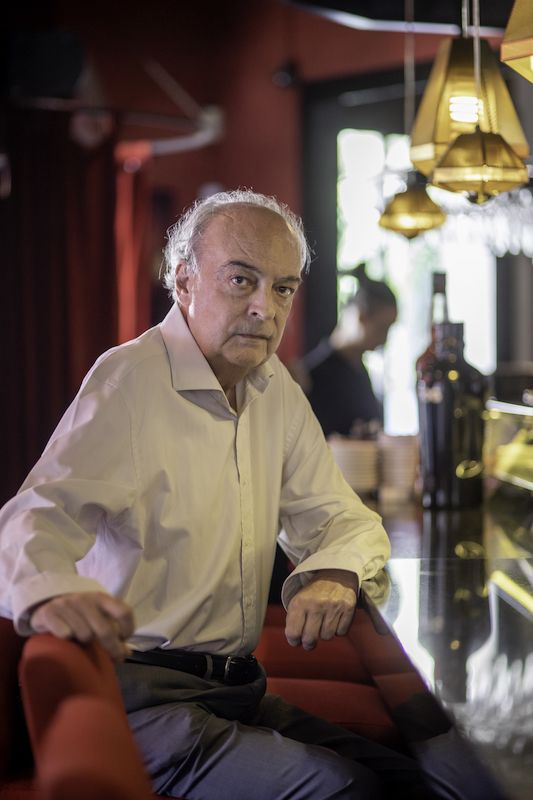
Two attempts in cinema stand out in the form of short films: Todos los jóvenes tristes, from 1969, and Fin de verano, shot in Cadaqués in 1970, with cinematography by Xavier Miserachs and starring Luis Ciges. Both, produced by Enrique's father who, after corroborating that the second was an attack on the family institution, turned off the tap. "Influenced by Pasolini's Teorema, Fin de verano competed in the official section of the Benalmádena Festival, coming in second to last," he laughs.
Returning to the present, writer Enrique Vila-Matas assures that his latest work is doing very well, "with ten translations already underway" and anticipates that he is already working on his next book, while, after the pauses typical of the pandemic and the recent surgical intervention, he has gladly resumed "traveling to give talks and conferences in various cities."
The Barcelonian who does not love Gaudí
The parishioner's relationship with Barcelona is one of "great identification with this city I always wanted to escape from," with the particularity that he is not, let's say, a devotee of Gaudí's figure.
"It has always been said that I don't like him, but what I don't like is the myth created around him. It's not that his Modernism thrills me either. In fact, I always say that I like Paris because it doesn't have Gaudí's works," he looks around, with the same expression of a kid who has just shot his slingshot at an unfriendly shopkeeper's window. And he recalls an occasion when he joked with a French journalist about being a descendant of the tram driver who ran over the brilliant architect. "Some believed it and still, in some biographical texts about me published in France, that detail appears." For the sake of not spoiling a nice story and not killing the illusion, the writer doesn't do much to rectify it either.
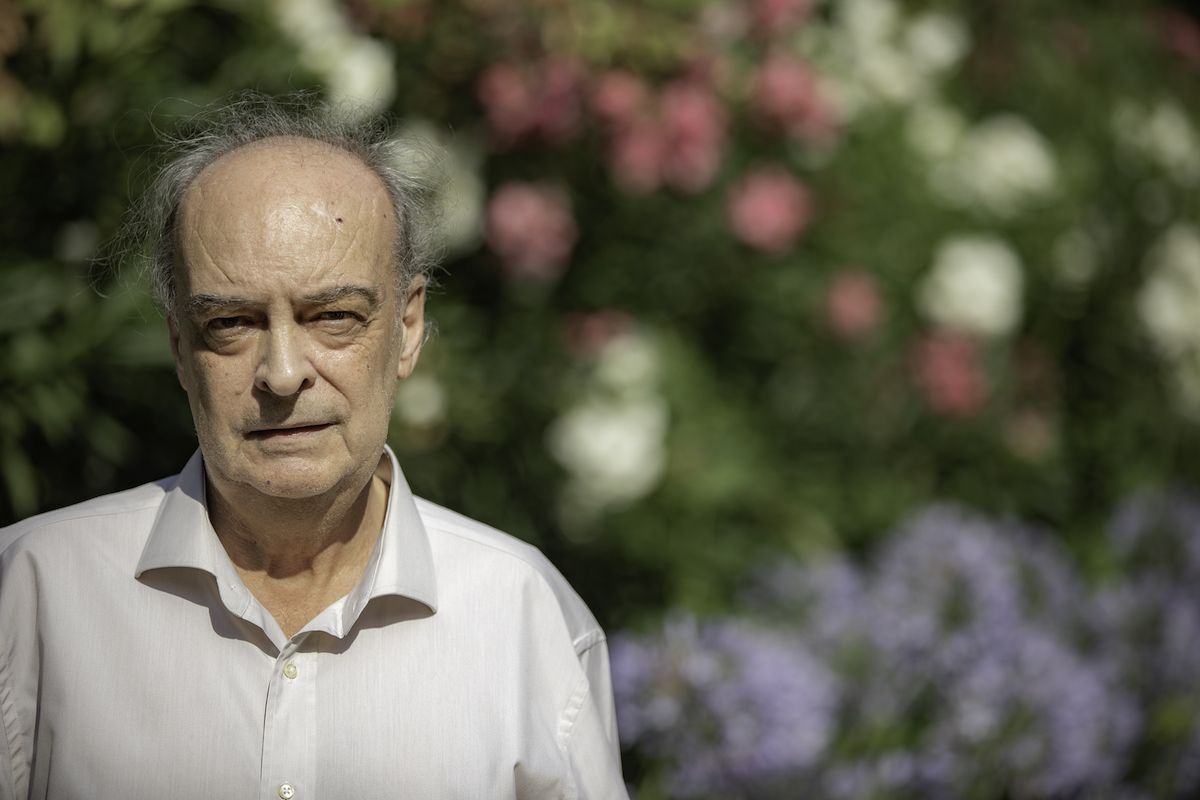
In his relationship with the city, he cites a very special moment for him, when in 2001 he received the Ciutat de Barcelona award for what is possibly his most widely read work, Bartleby y compañía. "It was an award that truly moved me, because of my connection and my family's connection with the city".
---This was the first of many awards you have received since, right?
---Well, actually it was the second. The first had been an essay prize given to me by the Marist Brothers of Paseo de Sant Joan, where I studied, when I was a teenager.
---You were already showing promise then, huh?
Enrique Vila-Matas finishes his café con leche and his smile intensifies, confessing that he received that award "because, as I later found out, I had been the only student to participate."
---No way!
---Yes, yes, and I still keep the trophy, believe it or not---, he continues to smile.
Add The New Barcelona Post as your preferred Google source for free
Stay informed with the latest news.
