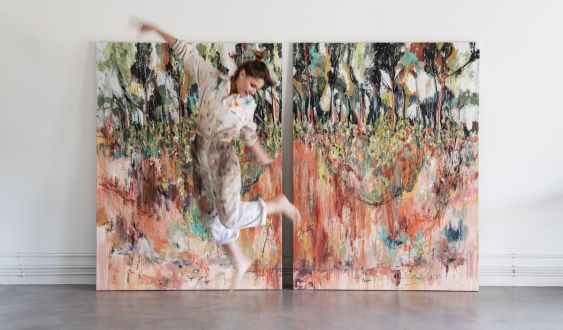
Throughout art history, women have been relegated to the role of muses and rarely recognized in their role as artists. When thinking of women artists, we still struggle to name more than a couple. An invisibility that Juno House, the social club for women, proposes to reverse with its new initiative Beyond Art. The project seeks to empower and promote female artistic talent, becoming a space that not only makes the works of women creators visible but also manages to project them internationally. The initiative kicks off with the exhibition Roots and Mud: Dialogues with Nature, the first abstract collection by Joana Santamans, which can be visited at the social club until May 26.
"We are so used to men occupying all positions of power that we don't even question it. In the art world, exactly the same thing happens; the lack of female role models diminishes us, and furthermore, the great gallery owners, those who decide what and where is exhibited, are still men," laments Santamans. The figures are clear: only 28% of solo exhibitions in museums and galleries in Spain are created by women artists. "Beyond Art is a natural evolution of Juno House; if we foster networking and female empowerment, we must also be a space that serves as a springboard and catalyst for the projection of artistic and cultural initiatives made by women," defends Natalie Batlle, its co-founder and CEO.
The Beyond Art project opens with Santamans' new exhibition, a collection of nine large-format oil paintings where the artist, until now recognized for her illustrations and figurative paintings of animals and nature, embarks on a path towards abstraction. Santamans acknowledges that she felt an inner voice encouraging her to try this new artistic language, moving away from more figurative painting, also inspired by abstract expressionist artists such as Helen Frankenthaler or Joan Mitchell. "This new stage represents a radical change in my career, but I have felt it as a very natural process, in which I have liberated my own nature, letting my intuition speak and the stroke flow, enjoying the process and not being so focused on a specific aesthetic result," acknowledges the artist.
Based in a small town in Empordà, the natural landscapes she walks through daily continue to be her source of inspiration, even though the language has become abstract. The brushstrokes reflect these lived and perceived landscapes, from the texture of the earth to the pulse of nature's invisible roots, roots that are, for the artist, a metaphor for her subconscious and inner voice. "Nature has been and continues to be the heart of my work, but if before I let the forms of nature penetrate me to paint them, now I establish a dialogue between these natural forms and my own voice," expresses Santamans.
Inspired by the dance of the five rhythms, which is defined by dancing with five very distinct rhythmic waves ---from calm to frantic rhythm---, the artist identifies her creative process as a dance, where the paint strokes flow in the same way that dance steps do. "It's quite hard for me to get into the creative process, but once I start I can't stop and my hands dance, to the rhythm of the strokes," confesses Santamans.
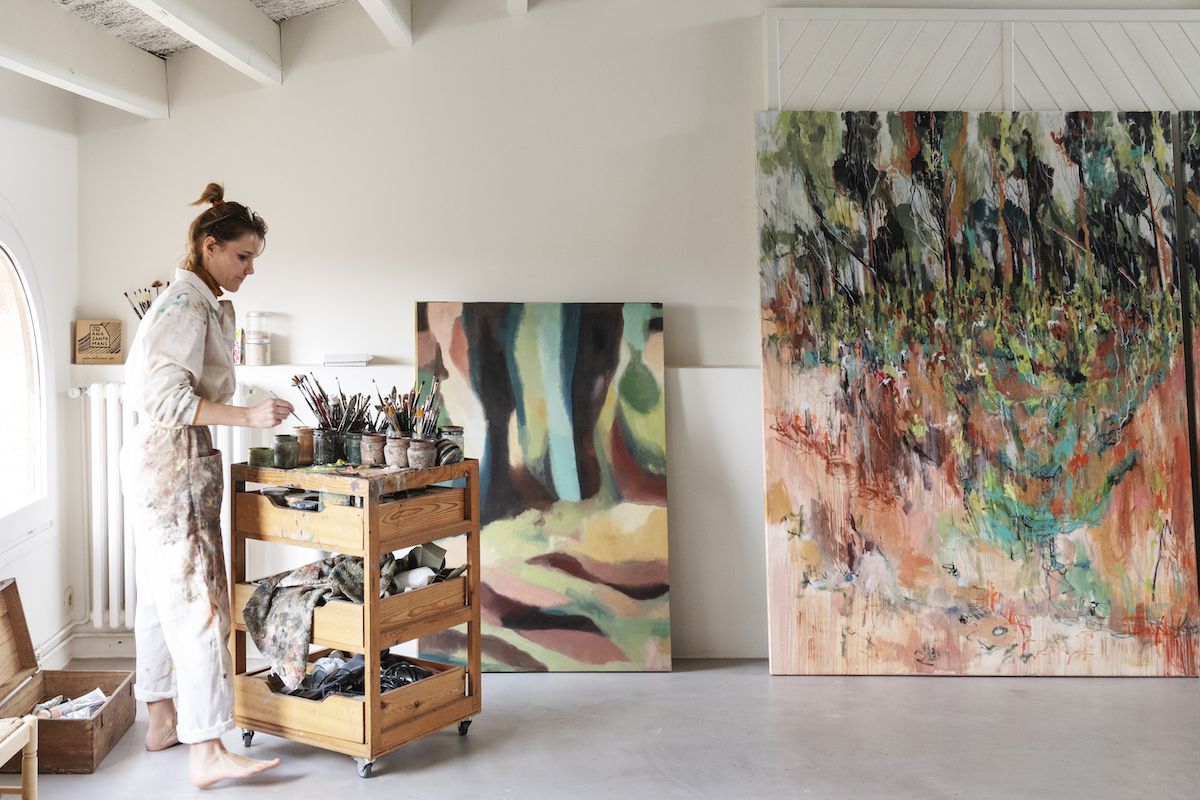
Roots and Mud therefore represents a change in Santamans' trajectory who, although she will not completely abandon her illustrations and commissions ---and is already preparing the third volume of her illustrated book Life, now focused on mammals---, wants to open up to a new market, that of contemporary abstract art. "All the commercial machinery I had sown over these years will need to be updated," acknowledges the artist, who feels the need to connect with new galleries and professionals who fit her new plastic language.
The purpose of Juno House's Beyond Art is precisely that the social club can also serve as a showcase to disseminate the work internationally, as the purpose is to organize events involving renowned gallerists or specialists in the sector. In fact, the inauguration event of this new exhibition featured personalities such as Khadija Hamdi, international gallerist, and Maria Bernat, art director of Casa Batlló.
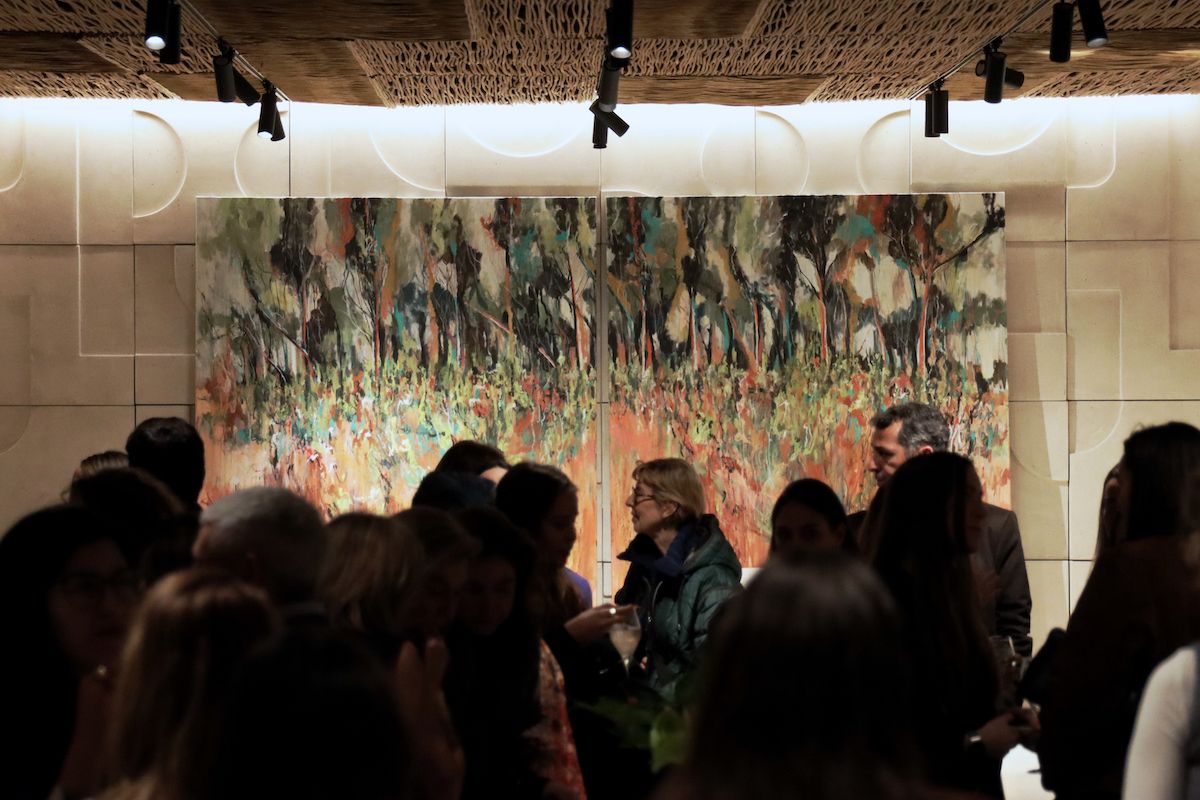
In addition, the initiative also wants to inspire its members to be aware that "being a woman artist, and even a mother, is possible," says Santamans. "For artists, linking up with a project like Juno House is also linking up with values of entrepreneurship and female resilience," says Batlle. Values that she believes are expressed in this new collection by Santamans, which for Batlle represents "the resilience of the force of nature and, consequently, of the force of women."
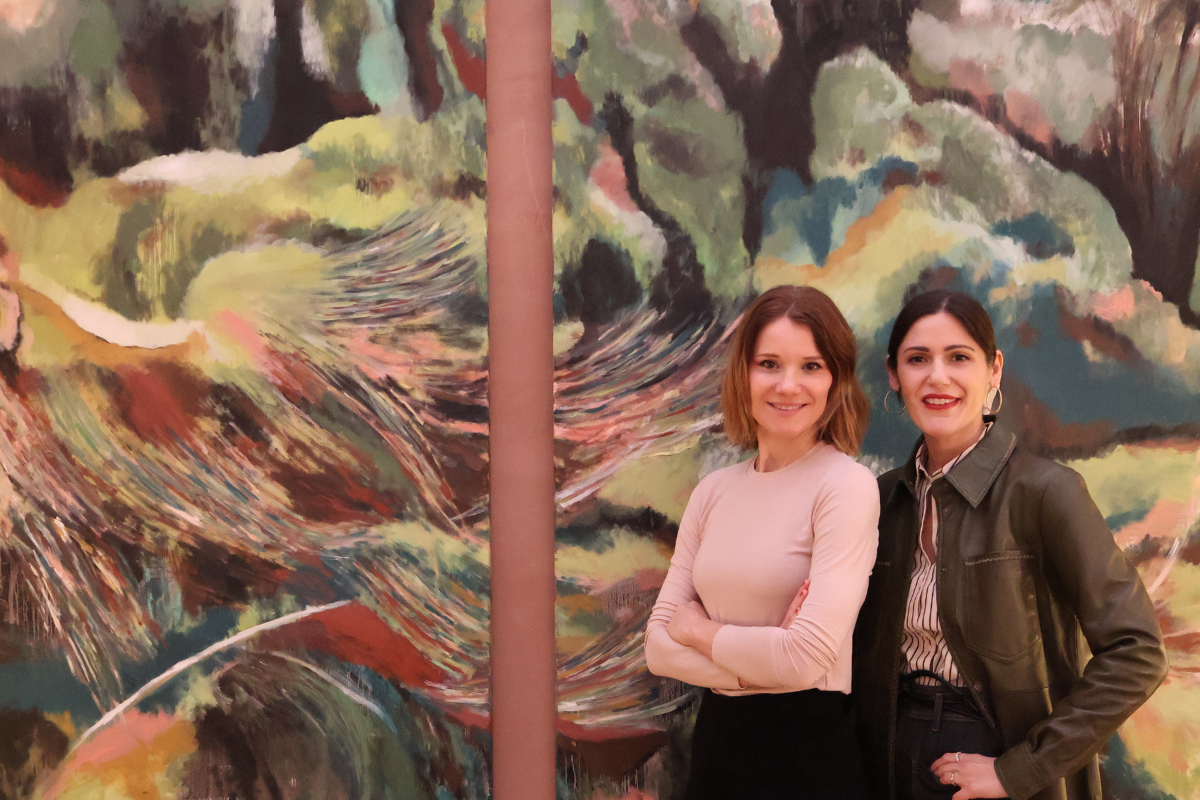
Juno House's purpose is to host at least two artistic exhibitions a year with the Beyond Art initiative, which not only wants to have representation of plastic artists, as in this first exhibition by Santamans, but also to open up to other disciplines such as sculpture, writing or even music. All with a clear objective: to bring together two forms of entrepreneurship, artistic and business, which the social club understands as complementary. Throughout its trajectory, Juno House has promoted initiatives such as the jewelry brand Hanan Moser or the ceramic studio Ash Barcelona.
With more than 600 members in Barcelona, where the social club opened three years ago in the iconic La Farinera de Aribau building, its purpose for 2025 is to expand its events and programs, with initiatives such as Beyond Art, but also with events related to entrepreneurship, banking or geopolitics, a plurality of events that, according to Batlle, reflects the "diversity of our community," according to Batlle. In addition, Juno House is also studying the possibility of opening a second house in other cities such as Madrid, where they will have a presence in the form of a pop-up at the end of March, or even in more distant cities.
Add The New Barcelona Post as your preferred Google source for free
Stay informed with the latest news.
