
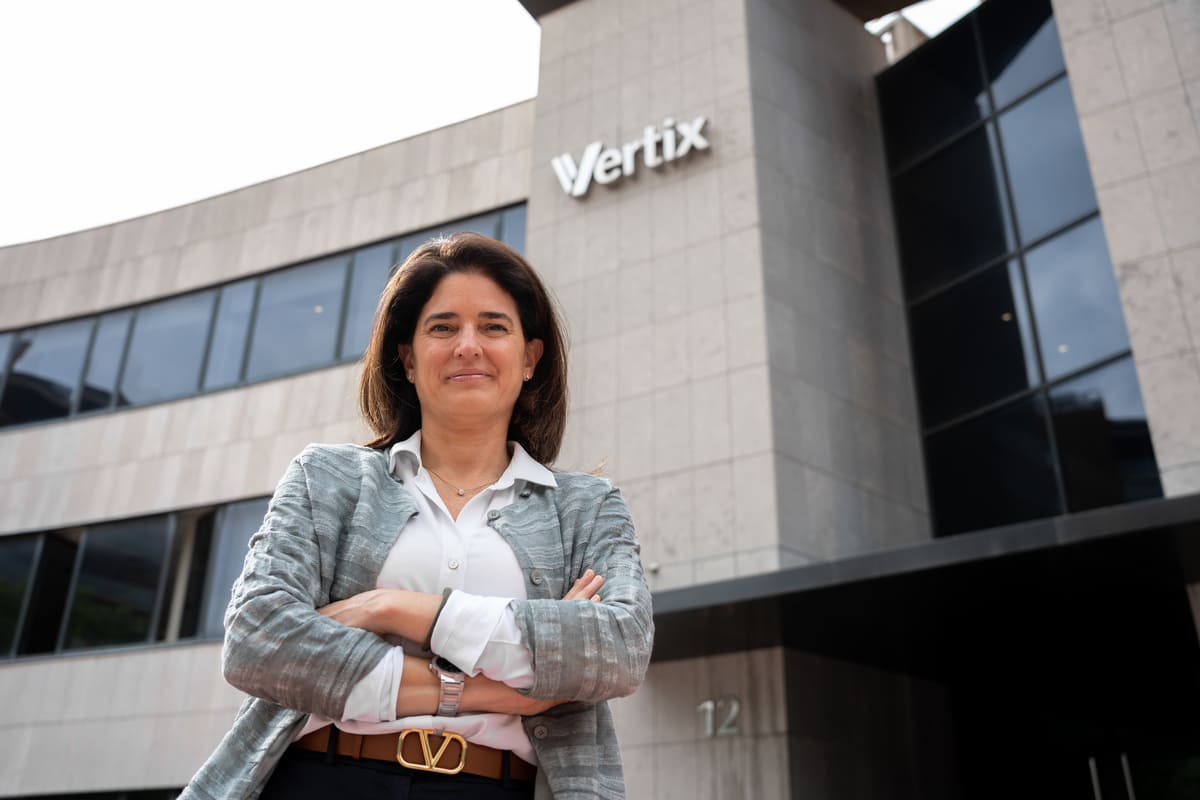
Elena Massot is the CEO of Vertix. The family business dedicated to the real estate world that her father Felip Massot founded more than fifty years ago. In fact, she explains that her father is her professional and personal role model. From a very young age, she found her vocation for business management at home. Without pressure and with a positive attitude.
The housing problem? In three points: political will, management, and resources. The administration problem? In three verbs: to serve, to facilitate, and to help.
Elena Massot is also the first vice-president of the Association of Developers of Catalonia (APCE), former president of Femcat, and is part of the Cambra, Òmnium, or Grup Set. "Self-demand is very feminine, but we have to overcome fear and take a step forward in the business and institutional world," she explains.
A dream? "To spend time in Italy studying Art History."
--- Why did you study Business Administration and Law?
--- As a child, I didn't have any clear vocation, but I had lived the family business from a very young age. I liked management and it was my natural path. I started Business Administration at IQS in the early 90s and my father recommended that I work while studying. I also studied Law at the UB and the UOC. I am very happy to have studied at all three universities: private, public, and distance learning.
--- What memories do you have of the family business?
--- As a child, I used to come to Vertix and had a blast. My parents were separated and Saturdays were also working days. A very human business life from which I have very good memories. I remember as if it were yesterday the first summer I worked. My mother told me to do typing and now I type at full speed.
--- "Connecting the dots," as Steve Jobs used to say.
--- During the first summer I worked, I made private contracts for clients, putting name, ID, address, entity, or form of payment with carbon paper. I also bought lunch for the administration department.
--- A working adolescence too.
--- The role of internships and undertaking in a tutored way within the working world should be allowed from a young age. If it doesn't fall into abuse or child exploitation, I don't understand what problem an adolescent can have with working if they can already do many other things. At my age, it was already done and it's a way of understanding hierarchies or the way of working within the business world.
--- Is Vertix a family business or a business family?
--- It has a very familiar DNA. My father is the founder and Vertix has already turned 53 years old. The pandemic interrupted our 50th celebration. My father says he is retired, but his figure weighs a lot, and so does mine.
--- And the rest of the family?
--- We are four siblings, I am the second and the only one who works in the company. The rest of the structure is very professionalized. I have two children and three nephews and we all have it very clear that this has to reach the next generation, preserving the value to be a solid and solvent company. It is a long-term view.
--- What is it like to work with your father?
--- We have a very good relationship and we understand each other very well. This doesn't happen in all families. I really like the world of management and I have a very structured mind for economic resources, people, and materials. I like it, I have a vocation for the company, but the vocation for housing comes from the company. It's what I've learned since I was very young.
--- Any pressure?
--- We don't have any kind of pressure to deliver results because the family is the shareholder. We don't have a stable production line where we can guarantee results because we have to go through all kinds of authorizations with the administration. You enter a kind of time tunnel...
"Vertix has a very familiar DNA and we don't have any kind of pressure to deliver results because the shareholder is the family"--- Time tunnel?
--- Perhaps you had planned to deliver a work in December, but this means you need a license 18 months in advance and it might end up reaching you 24 months later. It's difficult to manage deliveries this way. If you have a commitment to results in our sector, you can have big problems. We don't suffer from time pressure.
--- There is a serious problem with access to housing.
--- Yes, there has been no serious housing policy in Barcelona, Catalonia, or the Spanish State for the last 40 years. The rest of European countries allocate a significant part of their budget to housing. And now, we want to fix it with laws and decrees.
--- Better late than never?
--- Our references are European countries that were destroyed after World War II and have been building social housing since the 1950s. Here, the scenario was very different. If we want to reach their standards, we have to put in resources, will, and management.
"No serious housing policy has been implemented in Barcelona, Catalonia, or the Spanish State for the last 40 years. Resources, will, and management are lacking, but now we want to fix it with laws and decrees"--- For lack of words it won't be...
--- With the laws that are being made we are not on the right path to fix it. There has been no public policy, there has been a great growth of the population with the arrival of immigration, the real estate sector suffered a lot with the economic crisis and now, the people who have come have more difficulties, less education, lower paid jobs and social needs that the country is not in a position to provide. Access to housing cannot be solved without public policies.
--- What kind of public policies?
--- Decrees, laws... A National Housing Plan is needed. Now, any limitation of supply goes against solving the problem. From the Association of Promoters of Catalunya we defend that the housing supply must be increased because sale and rental prices are under pressure. The supply of new construction is ridiculous.
--- What do the data say?
--- In 2013 there was the minimum historical production around 3,000 units, while the cruising speed should be close to 25,000 units per year. We have been too far away for too long. Last year it was between 14,000 and 15,000 units. We are well below 2007. There are no apartments to offer and demand cannot be met. In fact, there are apartments that are rented in a matter of minutes or hours.
--- Vertix has also entered the hotel management business. Is tourism a source of wealth or a problem?
--- It is worth taking care of the significant sources of GDP generation that we have. The tourism model we want is another thing. That the first merit of a mayoress is to get rid of the Four Seasons... It was a good option to generate higher salaries and provide higher services. Now, we have a luxury apartment building, but we complain that low cost tourism we don't like. Where are we?
--- Where are we?
--- We have to define what we want, make a commitment to a tourism model and promote businesses, activities, infrastructures, services...
--- How do you see Barcelona?
--- Barcelona has spectacular potential. I went to the concert of Elton John and of Coldplay. Seeing the Olympic Stadium like that is amazing. However, Montjuic is destroyed and a mess… And all the Barça people are still missing. We do not take care of our city and we have to show the beautiful Barcelona. Despite the drift of recent years, we are capable of attracting events, foreign public, and investments. If we all went together, Barcelona would be unstoppable.
"Despite the drift of recent years, Barcelona is capable of attracting events, foreign public, and investments. If we all went together, Barcelona would be unstoppable"--- ¿Together?
--- Public-private collaboration
--- So then, why is it hard to work together?
--- It seems impossible and yet it is the best formula. There are antibodies from the administration and from some political parties. They have to understand that economic activity is the engine that generates resources to be able to make social policies. Inequalities have increased, services are needed, but activity is not encouraged to generate money and pay for it. It’s basic math. Money does not fall from the sky.
--- Is business activity being held back?
--- The administration is an absolute brake and we fall short in denouncing it. It seems like a business outcry, but it is ordinary citizens who suffer the most when doing any procedure. It took me a month to request a certificate of residence. Luckily I was not in a hurry...
"The administration is an absolute brake on business activity and we fall short in denouncing it"--- Things in the Palace go slowly, says the popular saying.
--- In 2019 we took a trip with FemCat to Estonia, which is a benchmark for a digitized country. Wonderful. I recommend any administration official to travel to Estonia and have them explain the XRoad model. They export the technology and the network. The administration is at the service of the citizen who enters their data into the system only once.
--- What is this system like?
--- The system has the information and is available to anyone who needs it. Going to the civil registry here is like going back to the 18th century. By hand and by machine. Surreal. If you have a child in Estonia, the doctor enters all the information and then you receive all the communications. The system tells you everything because all the information is already there to do it. It is political will.
--- Is there a lack of political will here?
--- Here they are very afraid. The Treasury has adopted the digital system because someone decided it. I remember Joan Iglesias saying that the Treasury's computer system is one of the best in Europe and the world. It is possible and you just have to set your mind to it. Estonia is the paradigm of digital identity. Here it's a drama...
--- The pandemic has been a crisis with opportunities.
--- With European funds... I don't know if they are already getting their act together in Madrid, but here we need to digitize like the bread we eat. It is a great complication of life for citizens. People have to take days off to do meaningless paperwork.
"Estonia's administration is at the service of the citizen, but here it's a drama and very scary"--- Holidays due to bureaucracy?
--- The pandemic and teleworking have made it even worse. We are not doing well. Any generation of business activity that needs an administrative permit paralyzes the country's growth. It is a brake that contributes nothing to anyone. For example, a building permit can take between 15 and 24 months, and this means that it takes longer with the paperwork before and after than doing the work and generating activity and employment.
---What are these types of procedures like?
--- Inspections, legalizations, permits... In some municipalities, we take more than two years for a building permit, which is a regulated act. We are not creating or innovating anything; we are just checking that the parameters are correct. Is housing not needed?
--- That seems to be the case...
--- Well, let's put resources. Is social housing not needed? Well, let's put more resources and a fast-track. Solutions instead of obstacles and problems.
--- What role does civil society have to play?
--- Civil society has to demand, but understanding only works when the other side also wants to listen. From FemCat and the employers' associations, we have denounced it actively and passively. We all see it the same way. The administration says yes, but does nothing, so we denounce it. We have to understand where the problems are to move forward all together.
"People who ask for aid go crazy with bureaucratic complexity"--- Where do we start?
--- The president of the third sector, Francina Alsina, often denounces the complexity of requesting aid. This is not a business problem, but a social one. People who ask for aid go crazy with bureaucratic complexity. Digitalization is the solution, although it should not be forgotten that there are people who do not have access to the digital world, either due to tools or knowledge. Administration offices are a disaster and citizens deserve proper attention. That's what we pay taxes for! The administration at the service of the administered.
--- Public servants vs. Civil servants.
--- Joan Iglesias explained that a tax inspector in Australia would help citizens with a friendly tone to pay their taxes and keep everything in order. This is the concept of a public servant. Here we rather have a threatening and demanding civil servant who, if you ask for help, seems annoyed. Their remuneration should be based on objectives, but no one has bothered to think about all of this.
--- Is the entrepreneur the good guy or the bad guy in the movie?
--- It's very easy to put hashtags on entrepreneurs because there are all kinds, from exemplary to fraudulent. This also happens among workers and in any group. In politics, there are also extraordinary people, freeloaders, corrupt individuals, and others who dip their hands into the till.
--- Trouble brews everywhere…
--- It is insulting to say that all entrepreneurs are speculators. The press has a part of responsibility when they magnify bad practices and if they are not true in the end, they rectify it with a small box. There are many such cases in my sector. If we accuse and are wrong, we also have to know how to rectify.
"Entrepreneurs are not heroes, but the work we do must be recognized, and it is insulting to say that we are all speculators"--- To rectify is wise…
--- We entrepreneurs exist to create value that is key for social progress. It makes no sense to discuss whether it is or not for our own benefit because a company, by definition, has to make money. If money is not made, then we are talking about an NGO or the social sector.
--- Being an entrepreneur also involves risks.
--- Entrepreneurs are not heroes, but the work we do must be recognized. We really like to criticize the Ibex-35 or the big companies, but the small ones would not exist without the big ones. Each company brings value at its own scale. We also have a historical problem of size. We are reluctant to mergers, but scale gives you more possibilities and competitive advantages. The company makes and loses money and nobody talks about this. The risk is getting it right and getting it wrong. Nobody always does well.
--- Every moment is a world.
--- A matter of cycles. Sometimes there is a market opportunity, but the risks are competition, geopolitics, macroeconomics... You have to make money now and build up cash for when things go wrong.
--- A bad moment?
--- From 2007 to 2013 when we went through a journey across the desert. The real estate companies that survived the crisis did so because we had resources and cash. We made a lot at the time and thanks to that we were able to keep the company alive, keep the workers, generate activity... Otherwise we would have disappeared. This also needs to be explained and everything must be looked at as a whole and with the perspective of the years.
"From 2007 to 2013 we went through a journey across the desert. You have to make money now and build up cash for when things go wrong"--- Heads or tails? Success or failure?
--- From the media only a generic message arrives and the media landscape is not too balanced. Different messages are needed and everyone should keep the one they like the most.
--- Everyone also reads what they want to read.
--- It's true. However, I look for the discourse in favor of the company in the media and it's very hard for me to find... I read what I don't like because unfortunately I can't find anything I like. It outrages me.
--- Business outrage?
--- Making money should be aspirational, but here the cultural discourse of leveling down has been established. The social elevator has to work and resources must be provided so that people who have less can get wherever they want. This will never happen by limiting the people at the top.
--- Where is the limit?
--- The better things go for the entrepreneur, the better things will go for everyone. What problem do we have with this? It's that simple: let them make a lot of money, let them pay a lot of taxes, and with these taxes let those at the bottom also be at the top. We motivate the culture of effort and meritocracy. We are not doing well if we promote the eternally gifted subsidy because there is no money and we still need more rich people to be able to pay for it. It's a bit absurd.
--- Are companies a good reflection of society?
--- Some are and some aren't. The big challenge for small companies is to survive. When we started talking about the SDGs, the small ones still didn't know what it was, while the big ones already had the pin on. There are model companies, others that are diligent, and others that simply do what they can.
"The better things go for the entrepreneur, the better things will go for everyone. What problem do we have with this?"--- She is the first woman to preside over a business organization in Catalonia.
--- Yes, after that came Mònica Roca, Aurora Catà, and Maite Barrera. Self-demand is very feminine ---"I won't be able to do it or I can't do it"---, but we have to overcome fear. In fact, there are many good women who are better than many of the bosses we've had. We have to believe in ourselves more. We need to value multitasking. Women are neither worse nor better than men.
--- The previous interviewee of Persona a Persona, Salvador Garcia-Ruiz, asks you the following questions: What prevents public-private collaboration in a challenge of the first magnitude such as building social housing?
--- Political will. The Barcelona City Council in collaboration with the AMB created the Metrópolis Barcelona vehicle, which is 50% public-private and has land to build 4,500 homes. The model is not bad, but they have not been able to launch it. In Madrid, they have the Plan Vive and are already laying bricks. In the administration, it seems that money belongs to no one and time does not count. You cannot afford this in the private world because there is a sense of responsibility. In FemCat, we have the common responsibility of paying salaries at the end of the month and, therefore, the rhythms are different. To build social housing, management, political will, and a global vision are needed.
--- The world turns and returns to...
--- Housing will not be solved with a city vision. Each municipality wants to solve the housing problem, but it is impossible from their scale. We need a metropolitan vision and good public transport. People measure distance by time, not kilometers. If Cercanías worked well, there are municipalities that could be a good option to live in due to their quality of life. This was the success of Sant Cugat in the late 90s. We are carrying out actions in Viladecans, El Prat, and Sitges. Let's broaden our perspective.
--- You are always one of the few women in different business associations. What do men and women have to do to reverse this situation?
--- Family burdens continue to weigh heavily on women. A lot of education needs to be done among young people because time is shared. If you want to be part of the institutional world, the hours are what they are. If we want more women, they need to have the peace of mind that there is someone at home who can solve everything. This is exhausting. You have to have a lot of energy. I am a great advocate for female talent, which needs the opportunity to shine, and forgetting it is a luxury we cannot afford as a country. Quotas are a necessary and temporary evil to gain visibility. Women must be an inspiring reference and it is worth taking the step. It is not a complaint, I have been very alone for years and, as there are more women, there will be even more.
"Self-demand is very feminine, but we have to overcome fear and take a step forward in the business and institutional world"--- Are we on the right track?
--- The integration of women into the working world is advancing. I really like the writer Gemma Ruiz and her book Les nostres mares. We come from there and there is still a long way to go. We are advancing fast. Society has become aware that photographs of suits and ties have expired. Personally, I encourage women to accept the challenge of being present. I am in FemCat, the Cambra, Òmnium, Grup Set, Asepeyo... It is most reasonable that everyone is represented.
SEVEN OF LIFE
- Role model: My father, in the professional and especially in the personal sphere.
- Book: Argelagues, a tribute to our grandmothers' generation. Also historical novels.
- Movie: Schindler's List. A display of humanity within horror. History gives us lessons we should not forget.
- Song: Palabras de amor, Joan Manel Serrat.
- Favorite spot: L'Empordà.
- Life motto: Having a positive attitude in everything I do and conveying it to my environment.
- Dream: To do a stay in Italy studying Art History.
Add The New Barcelona Post as your preferred Google source for free
Stay informed with the latest news.
