
Solano County is a Californian county of about 500,000 inhabitants located between San Francisco and Sacramento, traditionally a mining area and currently with a good part of its territory dedicated to crops and wind energy generation. In recent times, however, word had been spreading that an investment group was buying many properties in the area, sometimes using not very orthodox methods. It wasn't until mid-last month that the name of this group became known: California Forever, and that behind it are very important (and millionaire) names from the industry and finance of Silicon Valley. The objective of this land grabbing? To build a new city from scratch for hundreds of thousands of inhabitants, powered by 100% clean energy and managed with the most advanced technologies. Once the plans were revealed, and in the face of the controversy unleashed, the corporation has proposed holding a referendum among the county's population to obtain their approval for this project.
A few months ago, at the presentation of Istanbul's new strategic plan, sociologist and economist Saskia Sassen wondered ---referring especially to the case of the United States--- if it wouldn't make more sense to demolish existing cities and rebuild them, taking advantage of accumulated knowledge on sustainability and social justice. The reason is that many of these cities developed throughout the 20th century following the criteria shown to the world by the Futurama exhibition in 1939 in New York, under the auspices of the automotive industry. In Europe, which faced the last century with a more consolidated urban fabric, the reconstruction and renovation of this fabric after the two world wars also featured prominently the precepts of Le Corbusier's Modern Movement.
It is evident that all cities have evolved and adapted over time to changing environmental and demographic conditions (planning their growth), to political ups and downs (with the need or not for defensive elements such as walls, for example) and, above all, to technological changes that have revolutionized everything from their sanitation to their connectivity, including how food arrives or how people and goods move within them.
All these changes have been superimposed on cities as they were originally planned because, in general, cities have developed from a specific initial morphological proposal: from the grid of Hippodamus of Miletus and its extension throughout the Mediterranean and beyond thanks to Roman camps, to the British New Towns based on the garden city concept and other urban utopias of the era.
The construction of state capitals from scratch has also been a common practice throughout history: Washington D.C., Canberra, Brasilia, or, more recently, Astana are the most significant examples.
Today, in a world considered primarily urban and under the threat of an environmental and climate emergency that increasingly poses challenges to the proper functioning of cities, the need to adapt them to new circumstances becomes more pressing. This is how we see projects everywhere for redensification, for increasing green and blue areas versus gray, and for regenerating urban spaces to make them climatically more neutral, not to mention the volumes of investment in energy rehabilitation planned with the Next Generation EU funds.
But there are also those who entrust the solution to the problems posed by the changing living conditions on the planet to the creation of new cities from scratch, responding to Saskia Sassen's dilemma. In fact, many, more than a hundred currently: according to the 2018 Nobel laureate in Economics Paul Romer, from New York University, we will build more urban areas in the next 100 years than those already existing on Earth. Here are some of the most ambitious projects currently on the table worldwide:
Xiong'an (China)
A city of about 2,000 km2 projected in 2017 to decongest Beijing, in which 85 billion euros have already been invested since then and about 4,000 buildings have been constructed. Chinese President Xi Jinping's purpose is to achieve a combination of cutting-edge technology and ecological respect, while also becoming the economic engine of the capital.
Fujisawa (Japan)
Although with much more modest dimensions (about 1,000 homes), this joint project by the Japanese government and Panasonic, launched in 2011, has also attracted the attention of the urban planning world. The first inhabitants arrived in 2014 and since then all kinds of technologies have been deployed to eliminate environmental impact, while participatory processes have been put in place. However, the fact that the homes are single-family, for example, raises clear questions about the project, an aspect that Woven City, the urban experiment promoted by Toyota also in Japan, seems to have improved.
NEOM (Saudi Arabia)
A futuristic city project that is expected to be a smart and sustainable city powered by cutting-edge technology. It is located on the northwest coast of the Red Sea and is planned as a special economic zone with an emphasis on innovation and sustainability. Its promotion claims that 95% of the natural environment of the area will be respected.
Eko Atlantic (Nigeria)
A new city under development in Lagos, which is being built on an area of land reclaimed from the Atlantic Ocean. It is planned as a solution to the problems of congestion and overcrowding of the old Nigerian capital, which already exceeds 15 million inhabitants, as well as to provide space for commercial and residential development.
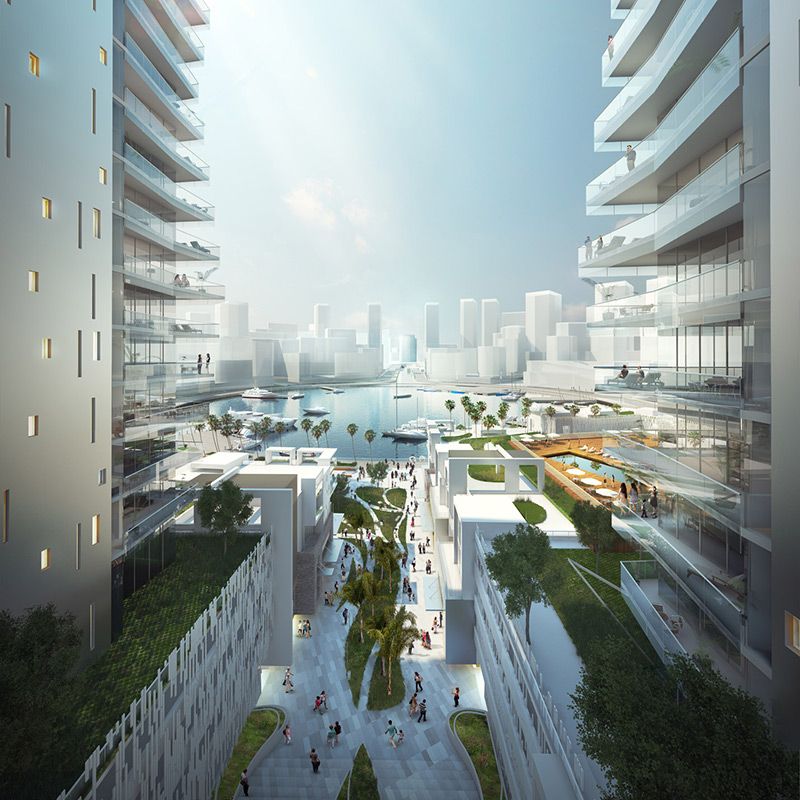
Masdar City (United Arab Emirates)
One of the oldest sustainable new city projects, as it was announced in 2006 as an investment of about 20,000 million euros with the intention of reaching 50,000 inhabitants by 2015 (in 2023 there were about 15,000, of which 5,000 permanent residents). Under the direction of architect Norman Foster's studio, it has been designed as a 100% carbon-free city, with a focus on renewable energy generation, energy efficiency, and sustainable transport.
Today, in a world that is considered primarily urban and under the threat of an environmental and climate emergency that increasingly poses challenges to the proper functioning of cities, the need to adapt them to new circumstances becomes more pressing.Among other projects that can be cataloged as considerably failed, Forest City stands out in Malaysia, a complex of four artificial islands that is currently considered more of a ghost city, having completed only 15% of its development in its 8 years of existence. Or the much-advertised Quayside in Canada, the dream of Google's founders to create the world's first smart city (a title currently highly disputed) as an expansion of Toronto, which lasted between 2018 and 2020. Of course, like so many other projects by big tech companies, nothing prevents it from resurfacing renewed and more determined at any time, especially when more than 2.5 billion euros had already been invested.
In Spain, and beyond certain municipal expansion projects that practically involved building new cities during the real estate exuberance of the early century, with cases like Seseña (Toledo) at the forefront, the trend of new cities is also modestly followed. Currently, there is talk of the Elysium City project, which aims to condense the latest in urban technology and sustainability into 12 km2 of an Extremaduran municipality. A proposal that pits the developing company against environmental groups under the indecisive gaze of the Junta de Extremadura.
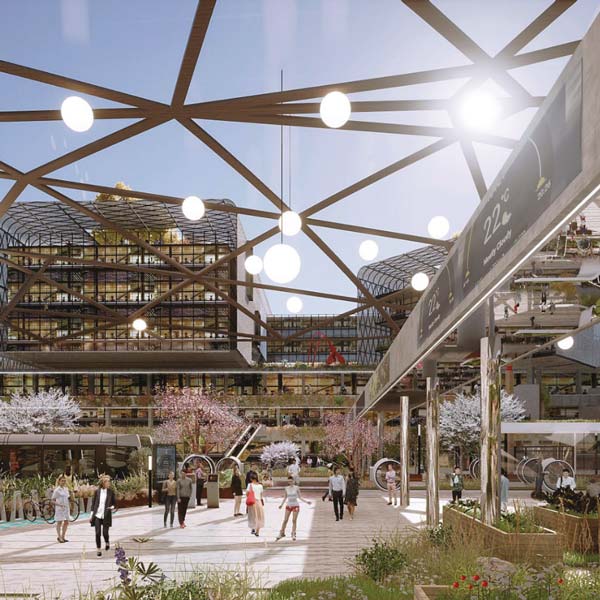
Be that as it may, it seems very difficult that in all these projects, no matter how much they multiply in the coming years at the hands of magnates, large companies, or more or less autocratic governments, we will find the key to solving the great challenges that cities face today. And much less in environments like ours.
On the contrary. In Europe, and particularly in the metropolitan region of Barcelona, we enjoy very high-quality urban fabrics, despite the threat posed in the last third of the 20th century by urban expansion far from the traditional characteristics of the Mediterranean city, which have subsequently been accepted as the most appropriate and which we could synthesize in the very fashionable proposal of the "15-minute city".
That is why it is very important to make the most of this pre-existing urban fabric, and therefore four fundamental premises must be taken into consideration:
- We must understand our city, in all decisions taken regarding our urban future, as the great metropolitan region that it is, as the real city that increasingly plays a leading role in the daily lives of five million people.
- We must urgently equip ourselves with planning instruments that provide adequate criteria for a 21st-century city, not only with the definitive approval of the instrument that must replace the 1976 Metropolitan General Plan for the 36 municipalities of the Barcelona Metropolitan Area, but also by reviewing other plans (such as the 2010 Metropolitan Territorial Plan) to extend these criteria to the rest of the metropolis.
- The highest degree of coordination between administrations, and between these and other economic and social actors, must be activated, so as not to let a single euro of the currently available funds escape to accelerate the necessary transformations (Next Generation EU and others).
- Special emphasis must be placed on those urban spaces that require a greater effort of physical transformation (aging or degraded neighborhoods, urbanizations, etc.) and economic impetus and strengthening of social capital and sense of community, which often coincide with the former, but not always. The development of a new and ambitious neighborhood plan under the law recently approved by the Parliament of Catalonia is essential in this regard.
Add The New Barcelona Post as your preferred Google source for free
Stay informed with the latest news.