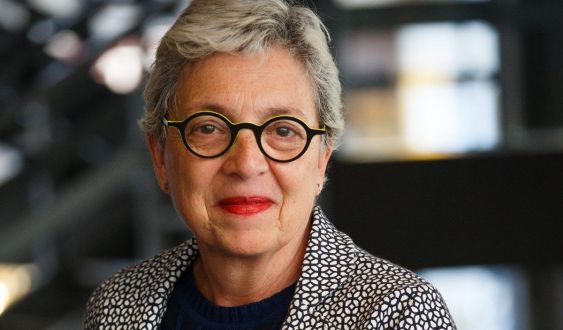
Assumpció Puig (Girona, 1954) became in 2018 the first dean in the history of the College of Architects of Catalonia (COAC) and also the first to hold this position without being from Barcelona. When Puig had to decide what she wanted to be when she grew up, she chose between being a doctor or an architect. "They are very different things, but I understood that both were aimed at society," she explains. As many of her friends studied Medicine, she opted for Architecture, "at a time when there were very few women."
She began her professional career in the 80s, mainly in Girona, although also in the Catalan capital, "a big city where you always end up arriving." With many years of experience behind her, Puig does not regret the decision she made as a young woman between Medicine and Architecture. "I have liked it a lot because each project and each client is different. You always have to be with your eyes open, you always have to be researching and you always have to be up to date with what your colleagues are doing," she explains.
With this need to be alert to know the latest trends and to know what society demands, Puig had always closely followed the work of the COAC. First, as a member of its assembly. Hand in hand with the previous dean, Lluís Comerón, who recently passed away, Puig joined the board of directors. Since then, she has spent 12 years in this institution, of which she became the highest representative in 2018, a mandate that ends this 2022. In an interview with The New Barcelona Post, the dean of the COAC analyzes how the pandemic has affected the sector and what role rehabilitation can play in the recovery through European funds, as well as the prominence that Barcelona will have in 2026 as World Capital of Architecture.
--- The pandemic has marked a before and after, not only for society, but also for the economy. How has this new crisis affected the sector?
--- Since 2008, the sector has been quite flat and has not recovered at all. Therefore, there had not been a great recovery at the time the pandemic locked us all at home. There was a slowdown, even fear, we didn't know where we were going. 2020 was a difficult year, in 2021 we began to recover, but we are still in a situation where there has not been a great recovery. The intervention in the projects we do most ---as architects--- is new construction and housing. Equipment is important, but the fabric of the city is really housing or multi-family buildings, and we see that, since the previous economic crisis, it is not recovering. One year we build 12,000 homes; the next we build 13,000; the following, 13,500... We have to think that we were building 100,000 homes in 2008. I believe that we have changed paradigms, that that will not return and that now we have to adapt because we have to work a lot on what is already built. Therefore, we have to work a lot on the concept of renovation and rehabilitation.
--- From Europe, there is a desire to respond to the crisis caused by covid with European funds, an unprecedented budget to overcome the slump that sets digitalization and sustainability as the objectives to be achieved. Can rehabilitation benefit from these resources?
--- Yes. The built park is giving us an energy efficiency certificate with letters like those on refrigerators. In its case, it is not an A but a D, an E or an F. These letters mean that there are buildings that can improve their envelope with better insulation. Since less cold and heat enter, there is no need to spend so much energy. Therefore, energy efficiency must be sought by working on the building's envelope, which are the facades and roofs, while also achieving a reduction in CO2 in the atmosphere because less fossil fuel is consumed. The Next Generation funds also mention moving towards renewable energies. This path can lead us to a situation of change, perhaps not 100%, but a change towards renewable energies, in the CO2 production of the built park and in the energy efficiency of the building.
--- What types of projects can be seen in Catalonia with the support of the Next Generation funds?
--- There are several lines of work and one of them will allow city councils to carry out comprehensive rehabilitations in neighborhoods. The other day, talking to a mayor, she told me that she had buildings that don't even have a community of owners because people who are very much on the edge live in them. In these cases, the municipality itself can invest, as in the Santa Coloma de Gramenet project, on Pirineus street. It is a project that is already two or three years old in which the City Council carries out the comprehensive rehabilitation of an entire street and, from here, whoever can pay, pays, while whoever cannot, can pay with whatever they can. The Next Generation funds can serve for city councils to take solutions like this to regenerate an urban fabric that is in very bad shape and that at the same time can act as a dynamizer for an entire area. This is one of the most important things: when in places that have a social problem of commercial decay and of the residents themselves, you make a significant investment that empowers and makes the neighborhood proud, the entire environment is also regenerated.
"The Next Generation funds can serve for city councils to take solutions to regenerate an urban fabric that is in very bad shape and that at the same time can act as a dynamizer for an entire area"--- Where else can these resources help?
--- There is a line of work that will be dedicated to building new social rental housing. This is another very necessary issue. Here we had a lot of subsidized housing that has entered the free market and, therefore, has market prices. In contrast, there is a lot of demand, increasingly so, for social rental housing.
--- In this context of promoting the rehabilitation of the built environment to reduce emissions and environmental impact, what can the COAC do?
--- In these four years of mandate, we have been working on the issue of rehabilitation. The COAC's heritage plan has been initiated to update our buildings and also to educate about what we need to incentivize as professionals by doing it in our own home. Not only in the Barcelona headquarters, but in the six buildings we own. We have 11 headquarters, but some are rented. As a profession, we are explaining to citizens the importance of rehabilitation, also of energy efficiency, knowing that the built environment is one of the great consumers of energy and, therefore, also one of the great producers of CO2. We are preaching that these funds can help us a lot to activate the sector, which has not recovered since the 2008 crisis. Rehabilitation can help maintain the fabric we have and, surely, create more. It is a breath of fresh air.
--- And all this, is there any way to bring it closer to the citizens?
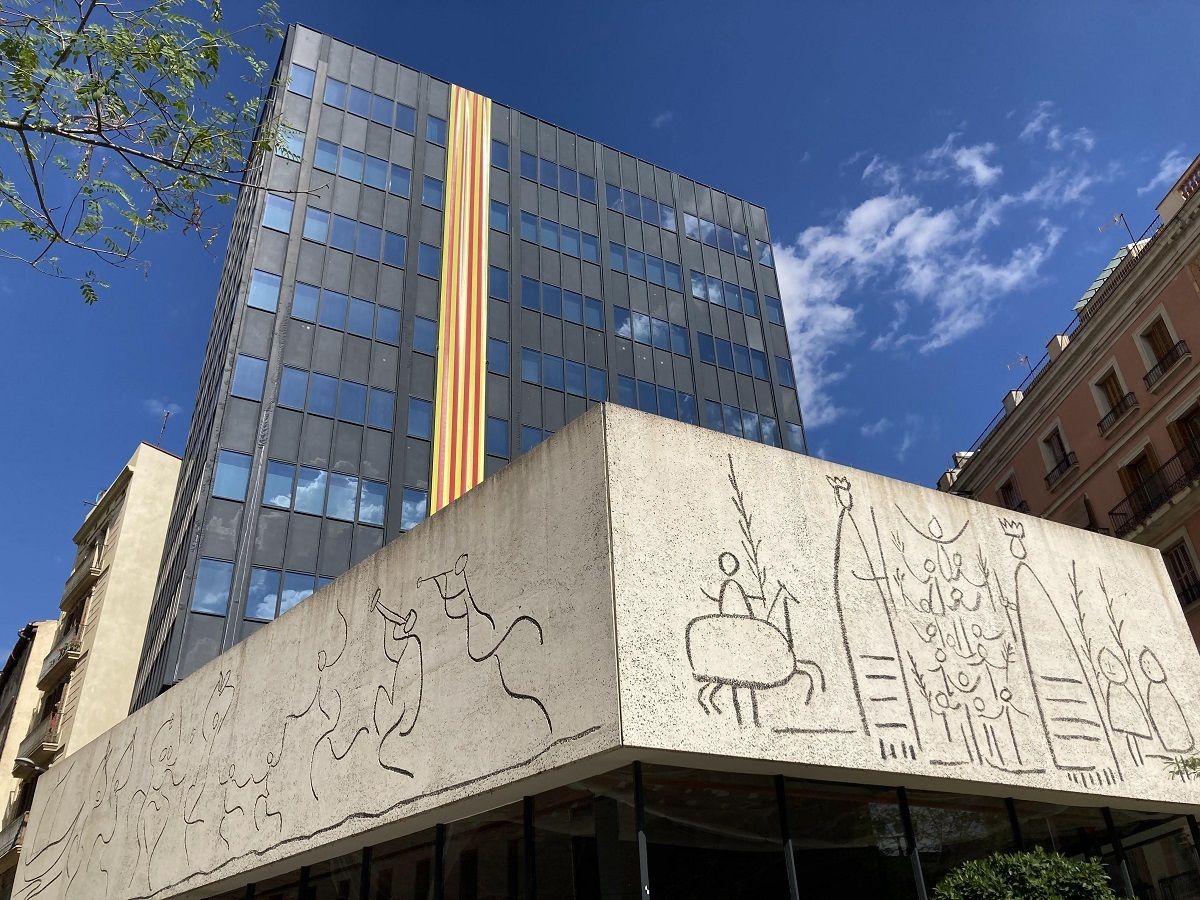
--- In these four years, we have another very interesting project which is the Open Architecture Center. What we want to do is consolidate all the activity we do both in the Historical Archive and in the library, the exhibitions and debates we organize throughout the territory, based on a single program. In Lleida, what is done there is known, and in Barcelona, what is done here. If we do it all together and there is a thematic axis, we will be able to explain the power of all COAC headquarters. We also want to bring debates to society and focus on the things that are good and how we should work on the things we need to improve. We have the ambition to be an international interlocutor. In the same way that there are other architecture centers around the world, we want ours to be another center recognized internationally.
--- There has always been a lot of talk about creating an Architecture Museum in Barcelona. Could the Open Architecture Center be the previous step?
--- I don't know if the Open Architecture Center is a 21st-century museum. I'm not very concerned about calling the Open Architecture Center a museum. What we want is to make Catalan architecture available to citizens, being able to see it from the beginning, with the first drawing and the first sketch, to being able to walk or see the buildings.
"Rehabilitation can help maintain the fabric we have and, surely, create more. It's a breath of fresh air"--- One of the most important dates Barcelona has marked on its calendar is the world capital of Architecture for 2026. What will it mean for the city?
--- A need that, perhaps, had been lost or diluted with the crisis, to put Catalan architecture back on the table with pride. We decided to present the candidacy for the congress of the International Union of Architects (UIA). It had a fantastic result. We competed with Beijing, which seemed to have more possibilities because it was in Asia and the next congress is already being held in Copenhagen. Despite this, our candidacy was the most voted. It is a very interesting project because it has a trajectory until 2026 and it allows us to have works on architecture within the city every year that can leave a mark.
--- What will this translate into?
--- We are finalizing it. It was already said that we will hold the Architecture Festival in May every year. It will consist of providing the Architecture Week with more content, with international debates or ephemeral interventions in the street. And some will not be so ephemeral. We will try to work together with all the fabric around architecture to leave a mark on the city during these festivals. This 2022 will already happen, also in 2023, 2024 and 2025. Four festivals to reach 2026 with a trajectory and a roadmap to make the explosion of the capital. We hope that the congress will be a complete success, as was the one we held here in 1996.

--- What played in favor of Barcelona's candidacy to become the most voted?
--- Most visitors who come to Barcelona do so for its architecture. We have Gaudí and modernism, very well valued, but we also have how Barcelona opens up to the sea and its public space. Barcelona is a city that made a qualitative leap from the moment the Eixample began until today. I believe that it has been making qualitative leaps and that it is seen throughout the world as a city where architecture is interesting. This is one of the things that was surely taken into account. I also believe that it was valued as a Mediterranean city for living in the street, for meeting, for community, for public space where things happen and these things that happen create more community. And more community leads to more well-being because people do not live so alone.
--- What are the most recent projects that the city has developed that may have added points?
--- Barcelona has worked with Paris and London on many of the interventions that during the pandemic were seen to be necessary: we don't have to have so much public space dedicated to cars. Not only to cars that move, but to cars that are parked for months in a space that could be used for something else. Therefore, there has been a way of acting that is quite in line with what has been done in Paris to plant more trees, have more green spaces and recover those that were obsolete, such as Anne Hidalgo's quays.
"Barcelona is a Mediterranean city for living in the street, for meeting, for community, for public space where things happen and these things that happen create more community"--- How will the Barcelona resident realize that this congress is taking place and that their city is the World Capital of Architecture?
--- The UIA congress is a professional congress like the Mobile, which brings people from all over the world who come here for the product that is taught. The UIA congress will basically bring debate because our product is the city and buildings. I believe that the capital status can radiate throughout Catalonia because it focuses on architecture and urbanism and, therefore, territorial planning, which we will have to teach in some way. We will also have countries that will intervene in the congress that will try to have spaces for promotion, explanation, debate or to show what they are doing, whether in India, China or Denmark. It will help citizens to better understand the benefits of everything this discipline can offer.
--- This congress will allow an international spotlight to be placed on Barcelona and its architects. How is the profession facing it?
--- Catalan architecture is experiencing a very good moment. An example is the Mies van der Rohe Awards. Of 40 selected, five are Catalan ---two of them have been chosen as finalists--- and six are Spanish. This means that, among all European states, Catalan architecture is at a very interesting level. Examples include the rehabilitation carried out in Fabra i Coats or the Borda and Cornellà housing, where wooden structures have begun to be worked on. Without naming architects, we are at a moment of high-level production. Architects here have understood sustainability and that there are buildings from the past that can be reconverted and have a different use and provide a high quality of life. The architecture being done now responds to these problems we have and does so from alternative housing solutions and, of course, sustainability solutions. These buildings have energy efficiency, introduce materials that have a much smaller ecological footprint than traditional materials we had been using until now, and think about the future, about the entire life cycle of the building. In other words, architects are not just catching up, they are even doing something more.
Add The New Barcelona Post as your preferred Google source for free
Stay informed with the latest news.
