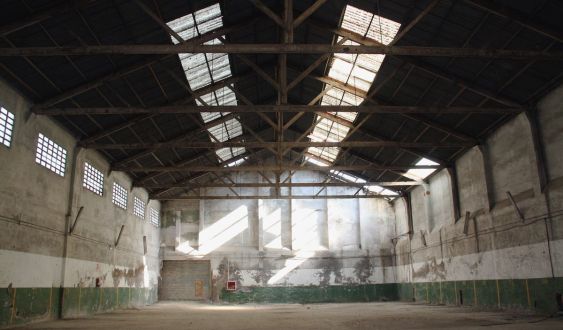
The Barcelona City Council will fill three empty warehouses, totaling 6,800 square meters and located in the former industrial areas of Besòs and 22@, with activity, hand in hand with private operators. Through public-private collaboration, sectors of the new economy, such as urban innovation, creative industries, and the circular economy, will be boosted, with the aim of fostering innovation and creating new companies and quality employment.
Through a public tender process that began last year, the selected agents have been the Institut d'Arquitectura Avançada de Catalunya (IAAC), Corporación Mondragón, and the UTE formed by Ingenia Cultura, Lavinia, and Arsmediatech. "We have opted for solvent companies with a track record that can guarantee not only economic viability, but also the sustainability of the entire project," says Fèlix Ortega, general director of Barcelon Activa.
The administration will cede the spaces to the selected companies, which will be responsible for revitalizing them. This is the same mechanism that was used to promote the 42 Barcelona programming campus with Telefónica or Ca L'Alier, where the BIT Habitat foundation and the multinational Cisco were installed, who will expand its commitment to the Catalan capital by locating its first European chip design center in the old factory. "Now we are doing it again and we are doing it on a more important scale," defends Deputy Mayor Laia Bonet.
The launch of the new poles of the new economy will entail an estimated investment of around ten million euros, a figure that will vary according to the contribution made by private operators. For now, the municipal investment has been 7.05 million euros. All in all, the three warehouses are expected to have an impact on 250 SMEs and startups through incubation, acceleration, and financing programs. It is also estimated that they will allow more than 1,000 students to be trained per year in innovation and technology topics, and reach 4,500 citizens in outreach activities.
The first leg of this initiative to become operational will be the one located in one of the Palo Alto warehouses, where Ingenia Cultura, Lavinia, and Arsmediatech will foster creative industries. It will focus on the creation of immersive experiences, virtual and augmented reality, animation, and 3D, which will be applied to culture, communication, video games, leisure, and education. With an area of 2,100 square meters, the City Council has invested 5.5 million euros. Works are underway and are expected to finish by the end of the year. The winning UTE has a ten-year concession, extendable by five.
Next will come the warehouse that will be occupied by the Basque cooperative university Mondragon Unibertsitatea —a member of the Mondragon Corporation—, scheduled for the end of 2024, which will host startups and corporations focused on creating circular economy solutions and SME digitalization, in addition to offering training. Located on Ciutat d'Asunción street, in Sant Andreu, the warehouse has an area of more than 3,300 square meters and will include coworking, meeting, and advisory and consulting spaces. The council bought the warehouse a year ago for 3.2 million euros and will grant a subsidy of one million euros to Mondragón, which has the right of surface for 25 years, with the possibility of a 15-year extension.
The IAAC warehouse, owned by the City Council, will be the last to start up, towards the end of 2024. With an area of more than 1,500 square meters, the space is located on Àvila street, in Poblenou. With the collaboration of the Col·legi d'Arquitectes de Catalunya (COAC), Tech Barcelona, and Barcelona Global, training programs will be carried out and there will be experimentation laboratories, as well as incubating startups and working on digital manufacturing programs, energy transition, sustainable buildings, nanomaterials, urban big data, open-source sensors, or smart mobility. The new urbantech hub wants to take advantage of initiatives such as the new European Bauhaus and Barcelona's capital status for Architecture in 2026. With a 25-year concession, extendable by 15 more, the local administration has granted them a subsidy of 550,000 euros. In this case, as in Mondragón's, public aid represents 30% of the investments that will have to be made, still to be defined.
Add The New Barcelona Post as your preferred Google source for free
Stay informed with the latest news.
