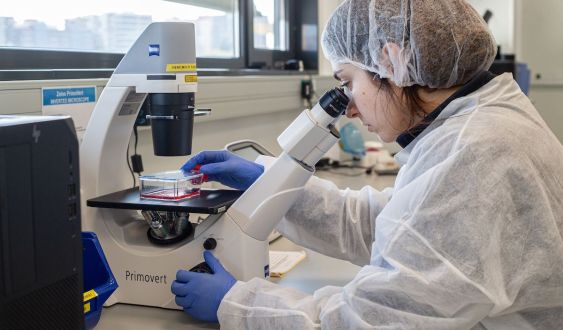
Barcelona continues to climb positions as a global reference in the field of science and innovation. Thanks to a robust scientific ecosystem, the Catalan capital is increasingly attracting international investment, both from private capital and from public research grants and scholarships. So much so that Barcelona has climbed to become the third European city that will receive the most grants this year for research within the ERC Proof of Concept call, from the European Research Council.
In addition, it is the second city in terms of the number of grants that is not a state capital, as only Paris and Munich will receive greater investment in the form of subsidies from the European Union. In total, this year the European Research Council will grant 22.5 million euros to 150 projects across the continent. Of these 150 European projects, seven groups are based in universities or research centers in Barcelona, groups that will each receive grants worth 150,000 euros. Thus, the city will receive a total of 1,050,000 euros among the different disruptive projects selected, which include everything from new cancer treatments to bio-inks for in vitro tissue printing.
With these grants, Barcelona leads in terms of state-funded research groups, with seven of the twenty projects subsidized throughout Spain. The objective of the Proof of Concept call is to foster knowledge transfer and enable research to move beyond laboratories and become products that improve people's lives. Thus, the grants will serve, on the one hand, to explore the commercial viability of the products and, on the other, to protect the results with intellectual property. Specifically, the grants finance frontier science projects, a term that refers to research that is at the current limits of scientific knowledge and therefore explores completely new and disruptive areas.
For the fourth deputy mayor of Economy, Housing, Finance, and Tourism, Jordi Valls, it is no coincidence that Barcelona concentrates this high number of subsidized projects, but rather "it demonstrates the success of the city's commitment to science and research as an economic and progress engine." With a robust scientific ecosystem formed by more than 1,500 companies, 93 research centers, and almost 60,000 professionals throughout Catalonia, the city has managed to climb to one of the top positions in scientific production, with a total of 22,688 publications, according to figures from the Science Citation Index.
"Barcelona's good position in obtaining these grants shows that our city is not only the undisputed Spanish capital of research, but one of the main ones in Europe," emphasizes Valls. For this reason, the City Council wants to continue reinforcing this leadership of the Catalan capital in the scientific field through the Strategic Plan for Science and Innovation, as well as through the public-private platform Barcelona Innovation Coast (BIC), which has doubled its budget to 46 million euros to finance projects to transfer academic and scientific innovation to the business sector. In addition, the city is already outlining and even finalizing growth projects that will transform the city and further boost research, such as the future Ciutadella del Coneixement or the CaixaResearch Institute.
The seven disruptive projects subsidized by these European Research Council grants are very varied, covering everything from the applications of artificial intelligence to predict the escalation of conflicts ---research group of the Barcelona School of Economics led by André Gröger--- to innovative tools such as the new EVOaware platform to test innovative cancer treatments, developed by the researcher from the Institute for Bioengineering of Catalonia (IBEC).
IBEC has also received a second grant for the research of Manuel Salmeron, which focuses on the manufacturing of bio-inks, containing living cells, for in vitro tissue printing. In the health field, research for a new treatment for chronic leukemia by Jose Ignacio Martin-Subero, from IDIBAPS Institut d'Investigacions Biomèdiques August Pi i Sunyer, and that of Laura Soucek ---awarded with the Ciutat de Barcelona prize--- for her study on the MYC protein as a therapeutic target for the treatment of solid tumors, have also been granted.
Finally, research by Neuroelectrics, with its new Galvani Swift project led by Giulio Ruffini for a new transcranial direct current stimulation therapy, and that of Víctor Vilarrasa, CSIC researcher at the Mediterranean Institute for Advanced Studies (IMEDEA-CSIC-UIB) to prevent and anticipate earthquakes, have also been granted.
Add The New Barcelona Post as your preferred Google source for free
Stay informed with the latest news.
