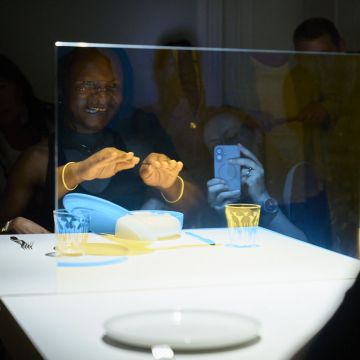
What came first, the egg or the chicken? In Barcelona, the egg arrived first. For a few days now, three giant eggs have appeared on Passeig de Gràcia, at the intersection with Consell de Cent, Diputació, and Gran Via streets. They are not just an artistic intervention: they announce a new birth. That of Salvador Dalí's house in the Catalan capital, which opens its doors at the Casa Amatller Digital Arts Center with an immersive experience that covers his entire universe, including that lesser-known facet of the artist: Dalí fascinated by science, technology, and the future.
Beyond being a new cultural experience in a city increasingly accustomed to this type of immersive proposals, Dalí's new house has a more symbolic dimension. It is the first permanent space dedicated to the artist in Barcelona, which settles a historical debt that the city has carried for decades with one of the most universal Catalan artists. Since his death in 1989, there have been several attempts to dedicate a street, a square, or a proper space to him, but none have come to fruition. Now, finally, Dalí finds his place in the city.
He does so in a symbolic space for Dalí: Passeig de Gràcia. Exactly a century ago, in November 1925, Salvador Dalí held his first solo exhibition there, at Galeries Dalmau. A year later he would return to exhibit again. And, a hundred years after those first exhibitions, the artist finds his permanent space in the Catalan capital.
He does so, moreover, with Layers of Reality —the studio responsible for IDEAL and creator of the great immersive experiences that can be seen in the city—. This studio was also responsible for reopening this part of Casa Amatller as a digital arts center in 2023, after the management of the modernist house wanted to recover and give patrimonial use to a previously little-accessible space in the modernist building. Since then, its walls have delved into experiences as different as the warm light of Sorolla or the darkness of Goya.
But, unlike the exhibitions usually seen at IDEAL, designed to last a few months before continuing their journey through other cities, Dalí's has no foreseen expiration date. The intention is for it to remain for years on Passeig de Gràcia, incorporating new layers and periodically renewing its content to invite visitors to return. The idea is to approach, in a certain way, the functioning of a traditional museum: a permanent collection that never stops transforming, with new temporary experiences that expand and keep it alive.
To do this, Layers of Reality revives the exhibition that IDEAL displayed during 2022, Cybernetic Dalí, but expanding and updating it. This decision responds to two reasons, one practical and one discursive. The first has to do with the characteristics of Casa Amatller, a space much more difficult to standardize than IDEAL and, therefore, less suitable for exhibitions conceived to travel from one city to another. Cybernetic Dalí, on the other hand, has demonstrated a great capacity for international circulation: since its premiere in 2022, it has passed through more than fifteen cities, including London, Berlin, Athens, Riyadh, and Tel-Aviv.
The second reason is more symbolic. "To reconcile the city with Dalí," argues Jordi Sellas, CEO and founding partner of Layers of Reality. The new house aims to help repair a paradoxical relationship: that of a city closely linked to the artist's trajectory but which, for decades, has not reserved any permanent public space for him.
The Dalí who looked to the future
Produced in collaboration with the Gala-Salvador Dalí Foundation, it combines digital arts, virtual reality, original objects, reproductions, and audiovisual material to explore a facet of the artist that often remains hidden behind the extravagant character and surrealism: his fascination with science, technology, fashion, jewelry, and the future.
“We reclaim a humanist Dalí, a visionary Dalí, and a cybernetic Dalí,” explains Anna Pou, curator of the project. The aim is to move away from a stereotypical view of the artist as a mere “mad surrealist,” in Sellas’s words, and to recover his multifaceted dimension. The Dalí that appears at Casa Amatller is an artist obsessed with what does not yet exist: machines, new forms of perception, physics, biology, the fourth dimension, DNA, and the possibilities of technology.
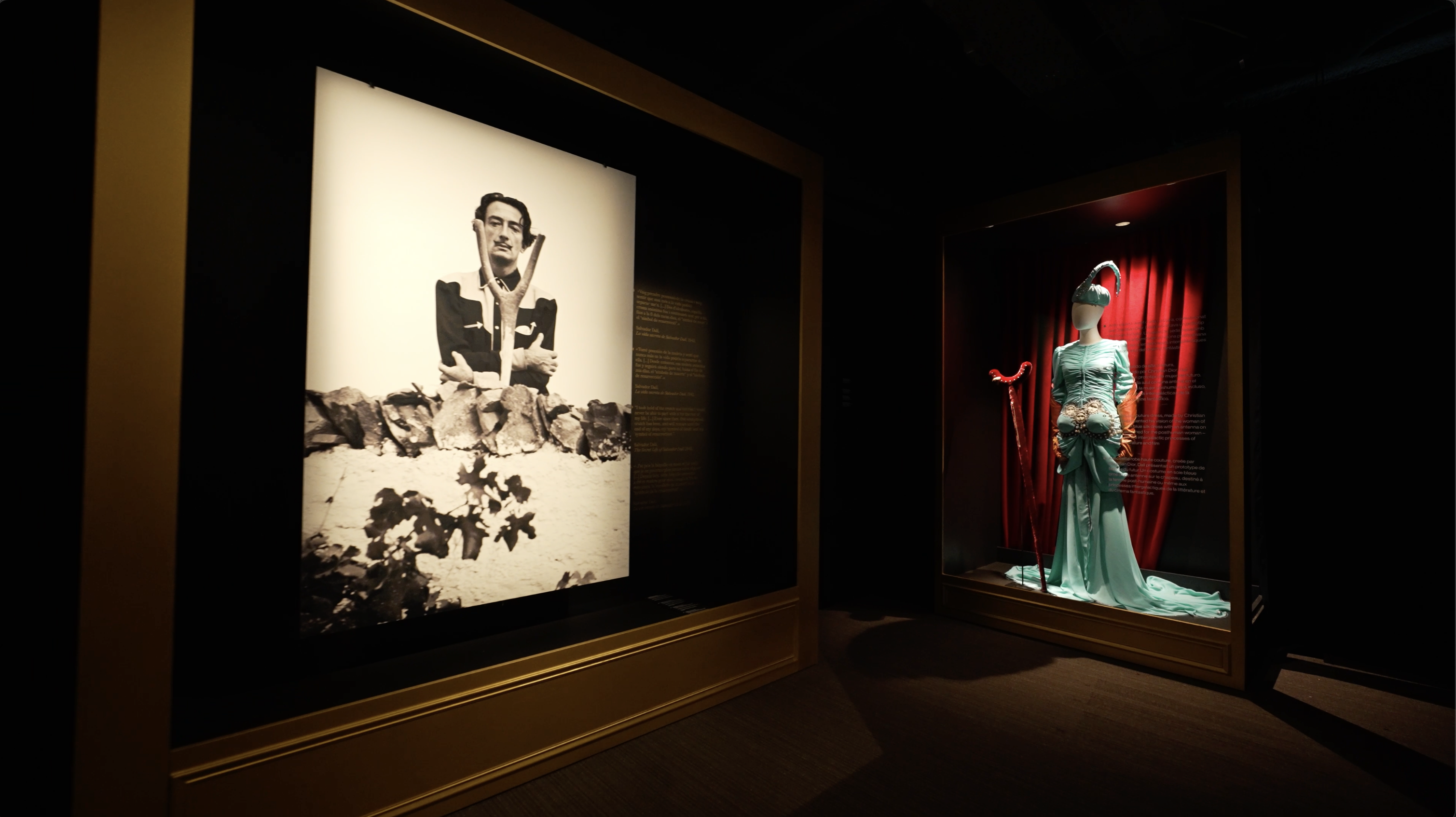
This gaze towards the future is also materialized in the objects that the visitor encounters along the route. The exhibition opens with a reproduction of the iconic golden astronaut suit that Dalí designed in 1958, a first declaration of his fascination with a future that had not yet arrived. Then appear pieces that show how this obsession also crossed fashion, jewelry, and design: the artist's original cane, Courrèges' Eskimo Eclipse glasses, a reproduction of the haute couture dress created with Christian Dior in 1965 to imagine the woman of the future, and publications such as Nugget magazine, where Dalí published several future predictions in 1957, including a “dream machine” that was supposed to allow systematic access to dreams and convert them into a stimulus for the imagination.
“Dalí would be fascinated by artificial intelligence,” assures Pou. The artist did not get to know AI tools as we understand them today, but he did show a constant interest in machines capable of expanding human faculties and in the possibilities that new technologies opened up. Dalí imagined before they existed: dream machines, electronic brains, and devices capable of intervening in creativity.
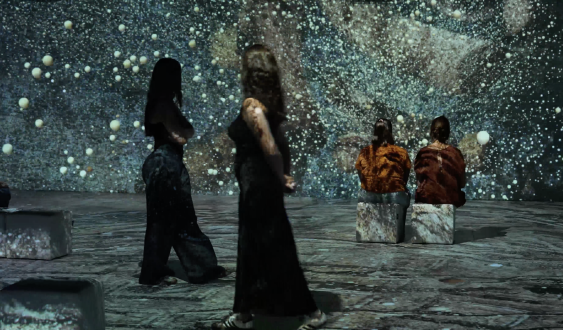
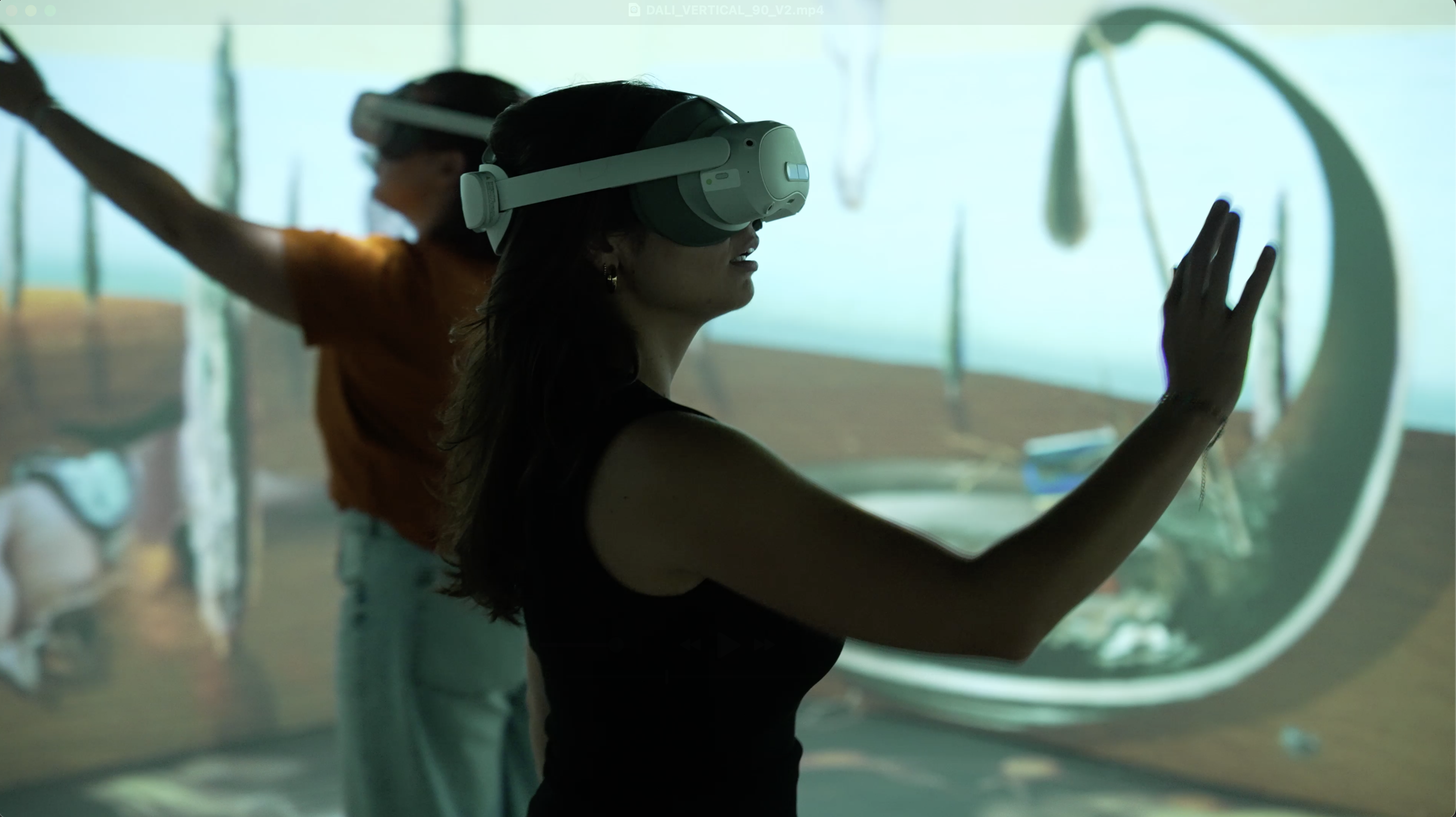
The exhibition is surprising because it leaves out a good part of Dalí's most stereotypical images, and discovers his other side. Thus, there is a gallery of paintings, although his imaginary is very present there, through virtual reality glasses —which proposes a journey aboard a ship, which the visitor can walk through, that crosses his universe, with ants, soft watches, eggs and other recurring elements of his work that appear and transform along the way—, and also in the immersive room.
However, this scientific and technological facet is not a contemporary view projected onto the artist, but a dimension that was already part of his thought, although it has often remained in the background. At the end of the tour, a selection of archival images from his stays in New York shows Dalí in an interview, explaining that he is no longer interested in art or literature, but in "cybernetics, biology, and quantum physics."
The proposal, however, does not intend to replace traditional museums or the experience of contemplating original works, but rather "should act as a satellite," as Sellas reminds us: a space that allows exploring other facets of the artist without taking the place of the centers that safeguard his work. And, furthermore, the space also has a symbolic charge: to begin to repair that "divorce" between Dalí and Barcelona that Sellas speaks of. One hundred years after his first exhibition on the same promenade, the artist once again has a home there, this time, permanently.
Add The New Barcelona Post as your preferred Google source for free
Stay informed with the latest news.