
The Vuelta will start again from Barcelona this weekend more than 60 years after the last, and only, time it did so. Somorrostro beach will be the starting point of the 68th edition of the cycling competition, the most important in Spain and one of the three most relevant internationally, along with the Tour de France and the Giro d'Italia. With the popular duo from Baix Llobregat Estopa as the official theme song, the Vuelta 2023 will feature city icons such as the Sagrada Família, the Torre Glòries and Arc de Triomf in the background during the first stage, while Montjuïc will be the protagonist of the second stage.
Barcelona will become the epicenter of professional cycling for two days, with some 3,500 people traveling to the city to make the sporting event possible, including organization staff and the riders and staff of the 22 participating teams. More than 1,000 journalists and 300 media outlets are also expected to broadcast their reports from the Catalan capital, with an estimated average audience in Spain of 1.5 million viewers.
It was 1962 when the Vuelta started from Barcelona for the first time. The Basque Antón Barrutia was the winner of that first stage, with a 90-kilometer route that started and ended in the Catalan capital. The sporting event did not return to the city until 2012, in a stage that started from Andorra and ended in Montjuïc, with victory for the Belgian Philippe Gilbert.
The 2023 edition of the cycling competition, with 21 stages, will not only be characterized by its return to Barcelona, but will also mark a milestone by finishing a stage for the first time in El Tourmalet, the most visited pass by the Tour. With an altitude of 2,115 meters, it will become the roof of the Spanish sporting event next September 8.
Before reaching the best-known French port, Barcelona will turn out this Saturday and Sunday for the Vuelta, which will entail major disruptions to the mobility of its residents, especially in the first stage, with a route of more than 14 kilometers that will run entirely through the streets of the Catalan capital. According to the City Council, it will be "the most significant traffic disruption in the city's history", for which almost 300 agents of the Guardia Urbana will be mobilized, accompanied by hundreds of mobility assistants. With cyclists going at an average speed of 50 km/h and able to reach up to 80 km/h, fences will be placed on the roads they will pass through, and a total of 78 crossings will be enabled that will open punctually, such as the bridge that has been installed on Tarragona street to connect Plaza España.
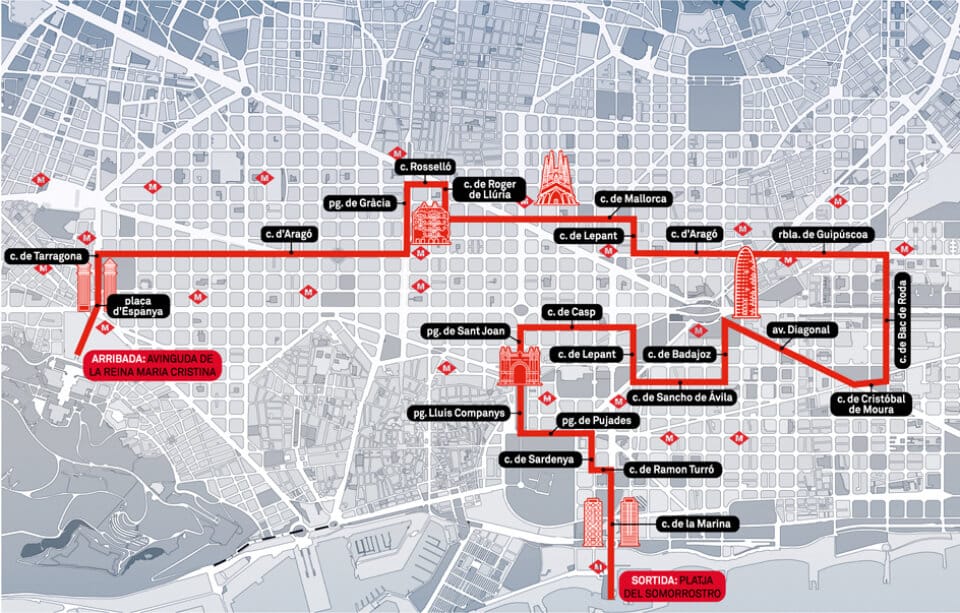
The first stage of the Vuelta 2023 will be a team time trial that will pedal through the Port Olímpic, Arc de Triomf, the Torre Glòries, the Sagrada Família, La Pedrera, and the Torres Venecianas on a 14.6-kilometer route. Training will begin at 4 in the afternoon. The competition will start at 7 in the evening on the Marina dock and will end at 9 in the evening on Avenida Reina Maria Cristina.
During Saturday, August 26, mobility disruptions will begin at 5 in the morning, with punctual traffic restrictions, and circulation will be completely cut off from 2 in the afternoon. The cut will extend until 9 at night. The cuts will affect vehicular traffic, but also pedestrians, who will not be able to cross at the crosswalks located on the streets that are part of the competition circuit. TMB has modified the routes of more than 40 bus lines and has reinforced the metro lines that cover the areas affected by traffic restrictions, with the L4 already fully operational after the summer works ended. In addition, parking is not allowed in the route area since this Friday.
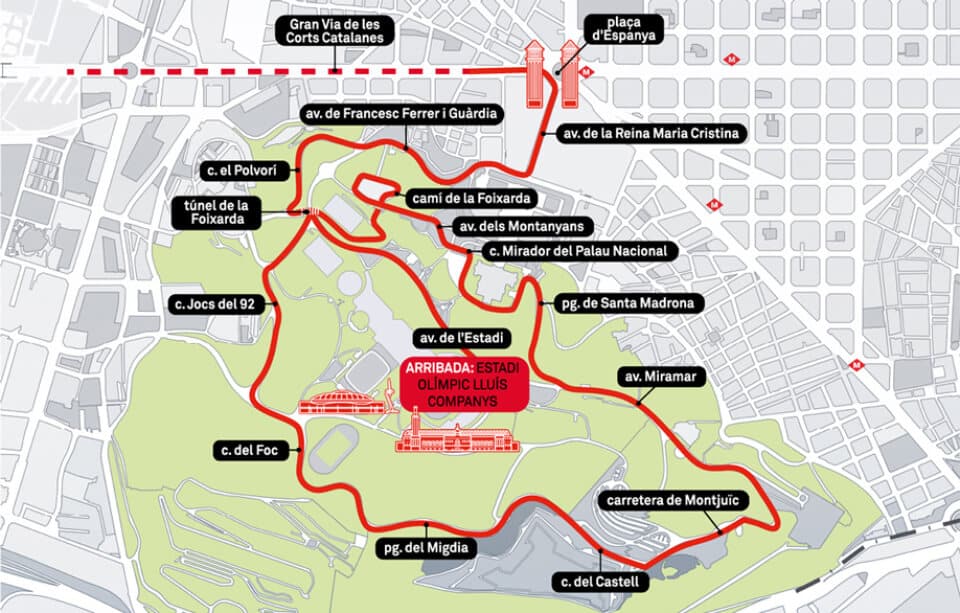
The second stage of the Vuelta 2023 will start in Mataró and pass through different Catalan cities such as la Roca del Vallès, Sabadell, Manresa, Olesa de Montserrat, Molins de Rei, Cornellà de Llobregat and L'Hospitalet de Llobregat. With a route of 181.3 kilometers, cyclists will face the climbs of Coll de Sant Bartomeu, a third-category climb, and Coll d'Estenalles, a second-category climb. The finish will be in the Catalan capital, entering from L'Hospitalet via Gran Via and climbing Montjuïc, the last climb, a third-category climb, to reach the Lluís Companys Olympic Stadium. It is estimated that the first cyclists will enter the Catalan capital from 4:30 p.m.
As the day before, Sunday, August 27, will also see mobility disruptions. Although they will be less significant, those returning from vacation that day will have to take them into account. From 10 in the morning, some traffic restrictions will be implemented in the route area according to the needs of the competition organization. The total isolation of the circuit will be from 3 in the afternoon until 5:30. A total of 17 bus lines will be affected on Sunday. Likewise, parking will not be allowed in the route area from Saturday.
Stage 1 of the Vuelta 2023: Barcelona > Barcelona (14.6 km)
- Start: Somorrostro Beach.
- Itinerary: Marina Street - Plaza dels Voluntaris Olímpics - Marina Street - Ramon Turró Street - Sardenya Street - Pujades Street - Pujades Promenade - Lluís Companys Promenade - Sant Joan Promenade - Casp Street - Lepant Street - Sancho d'Àvila Street - Badajoz Street - Diagonal Avenue - Cristòfol de Moura Street - Bac de Roda Street - Guipúscoa Street - Aragó Street - Lepant Street - Mallorca Street - Roger de Llúria Street - Roselló Street - Passeig de Gràcia - Aragó Street - Tarragona Street - Plaza de Espanya.
- Finish: Reina Maria Cristina Avenue.
Stage 2 of the Vuelta 2023: Mataró > Barcelona (181.3 km)
- Departure: Port of Mataró.
- Itinerary: Òrrius - Coll de Sant Bartomeu - La Roca del Vallès - Vilanova del Vallès - Montornès del Vallès - Montmeló - Circuit de Catalunya - Parets del Vallès - Palau-solità i Plegamans - Polinyà - Sabadell - Matadepera - Coll d'Estenalles - Talamanca - Navarcles - Sant Fruitós de Bages - Manresa - Salelles - Sant Salvador de Guardiola - Marganell - Castellbell i Vilar - Olesa de Montserrat - Sant Andreu de la Barca - Pallejà - Molins de Rei - Sant Feliu de Llobregat - Sant Joan Despí - Cornellà de Llobregat - L'Hospitalet de Llobregat.
- Itinerary passing through Barcelona: Gran Via de les Corts Catalanes - Plaza Espanya - Avenida Reina Maria Cristina - Avenida Francesc Ferrer i Guàrdia - Calle Polvorí - Túnel de la Foixarda - Camino de la Foixarda - Calle de la Foixarda - Avenida Montanyans - Calle Mirador del Palau Nacional - Paseo Santa Madrona - Avenida Miramar - Calle Torreforta - Carretera de Montjuïc - Calle del Castell - Paseo del Migdia - Calle Foc - Calle Jocs del 92 - Avenida Estadi.
- Arrival: Lluís Companys Olympic Stadium.
Add The New Barcelona Post as your preferred Google source for free
Stay informed with the latest news.
