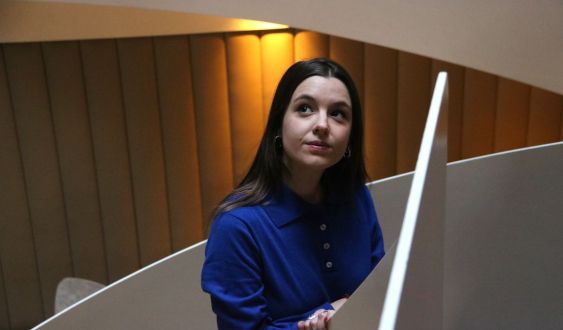
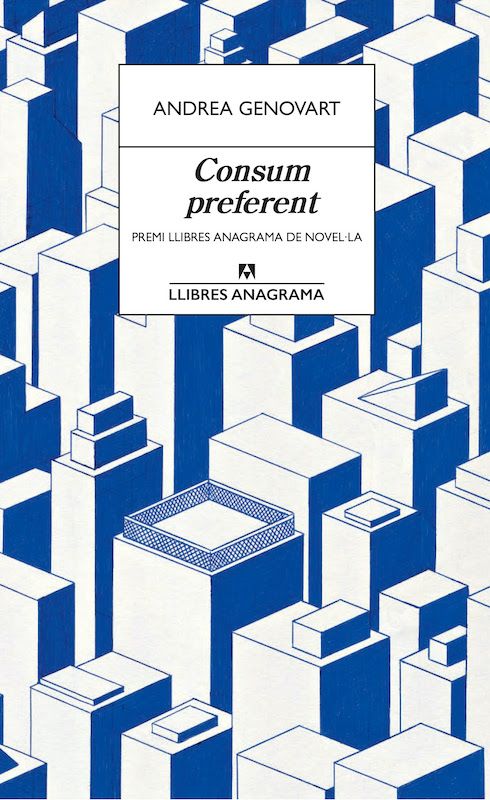
Andrea Genovart (Barcelona, 1993) debuts this Sant Jordi with Consum preferent, winner of the 8th Premi Llibres Anagrama de Novel·la. Her first novel is a daring and accelerated proposal about a precarious reality dotted with temporary jobs, shared flats, half-hearted relationships, and the poisoned comfort of receiving new notifications, with the background noise of a city that doesn't know how to offer an answer for everyone.
For four years, the writer has shaped a story in which style carries a lot of weight, with a realistic and unfiltered approach where multiple discourses claim their space, slipping through any crack. Started when she became unemployed, Genovart has been forced to "rewrite and rewrite" to transmit the same anguish that the narrator experiences in the reading experience, measuring every word so as not to lose the reader's attention for a moment, overwhelming them if she has to overwhelm them.
With a degree in Literary Theory and Comparative Literature from the University of Barcelona (UB) and a master's in Cultural Management from the Factoría de Arte y Desarrollo de Madrid, the author combines writing with her work as head of press and communication for several publishing houses. After Consum preferent, which will be translated into Spanish next academic year, Genovart already has a second novel in mind, but she hasn't started writing it yet. According to her, it will have nothing to do with the first, making it easier to overcome the vertigo of initial success.
--- Consum preferent is the first novel you've written. How did you start to conceive it?
--- I've written everything: poetry, short stories, narratives... I've also entered short story contests and done things for myself; I have a lot of unfinished things. I've always been a bit disorganized when it comes to having a project because I found it difficult, even, to define the type of project I wanted to do. I knew more about its nature, which was writing, but I didn't have a clear idea. I kept going, and four years ago I decided to write a novel, also a bit due to the prejudice that many people in literature have, believing that the novel is the serious thing. In fact, I had the idea of wanting to write a novel before I had the novel itself. That is, I knew what I wanted to talk about, but I didn't have a very defined plot.
--- How did you solve that?
--- It has been a curious process because, thinking about how I could shape everything I wanted to talk about, I realized that I found it difficult to have a closed plot in a classic way, in the sense of exposition-rising action-resolution. I didn't have a big conflict. So I started to wonder why I couldn't project a story in this way. From here, I started to try to shape a story from its impossibility. When I was writing the novel, they would ask me, "and, what is it about?", and I would say, "nothing, nothing happens." I said it under my breath because I felt bad. But, I also think it's like a kind of everyday zoom. There are many more costumbrista proposals, like Cesc Gay, where no big things happen, they are not epic or dramatic. That's why I think everyone can also feel more or less represented.
--- Without a big conflict, what does it tell?
--- For me, the key concepts are discursive polyphony and the impossibility of clinging to an identity in an absolute way. In a modern city like Barcelona, where a plurality of different discourses coexist that demand a coherent and absolute positioning from you, the narrator, Alba, carries the anguish of not being able to identify with any of the options it offers her. All this is related to the style, the theme and the style go very much hand in hand, they are a mirror of each other.
"In a modern city like Barcelona, where a plurality of different discourses coexist that demand a coherent and absolute positioning from you, the narrator carries the anguish of not being able to identify with any of the options"--- Barcelona is another character among the noisy discourses that assault the narrator.
--- I decided to focus on Barcelona because, like all modern cities, it is overstimulating, inhabited by all kinds of people, with different ideologies, ways of life... Theoretically, it is a city that offers all possibilities for you to find your place and that's how it's sold. But, I try to turn it around by saying, given this introduction, what happens when nothing convinces us, having so many possibilities to identify ourselves within reach.
--- How does one live in this Barcelona?
--- It's a city that really interrupts you, it can be with an ad in the subway or someone giving you a "We buy gold" flyer. That is, all the time you are exposed to the invasion of messages, demands, ideological imperatives. Do this, vote this, be a good citizen, volunteer, live your adventure, Vueling. Demands that can coexist when you go down to the platform in just three meters of distance and that are completely different. Your head can explode. It's very striking how we've gotten used to being crossed by totally unconnected, random things without any distinction of value. That is, everything is important. It's not the same if I sell you a taco or a will, they stir very different things in you, right? But, even so, they present them to you in an equal way.
--- What other faces does the city that Alba inhabits, as best she can, have?
--- It is also a city that is built a lot on the basis of boasting that it is a cultural icon, but, at the same time, people have a daily life that wears them down so much that they don't have a healthy relationship with culture. The narrator studied Philosophy, but has had to redirect herself by studying Graphic Design and arrives home so tired that in the end she doesn't want to read what she likes. She prefers to gorge on pizzas, which end up making her feel bad and she vomits them, watch anything on her phone and that's it. It's a city where the price of rent also affects and conditions all decision-making capacity and the ability to project oneself in a non-suffocated way. It is not specified how old the narrator is, she is bordering on thirty. It's on purpose, because, what does it matter? In the end, if you are 28 or 34 and you can identify, something is wrong.
--- What have been the first reactions?
--- Barcelona is a city that crosses paths with many different people. I have met people aged 45 or 50 who have read Consum preferent and tell me they feel represented. That's why I'm a bit wary of being pigeonholed as a generational author because, sometimes, I think there are problems that affect everyone, perhaps not in the same way, but I don't know to what extent they belong to a single generation. I think we have largely assumed that certain things, when they have a complaining tone, are part of a young character because it is energetic and rebellious. Furthermore, when it's a young proposal, a filter is applied that says identification is necessary. People ask me, "will I understand it?", and I say, "I don't know", but it's also like, what does it matter if you understand it or not? I approach literary and cinematographic proposals not because I want to identify with them, but to see how they are resolved, and perhaps I understand half of it, but so what? It's simply curiosity.
"I'm a bit wary of being pigeonholed as a generational author because, sometimes, I think there are problems that affect everyone"--- The voice is also very characteristic of the narrator of Consum preferent.
--- It's an acidic and cynical voice so as not to sink. The narrator doesn't feel represented in her environment and also doesn't quite have enough strength to say, "look, well, I'll put up with this indefiniteness and it's fine with me." She only has one space left, the way she thinks and doesn't communicate because she knows it's not the right one. It's a survival mechanism in a reality that is not very kind to her.
--- A narration that mixes with the emails she reads at work and the television speeches she hears on TV, she speaks in different languages...
--- That's how I tried to reflect the way the narrator thinks. Thoughts really cross your mind from different places and you don't process them, we don't think in a mediated way. And the linguistic interference is another type of interference that I wanted to represent in a city where there are constant interruptions. If I wanted to be truthful about what Barcelona is like today, regardless of whether I think it's good, which I already say from the outset I don't, Spanish and English had to be there because it's a reality.
--- After this accelerated narration, at the beat of a notification, which you have reflected in Consum preferent, are you working on something new?
--- I already have the idea for the second novel in my head. It's completely different from the current one and I'm quite happy to feel that I have the capacity to stimulate myself, inspire myself, and invent different things. I was very afraid of only being able to do one type of thing. But right now I can't write, I'm not one of those writers who sits in front of the computer for an hour daily and writes. First, because I have a rather chaotic life and, second, because I need a lot of emotional involvement to write and, if it's not locking myself away for six hours on a Sunday, for an hour I can't get in and out of the story.
Add The New Barcelona Post as your preferred Google source for free
Stay informed with the latest news.
