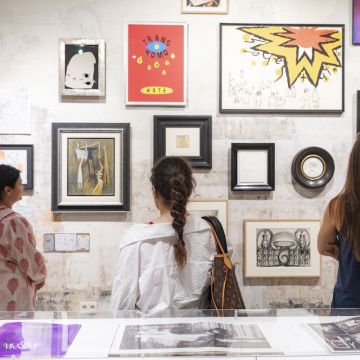
When I was six years old, I would ask my parents to take me to the Prado Museum for my birthday. I could spend hours there looking at paintings. I knew almost nothing about technique, but it didn’t matter. What kept me spellbound in front of each work was something much harder to explain: the sensation that someone, in another time and another place, had found a way to express a moment, a feeling that words could not reach.
This is how I have understood Art for as long as I can remember. And this is also how I understand hope: not as a synonym for easy optimism, but as something that holds possibility, that opens up new ways of seeing. It is difficult for me to think of art, Barcelona, and positivity without seeing them as intrinsically connected. They are three words that, in my mind, constantly call to one another. What is truly significant about works of art is that they continually show us infinite ways of approaching a question, of embracing a subject. And that is where hope lies. Not in the answers, but in the multiplicity of paths we can take in search of them.
When I moved to Barcelona more than twenty years ago, I was struck by something few cities have: cultural spaces with a personality of their own, which do not compete with one another but complement each other. MACBA, CCCB, the Miró Foundation, the Tàpies Museum, and its galleries are not simply institutions. They are open conversations with the world. Perhaps exhibitions with the vast budgets of other European capitals do not always make their way here, but I can assure you that the content is carefully curated to encourage visitors to ask questions. To restore their faith in humanity and in our capacity to create. There is an intellectual honesty in the way Barcelona approaches culture that is not always found in larger, noisier cities.
That is what I believe art is about: embracing plurality in all its forms, proposing a conversation that remains open rather than closed. When my students at Elisava ask me whether I liked an exhibition or not, I answer with another question: How does what you have seen live within you? Art should not impose; it should encourage observation. That distinction, so simple to articulate and so difficult to sustain, seems to me one of the most important things a city can embrace if it wants to remain culturally alive. Art is not about telling us what to think, but about helping us think differently. About looking at what we already know with different eyes. About finding, in the everyday, a crack through which something unexpected can enter.
And Barcelona, in that sense, has something that cannot be manufactured: a natural willingness to be surprised. This is how it has always opened itself to Art: as a city receptive to what arrives from other shores, with the wonderfully childlike hope of welcoming the stranger, of allowing itself to be transformed by what we do not yet know. Antoni Gaudí, Aurèlia Muñoz, Joan Miró, and many others share something: that deliciously pure and innocent gaze, as if the light of the Mediterranean had conquered their souls. The artists who have lived in this city become what the Barcelona poet Jesús Lizano called “curved people”. A poem I warmly invite you to discover.
“There is an intellectual honesty in the way Barcelona approaches culture that is not always found in larger, noisier cities”
Because there is something about curvature that explains everything. The straight is efficient, predictable, easy to categorise. The curved, by contrast, forces you to change your pace, adjust your gaze, and find your balance in motion. The art that interests me most, the art that this city has cultivated with such care, is always curved. It does not offer direct answers. It invites you to circle around the question until you find your own angle. And in that process of circling, of approaching, of feeling your way forward, something happens that no manual can teach: you learn to tolerate uncertainty. To live comfortably in the space between the question and the answer. Which is, after all, where most of real life takes place.
Add The New Barcelona Post as your preferred Google source for free
Stay informed with the latest news.