
The legal status of graffiti in our city is more complicated to understand than the mystery of the Holy Trinity. The current Ordinance on the uses of the urban landscape of the city of Barcelona, available on the City Council's website, establishes as a minor infraction "the application of graffiti or painted messages on any element of the urban landscape without express authorization." In fact, Barcelona's cleaning service (consult the current 2021-23 contract) not only boasts of having carried out more than 164,000 actions against graffiti during 2019, but also of introducing "a catalog of tags that helps identify their authorship through an artificial intelligence system." The norm, as often happens, clashes head-on with the habits of culture vultures and artists who can devise and find excellent graffiti on the murals of Nau Bostik, on the corner of the Parc del Centre del Poblenou or the Jardins de les Tres Xemeneies.
This last hot spot for Barcelona graffiti artists became especially well-known when the Colau administration cleaned (sic) a mural critical of the King Emeritus by the artist Roc Blackbock, painted next to works critical of the kidnapping of rapper Pablo Hasél. The mayor apologized via Twitter for the act of censorship, promising to review the protocol that had been applied on that occasion, one of many good intentions that have remained in the internet cloud. This new case of ambivalence with graffiti contrasts with this museum year's star exhibition, precisely that of a graffiti artist, Banksy: The Art of Protest, an unauthorized retrospective of works by the anonymous English artist that you can see at the Disseny Hub Barcelona, an exhibition that has been advertised following adjectives of spectacularity (immersive, multimedia) and backed by great international success.
Walking through the exhibition, it is surprising that a city where graffiti is still pseudo-legal champions an artist tremendously critical of capitalism who had taken advantage of the liberal graffiti scene of the 90s to leave some imprint on our streets. To understand it, it is worth watching the documentary BCN Rise & Fall by graffiti artist Aleix Gordo and filmmaker Gustavo López, a film that explains the rise of street art during the Olympic era, as well as the sanctioning spirit of the socialist administration towards graffiti starting with the 2006 ordinances and the consequent police repression. Several graffiti artists like Pez, dr. Case, Olivia, Dixon, and Sixe narrate how the spirit of openness of a city that managed to attract the hands and colors of international artists like London Police, Os Gemeos, or, ironically, Banksy himself, has ended in an almost criminalization of the practice.
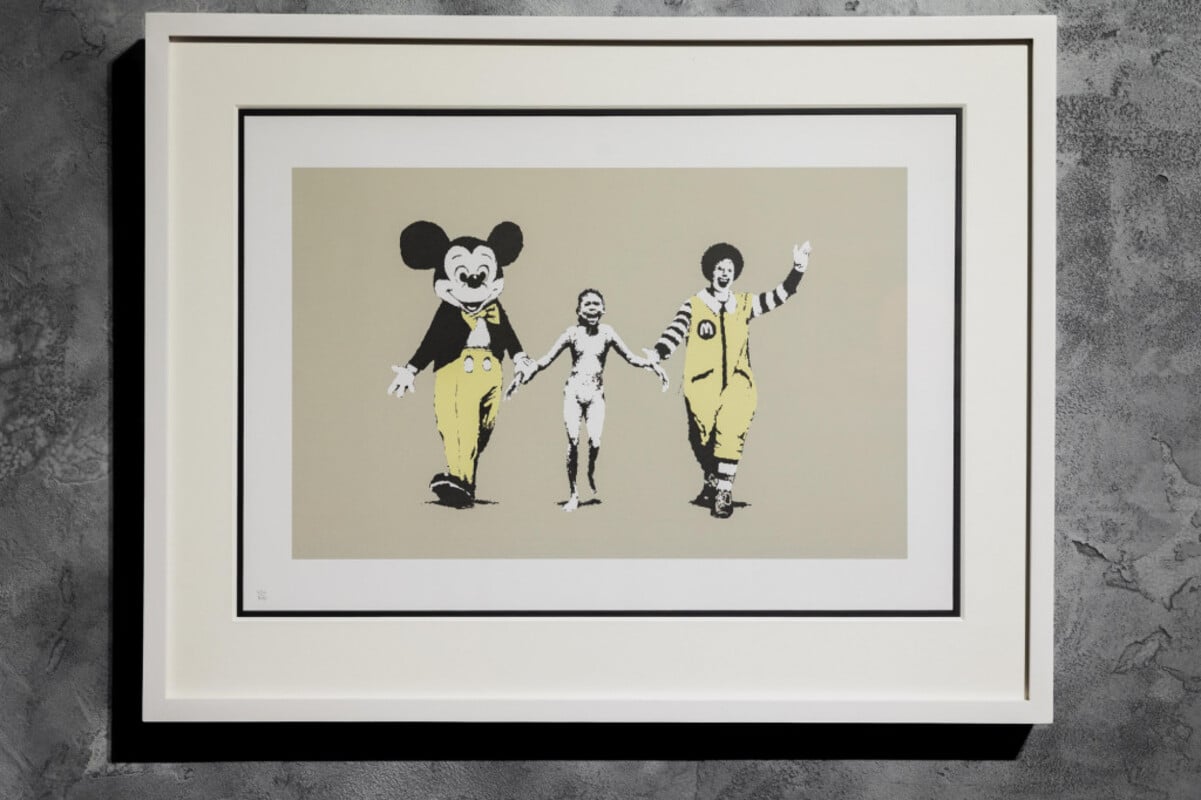
That a space like the Hub, erected as a "laboratory of creative industries, the dissemination of the city's heritage and culture on a global scale" sets Banksy as a reference in protest art while Barcelona still makes things difficult for present artists (that is, the heritage of the future) is one of those ironies that one must swallow with a certain stoicism. In fact, Banksy (an anonymous but highly valued artist, a true wet dream of the private collections that make up the exhibition) has ended up being the perfect example of how protest can become business and, at an even deeper level, of how Barcelona and its administration seem to embrace business based on protest against capital. That "colauismo" ends up functioning as a money-making machine while doing everything possible to prevent people from earning too much pasta surpasses its irony and fully enters the universe of Hegelian contradictions.
That "colauismo" ends up functioning as a money-making machine while doing everything possible to prevent people from earning too much pasta surpasses its irony and fully enters the universe of Hegelian contradictionsBe that as it may, Banksy's institutionalization informs us that graffiti will be accepted as long as it remains a tolerable form of protest, and this is how fantastic projects have been promoted in Barcelona, such as Rebobinart (which has featured artists mainstreamtype Lara Costafreda or Paula Bonet to adorn some of our walls), the Murs Liures of Poblenou Urban District, with beautiful places that include artistic residencies like La Escocesa on Pere IV Street. The situation of graffiti interests me, I insist, because it has managed to create an industry despite its pseudo-prohibition, giving us the idea that if something works (and on top of that, is beautiful) what one should do is take advantage of it; an idea, look at that, that at home we have always known by the name of "capitalism." Let artists take note because, as happened in the 70s,protesting will become a great boon
It doesn't surprise me that the latest flirtation Banksy allows himself with pre-institutionalized protest, in an environment where our identity becomes more collective and a source of invasion every day, turns out to be the persistence of living in anonymity. This way, the artist can, while condemning the world of money, spend the fees from his old circumstantial pieces on all the whims that freedom allows him. I feel an unhealthy envy, I must admit.
Add The New Barcelona Post as your preferred Google source for free
Stay informed with the latest news.