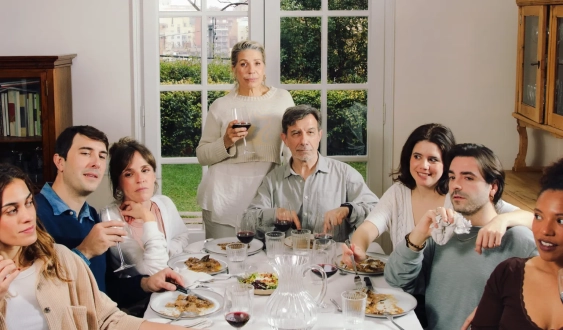
A village house. A birthday. A family meal. This is how La truita begins, the play that the Teatre Poliorama presents for the Grec Barcelona, written by French playwright Baptiste Amann and directed by Ferran Utzet. It is a comedy with a luxury cast led by the parents, Emma Vilarasau and Jordi Boixaderas, accompanied by Sara Espígul, Miranda Gas and Júlia Bonjoch as the couple's three daughters, and Arnau Puig, Marc Bosch and Tai Fati as the daughters' partners.
The play begins with the introduction of the characters. On one hand, we have the parents, a couple in their sixties who have decided to give a new direction to their lives by moving to a village and starting a family business with an organic bakery. On the other hand, the first two daughters, played by Sara Espígul and Miranda Gas, are first-time mothers with a "stable" and "normal" life (in quotes, of course, because what is stability? What is normality?).
Both are accompanied by their partners, Arnau Puig and Marc Bosch, two very different characters, but who try to fit in with their in-laws. The third daughter, played by Júlia Bonjoch, is the most different of them all: a traveler, unattached, artist, and lesbian.
This first part, where the characters are introduced, is very enjoyable, original, and entertaining. The different couples are presented from various perspectives: when they are alone, when they are with their partners, and when they are with family. The audience witnesses the characters' thoughts and ideas, a resource that brings veracity to the story, naturalness, and manages to generate empathy. This happens in the presentation of the character played by Sara Espígul when, in the first car scene, we hear her thoughts regarding the boredom her partner generates in her. A funny, brilliant moment, brimming with naturalness.
A fresh and chronological structure
La truita is structured in three parts, the three typical parts of a food menu: starter, main course, and dessert. And already, in the starters, the first family conflicts begin to erupt. Conflicts that, at first, are appeased in favor of good manners, to try to make the meal go well and to create a sense of family harmony that, even if false, can generate that momentary illusion of "happy family" that many families wish to project. But the daughters are not up to the task: the exhaustion of motherhood, the weight of responsibilities, and the wear and tear of maturity make nerves frayed.
The first outburst comes from the food that gives the play its name: the trout (truita, in Catalan). The daughter played by Espígul brings a trout to the family meal because she has become lacto-pesco-vegetarian, meaning she doesn't eat meat, but she does eat fish and dairy. This means she rejects the fricandó cooked by her mother, the classic family dish she has prepared all her life.
The mother (Vilarasau) takes this decision as an offense, but, with a small voice, decides to accept this change of pace and cook the trout for her daughter. But the conflict is already served, like the starters of the menu: tension, reproaches, and family misunderstandings begin to be glimpsed between the tablecloths on the table.
Very natural and credible interpretations
One of the strongest points of La truita is its cast. On stage, we find a real family: with their quirks, their (bad) habits, their reproaches, their unhealthy relationships... The mother-daughter relationship is very well reflected, a relationship of emotional dependence, but with a constant conflict that makes every phrase, action, or gesture susceptible to misinterpretation; that relationship that moves, sometimes, between love and hate, or love and weariness.
We are before a costumbrista portrait of a family in which the mother is in charge of organizing everything. She is so used to running her home and her family that, in the end (and unconsciously), she doesn't let anyone intercede, no one change her structure. The daughters and brothers-in-law (especially the one played by Marc Bosch) want to break with this harmony, but the mother is uncomfortable when she loses control. The father (Jordi Boixaderas) appears as the figure of the eternal absentee, the shadow of the house; a person who lives there, who helps make life more pleasant, but who tiptoes through life.

The daughters, influenced by the figure of the mother, want to please her, they want her to feel proud of them, of their work, of their life, of their daughters... But they are lost in life: they are lost without their mother. They want to be free, independent, but they don't know how to do it and they expect their parents to keep saving their bacon, even though they are already over forty. That's why they reproach their parents for everything, because they are guilty and not guilty at the same time: they wanted to educate them in freedom, with endless options ahead, but without giving up the bourgeois structure and a very defined model of family and life. They, now first-time mothers, don't know how to be mothers, how to be women, or how to be happy.
The third daughter (Júlia Bonjoch) embodies the ideal of a free woman, one who has rejected the model of life offered by her parents to become an artist and nomad. She has no fixed residence, no stable job, but she believes she is happy for having found a different path from the one imposed by her family. Although, deep down, she also lives drowned in her own fears and her own desires for freedom.
The generational confrontation between parents and daughters is well presented by the tension that permeates the play, by the personality of the characters and by the decisions we see they have made in life. They are not happy. They should be, because they have everything to be, but they are not. "What's wrong?", the daughters seem to ask themselves, "Who is to blame?", they continue to question themselves inwardly. The answer is presented to them as a lifeline to cling to: "The parents". But the parents will make them see that injustice, also accepting their share of blame in education and upbringing, but defending their position and their decisions.
Unorganic and unnatural turns
But in the play, we find that the main plot twists do not breathe naturally. Starting with the central theme, the trout, the issue that should constitute the main conflict and that, in reality, does not happen on stage. The trout is constantly mentioned, but it does not trigger any intergenerational debate at the moment it appears. Later, there is a kind of "echo" of that conflict, which we have not actually seen, and which is used to introduce the confrontation between generations. It is not a natural, organic, or plausible debate; it is introduced in a somewhat forced way to talk about what they want to talk about.
This also happens with the characters' arc. Throughout the play, we find extensive monologues from the characters; these are interventions that present the psyche of each of them, delve into their fears, their thoughts and their personality so that their motivations and objectives are better known. These speeches cause the rhythm to decline and interest to decrease.
A separate mention deserves the endless anecdote (which must last about fifteen minutes, no exaggeration) about an accident that turns out to be a totally unnecessary story for the development of the plot and the play. All these elements cause the rhythm to suffer, the force of what happens on stage to diminish and the dramatic truth that had been achieved at the beginning of the play, to vanish.

Between comedy and tragedy
La truita is presented as a comedy, but the truth is that it is a more tragic than comic play. Although there are situations that draw a smile on our face, the background of the play is shocking and the message read between the lines is very tragic. Without intending to spoiler, I will only say that the last part of the play is capable of producing a knot in the stomach, especially with the excessively detailed and meticulous explanation of the character played by Tai Fati.
That said: there are some comedy scenes that are very well resolved. The most successful one takes place at the beginning of the play when Bosch rambles about the dispersion of his own mind. This is a brilliant moment, full of truth, that serves as a mirror and highlights a situation so normal and human that it is rarely mentioned. We also see very funny moments between the parents or the reactions of the sisters who, as I have already pointed out above, help to define well that kind of love-hate relationship that is experienced in families.
But the comedic atmosphere is constantly broken by the appearance of arguments and reproaches that keep popping up in every line. To lower the tone of dispute, the choice is made to include two traditional comic resources in comedy plays, but which do not fit well with the story and end up generating a feeling of strangeness. One of them is the insertion of the musical moment, the karaoke moment; it is a forced scene, in which the audience is encouraged to sing and participate and which does not have much dramatic sense. The other comic resource used takes place in the bow and arrow scene, the outburst in the form of madness by one of the daughters (Miranda Gas); this scene also ends up being exaggerated and over the top.
Despite this, La truita is a very well-stitched family portrait that seems to pay homage to the wonderful chaos of family. Because, although there are disputes, confrontations and reproaches, the truth is that, without family, it would be much more difficult to get ahead and find our own way.
Add The New Barcelona Post as your preferred Google source for free
Stay informed with the latest news.