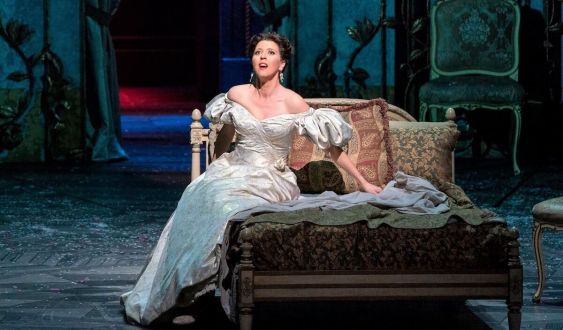
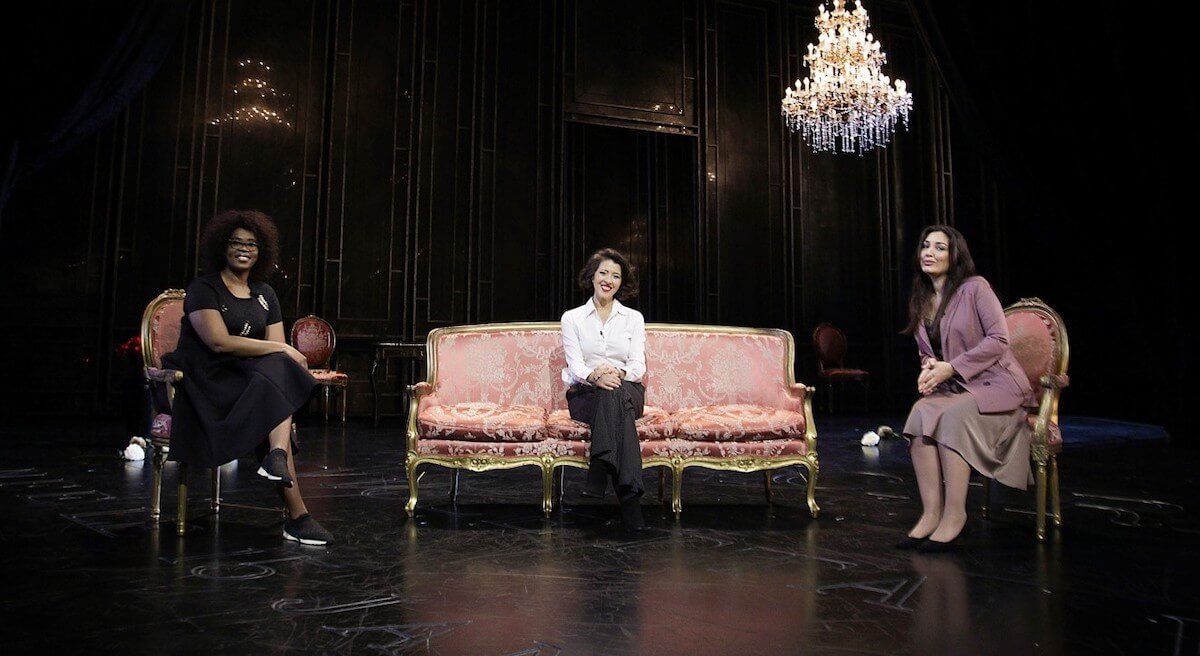
The quartet of sopranos who characterize the protagonist of Giuseppe Verdi's La traviata, at the Liceu, whose performances resume on Monday, December 14, after a hiatus with Speranza Scappucci directing, is of an exceptional level. Alongside Kristina Mkhitaryan, Ermonela Jaho, and Pretty Yende ---to whom we already dedicated a piece--- the participation of Lisette Oropesa stands out. An American singer of Cuban descent, she debuted very young with an enormous role ---none other than interpreting Susanna in Le nozze di Figaro--- at the New York Opera. She is a versatile soprano, agile in coloratura, and with the gravitas required for a role like Violetta Valery. A role that Callas elevated, endowing the protagonist of Verdi's melodrama with a tragic dimension. Between rehearsals, we chatted with a smiling Lisette Oropesa, very happy to be in Barcelona, a city she confesses to love.
[subscribe_newsletter_esp]
--- It's a pleasure to see you again at the Liceu, and I suppose it will also be a pleasure for you to get on stage. How has the pandemic and lockdown situation affected you? Is it hard to stay in shape, from an artistic point of view?
Well, at the beginning of the lockdown, in March and April, I didn't handle it too well, to be honest. All the theaters were closing, everything canceled. I felt very bad, without spirit. In fact, I went a couple of weeks without singing. But then I changed my attitude, and started to get involved in training young people through masterclasses on technique, belcanto, repertoire… All free. The initiative grew to become a very large community, with hundreds of people. People from all continents gathered in each Zoom session for the pure pleasure of learning! That gave me encouragement again, it brought back my love for singing.
--- And among so many cancellations, overnight you get the opportunity to do a substitution and sing La traviata in Barcelona. Did it take you long to decide?
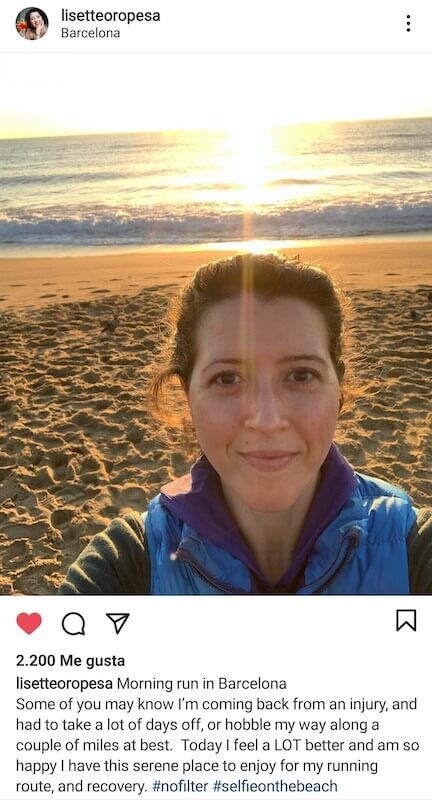
Without thinking, I answered "of course!", because I love Barcelona. There's an energy that can only be found here, it has to do with art, music, culture. But it's also in the people. You perceive it when walking down the street. In the style and design. Also, people in Barcelona are very friendly. It's a city to fall in love with. When I'm here, I like to go for a run along Barceloneta. On my first trip, I was fascinated by the Sagrada Familia, which I hope to visit again. Of course, the nightlife is also very characteristic, it's a shame to find everything so different these days.
--- That's why, perhaps more than ever, we need a space to disconnect, to forget for a moment our situation and live other people's stories, like those offered by opera, don't you think?
Of course, we all want to disconnect and escape reality. People go to the theater to dream, to live another world or exercise fantasy. It works as therapy! When I sing, I am extremely focused on what I am doing and I don't think about the news or any other issue or situation in the world, outside the stage. I am thinking only about the character, about the music, along with my colleagues. Those moments are precious. It seems that sometimes doing without "the truth" makes us feel truly good.
People go to the theater to dream, to live another world or exercise fantasy, it works as therapy!--- Without a doubt, the power of storytelling is fascinating, which in the case of opera is very efficiently conveyed through the emotional triggers activated by singing… Although you didn't start singing, or at least with the awareness that that was your path.
Well no, I started playing the flute. My mother was a singer and pianist, she always sang around the house, and as a young person I didn't want to follow in her footsteps, I wanted to do something else. That's why I started studying the flute ---I still like it a lot--- because I wanted to dedicate myself to music, but in a different way.
--- And, what happened? What went "wrong"?
It turns out I had much more talent as a singer! [laughs] Perhaps due to something genetic, in fact my grandfather was also a singer. And he still sings, he has a very natural voice. This is like athletes, within a family aptitudes are inherited. But I must say that if it weren't for the flute I wouldn't be the singer I am. Besides, the flute has a sound that still touches my heart.
--- And now, after playing the role of a strong woman in Mozart's The Abduction from the Seraglio ---that marvelous Konstanze--- you take on the protagonist role of La traviata. A "demi-mondaine" ---according to Dumas' expression--- who demonstrates great psychological complexity, with musically perceptible nuances thanks to Verdi's genius.
Violetta's case is very special. Unlike other melodrama heroines, she does not die voluntarily nor does she let herself be killed, but rather she does so due to an illness she does not wish for. On the contrary, she is a vital woman. She is clear about the lifestyle she wants to lead and the money she needs for it, as Alexandre Dumas fils explains in The Lady of the Camellias. The first thing for her is not love. That's why she initially doesn't want to get together with Alfredo Germont.
--- As you put it, it seems that Alfredo Germont is the one who dramatizes a situation that Violetta doesn't find particularly problematic.
Yes, because it is Alfredo who has a kind of "savior" complex. He wants to save her. From her illness, from society... from the life she is in. And he says it clearly in the opera: "If you were mine, I would cure you, I would take you out of all this." And she replies: "Ha! That's what you think, you are not a savior." And although he returns with that purpose, he does not save her. There is nothing he can do to cure her illness. Reality is reality.
It's just that, really, if anyone plays the role of savior, it's her. Violetta saves Alfredo's sister. Alfredo's father convinces her to leave his son so that her name is disassociated from the Germont family and thus the daughter's wedding can go ahead.
--- Is there anything in David McVicar's staging at the Liceu that emphasizes her psychological depth in this sense?
The Liceu production primarily aims to show the love between Violetta and Alfredo. For example, at Flora's party, when Alfredo offensively throws money in her face ---and he himself is reproached by all the partygoers--- almost always what we see on stage is that Violetta falls, or faints. Then she gets up again and sings her aria ("Alfredo, Alfredo, you cannot comprehend all the love in my heart") but separated from him. In the Liceu production, however, she neither faints nor makes any aside: she remains very serene, in the middle of the stage. She caresses and holds him as if he were a baby. She comforts him. I believe that is very novel and revealing.
In the Liceu production, Violetta does not faint: she remains very serene, and caresses Alfredo, holding him as if he were a baby--- It seems like a balsamic song, which cleanses Alfredo's image as if she didn't care about the scandal he has caused, and instead was very sure of her position and her love. Again, she acts as a savior...
Yes, exactly! What is represented in public is a very intimate reality. This characterization of the scene, infrequent, is of a wonderful tenderness, by allowing the private feeling to be shown publicly, without the shock or contradiction that would socially be expected.
--- Violetta's ambivalence, as a woman who wants to be free ---while socially conditioned by the values of the era--- is emphasized more or less depending on the staging. In our historical moment, of legitimate and necessary vindication, do you consider her an emancipated woman or, on the contrary, do you believe she perpetuates a very sophisticated form of submission?
Well, I believe this depends quite a bit on how each woman interprets her, as an actress. And also according to the voice. There are ways of acting and singing with which one shows oneself as a fragile person, a weak person. Because, in fact, she is sick and has to show her weakness. But at the same time she sings strongly. She shouts at Germont senior: "You don't talk to me like that!" She is not pusillanimous. However, it ultimately depends on the woman who interprets her…
--- And you, how do you interpret her?
With strength! What did you think? But also, in any case, that is still a costume, an appearance. Violetta is not used to showing her emotions, her doubts, her suffering in front of people. Rather, she prefers to make people believe that everything is fine, that everything is perfect. Do you know what I mean?
--- I think so, in a way she offers an image of a person who protects herself and protects her freedom, who wants to be in control or at least not leave it in the hands of others.
Yes, that's right. It's important to know that when Germont senior says "where are you getting all this money? This money must be ours, from our family, you are robbing us," she replies: "Excuse me, this is my money, I earned it. Perhaps in a way you don't like, but it's mine." This is very modern. In this sense, Violetta is not a victim. She dies from her illness, but not as a victim of society.
Add The New Barcelona Post as your preferred Google source for free
Stay informed with the latest news.
