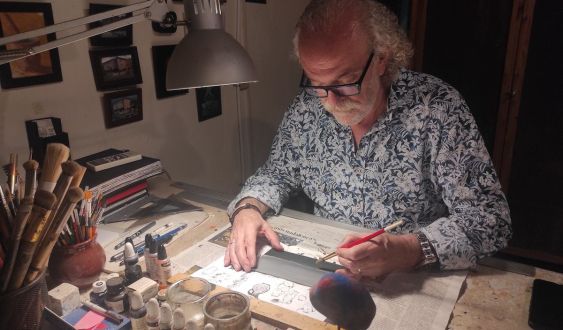
Four in the afternoon. The entrance of a small house on Monges de Sant Andreu street, a corner full of village charm, opens, as every day, more or less at the same time, because that's when Ramon Vila arrives at his workshop to spend the afternoon. He turns on the radio to let music or the voices of a program accompany his stay, a few hours, every afternoon, until before going to dinner. The artist observes, watches how the paint has evolved on the canvas that twenty-four hours earlier had taken its place on the painting under construction, takes the brush to follow the stroke where it had left off... "There are days when I paint a lot, others when, more than anything, I prepare, and there are times when it seems like I do very little, but I always work," says Ramon Vila.
At sixty-eight years old, and especially when he is not preparing any exhibition, the rhythm of the painter from Sant Andreu is made, above all, of constancy. "Every afternoon of my life I have come to paint," he confesses. Before retiring from the company where he worked, in the mornings he worked as a draftsman, and in the afternoon, the workshop awaited him to align images with brushstrokes on a canvas. "I usually have three or four started," comments the painter.
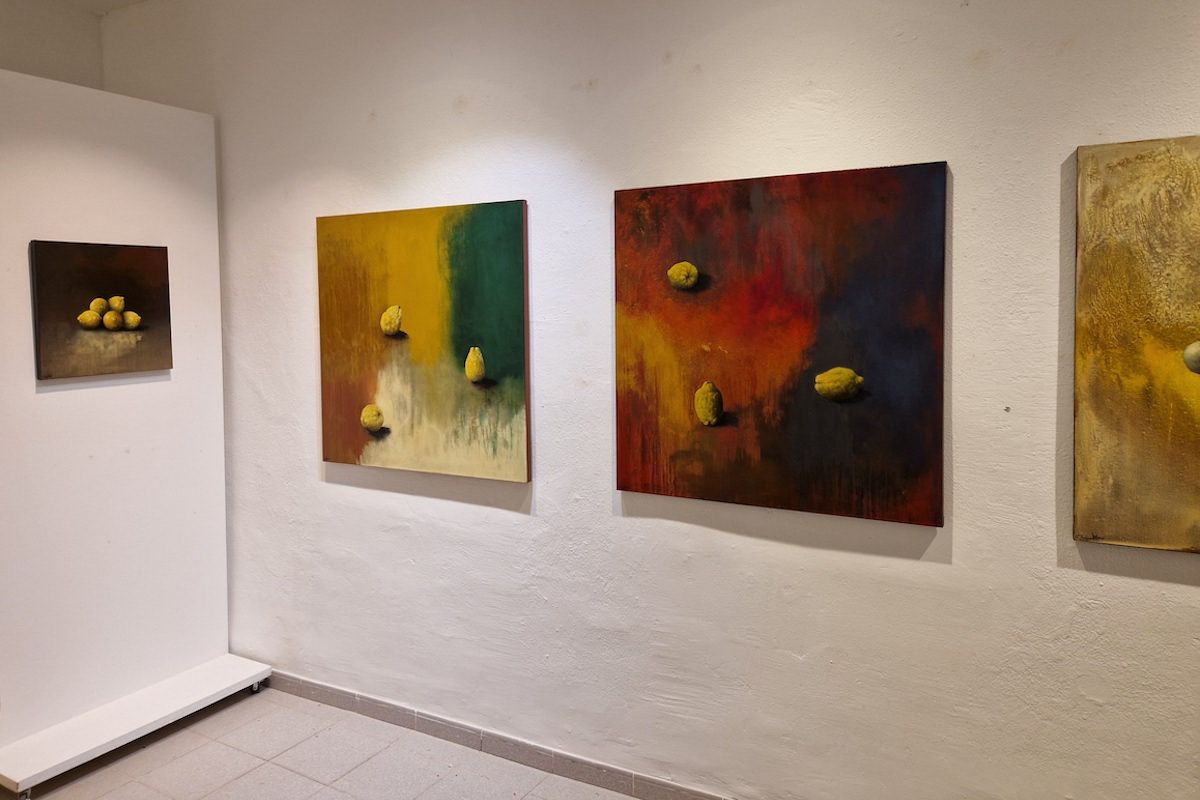
His works can be seen and acquired at Espai (B), a gallery at number 10 Luis Antúnez Street, in Gràcia, which is a showcase for several artists and also one of the few galleries that resist in the city of Barcelona. It does so by swimming against the current, because, as Ramon Vila explains, culture seems to be taking big steps backward. "Now ---he says--- when we see someone reading a book on the subway, it catches our attention, when, some time ago, it was the most normal thing. But, as a society, a lot has been lost culturally."
And ---the painter specifies--- "I'm not talking about the sale of works of art, I'm talking about the desire to hold exhibitions and installations." And he explains: "In the seventies and eighties, Barcelona had a very good gallery scene. Exhibition openings were held and each one was a party, either because people bought art or simply because people liked to go see the exhibitions. There were hundreds of art galleries that were functioning."
He had his first exhibition in 1979, at El Nus bar, in the Born neighborhood. "People came from everywhere and also people who owned art galleries." Although he admits that living exclusively from art has actually been very difficult for him, "there were four artists who sold a lot by themselves, but the rest of the people exhibited and there was a large audience. Now, there are no possibilities." Vila believes that "politically there is a lack of concern for art."
Visiting museums
Ramon's wife studied Art History and has been a teacher. Now both retired, they take some trips, not too many, but whenever they do, they visit museums. "Once a year we go to the Prado Museum," he explains. "You always discover things. One day you dedicate yourself to one thing and another day to another. Of course, my wife follows some painters, and I follow others. And I take things to the workshop, for example, Zurbarán's light." Everything observed is a lesson and an inspiring starting point. "When something impacts you, you are there," he reasons.
The day of the power outage, he and his wife were curiously surprised visiting the Prado Museum. "I was precisely in Goya's black period, and my wife in front of the Naked Maja, when they evacuated the museum," he explains.
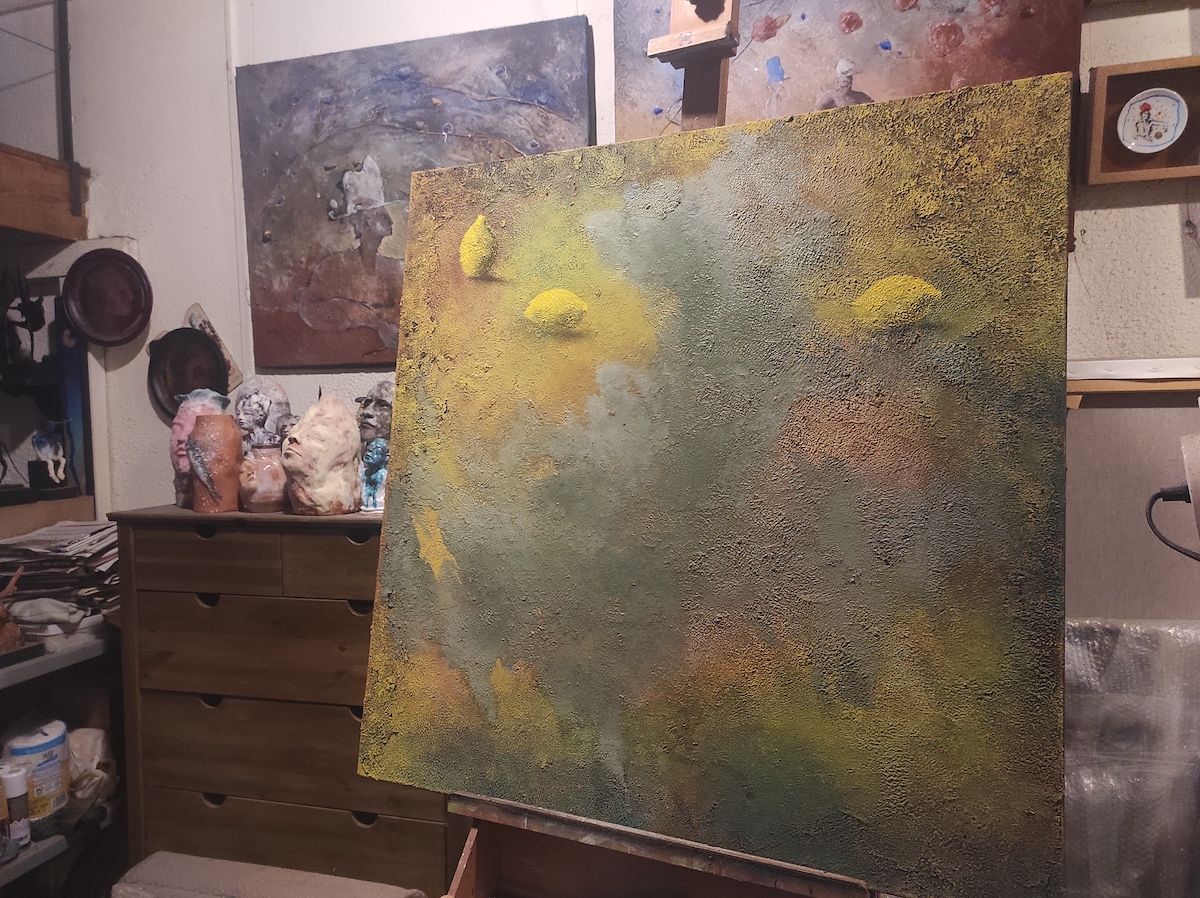
Brush pots, the easel, the stove for winter, and different workspaces configure the atmosphere in Ramon's workshop. The radio, always in the background. It is a faithful companion. He loves this medium of communication. "I have radio sets everywhere," he confesses. "The radio makes you discover, there is always some surprise, every night I connect the radio under my pillow to fall asleep." It is his ritual. And in the workshop, painting, he has others. For example, a very surprising one: "The first thing I do when I pick up a canvas is paint it all black and, from there, the colors emerge," he explains. And why does he do this? Well, because he knows that "the blank canvas impresses, it's very scary."
"One painting leads you to another, and one background leads you to another"Instead, with his ingenious system, you no longer have to say "where do I start? By painting it black, you make the canvas your own. And that's how the relationship emerges. Then, Ramon explains, "the path is given to you by the work itself." Furthermore, he adds, "the advantage over black is that accidents with colors are not accidents, but become realities. Whereas, on white, this doesn't work." The painter has thus found his technique from which the canvas leads him, while ---he says--- white leads him nowhere.
Thus, day by day and year after year, Vila has been forging a work style, a habit of every afternoon of his life, accompanied by a discipline that, even now, past 65, he does not want to lose. "I apply my schedule strictly, as if I were working, from four in the afternoon until seven or seven-thirty," he says. Painting, for him, is a form of expression, no, even more, it is a necessity, as breathing is. With the paintings he makes, sculptures coexist, many of them figures of faces. He tells us, however, that ceramics are made to be painted on, only as a support. Therefore, we can speak of painting in three dimensions.
Sources of inspiration
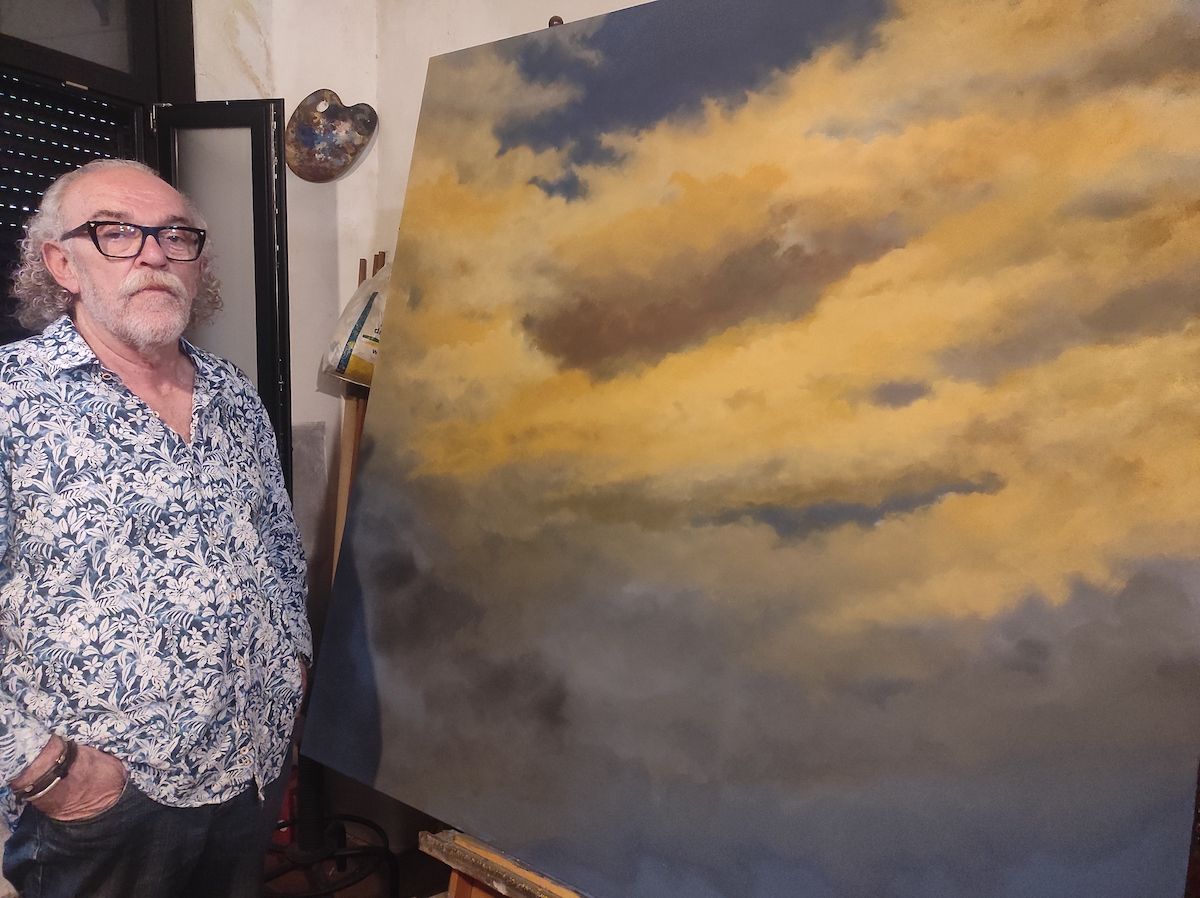
Ramon is left-handed by birth, that is, his good hand for doing everything with precision is the left, "but I use both, because as a child at school they forced me to use the right," he says. "Now with the left I do the details, but the backgrounds I can do with the right." Details and backgrounds have made captivating skies appear on canvases he is working on when we visit him. "The motifs arise on the fly," he explains. "One painting leads you to another, and one background leads you to another," so all his work has a link, an origin and a continuity and the same birthplace.
"It's never the last painting, because you always seek perfection and, since it's never achieved, you never consider it finished"The wooden beams on the small upper floor of the workshop overlooking the workspace still enhance that rural atmosphere of the part of Sant Andreu where we are located. From above, the perspective is fabulous. The main workbench, with notes that will kick off a painting, paints, more brushes very classified by different precision measurements, and the feeling that so many hours of creation, inspiration, and work in this space so much his own, and so many bonds, relationships, and pacts of the artist with each of his works have created a special environment and climate.
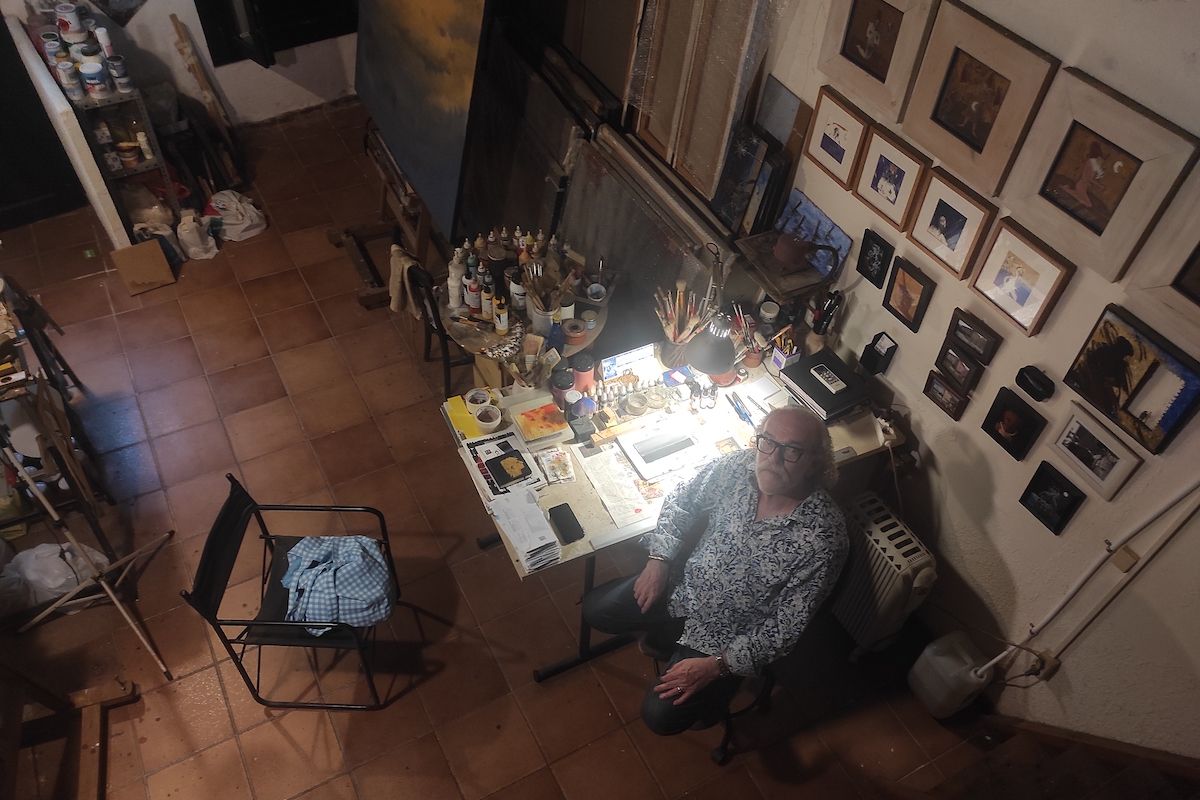
At the back of the workshop, a small patio culminates a room that is more like a farmhouse than a city dwelling. This village structure and atmosphere of Sant Andreu's most neuralgic neighborhood greatly helped him in adolescence to take root in the city where his entire family, from Berga, came to settle when his father began working in a stainless steel factory, one of the many factories that had been in Sant Andreu. That Sant Andreu that made and still makes one feel the breath of a village made it easier for him not to think so much about the friends and the streets and squares of his native Berga that he had had to leave behind. Also the skies and fields, rivers and lakes on canvas in the afternoons in the workshop have been the core of his particular oasis.
In each work, the artist starts again with the same innocence every time. Brush in hand, on a background that we now know is always black, a new story advances and not even he knows where it will go. "Painting is nothing more than an investigation into tones, lines, volumes. It's always as if I were painting the first picture, driven by the need for expression. And it's never the last picture, because you always seek perfection and, since it's never achieved, you never consider it finished," he concludes.
Add The New Barcelona Post as your preferred Google source for free
Stay informed with the latest news.
