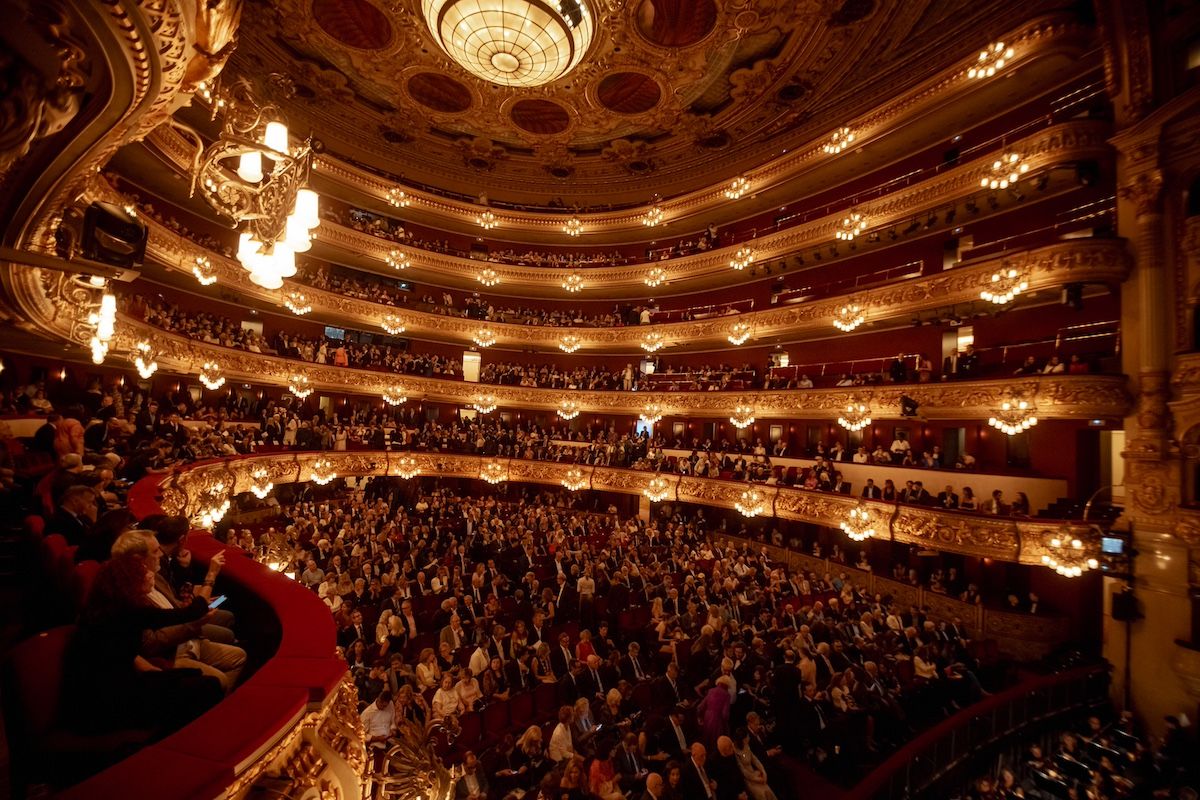
I don't know about opera. I know about Liceu, I play a bit by ear in music and I have my opinions and preferences. Don't look for an operatic review here, it's impossible, I neither can nor want to do it. This is the chronicle of what this humble servant observed at the premiere of Lady Macbeth of Mtsensk, as the inaugural work of the Liceu season. A work of 3 hours and 20 minutes, in four acts, sung in Russian and not in German or Italian, Shostakovich, 1930s. Don't look for frills or sweet arias to take to bed with birds in your belly, expect rawness and cruelty and to get straight to the point. All this after a red carpet, a photocall and a reception long enough for the legendary punctuality of the Liceu to suffer greatly.
Almost everyone was there: president Illa, president Pujol in full public rehabilitation, mayor Collboni, various consellers, a small group of republican exconsellers, the opposition councilors in the City Council grouped on the south flank, celebrities like singer Julieta, journalist Núria Marín or chef Maria Nicolau, actor Pere Arquillué who makes me kneel every time he stands in front of me, Mateu Hernández and Miquel Molina and Agnès Marquès and Miquel Roca, many directors of cultural institutions and a long etcetera that you can imagine: Salvador Alemany, Valentí Oviedo and Víctor García de Gomar know how to be good hosts and know how to program well. In this case, Shostakovich's last opera which, by denouncing the conditions of workers and especially women in pre-Soviet Russia, after its great reception deserved Stalin's censorship and withdrawal from the stage. You know, when it comes to societies that venerate the order of a lifetime too much.
Josep Pons conducting the music, Àlex Ollé (now without the Fura brand) acting as theatrical director with more than demonstrable excellence: I had never seen singers turned into such good actors. Several scenes of explicit sex or direct rapes are violent, as it cannot be otherwise, no matter how much the most delicate skins squirm in their seats. And above all, the sheet of water at the foot of the stage, soaking shoes and skirts and stockings, but also reflecting waves of movement on the perejáumicas armchair ceilings of the Liceu. It seems that these are reused waters, so no one should be scandalized by the drought: let it serve to finally turn on the fountains of Plaça Catalunya and Passeig de Gràcia, or the magical ones, also fully reusable and reused. And stop with useless hypocrisies, or making exceptions only for opera.
Applause to Alfons Flores' set design, creator of this aquatic idea (onanistic, surreal, nightmarish) but also of the delightful descent of double beds (and adultery) in the third act as if it were the descent of all temptations and also of all needs for tenderness. Katerina (Sara Jakubiak, great soprano and better actress or vice versa) lacks tenderness and true love in the midst of a suffocating atmosphere of oppression and machismo, closely watched by her father-in-law and merchant Zinovi (for me the best of the night, Ilyra Slivanov) who keeps her locked up until the miracle of conceiving offspring with his son Boris (Alexei Botarcuic) opens, visibly gay in this interpretation, which seems an impossible task because Katerina is neither happy nor can she get rid of the attraction of the fourth in discord, the scoundrel Serguei (Pavel Cernoch).
This plot developed by the librettist Nikolai Leskov made an impact at the time and still does, universal as the plot is, but ultra-local as was the drift into the Siberian deportation of the protagonists and the censorship itself and subsequent evolution of the piece. Well, and full of blood and despair as the title of the work already suggests. The message: individual freedom, free love, and especially women. Russia, however much it offended Stalin, is more of a secondary actor: there is still a lot of authoritarian mentality present among us, not only among the boxes.
The plot of Lady Macbeth of Mtsensk made an impact at the time and still does, universal as the plot isThey were three hours and a bit that passed perfectly, that maintained attention and tension without any margin for boredom or redundancy, which even before Shostakovich's abstract music flowed like perfect theatrical dialogues, even with a Liceu choir that acted without overacting and that shone with verisimilitude to the action. Singing, acting and denouncing at the same time, under visual effects of great poetic effect.
I don't know about opera, but I know what I've seen and what I've heard, and this season that some said "starts with hard drugs", or with "a dense work", in truth starts with a refreshing splash of beauty. Yes, I know it's a very hard story. But even cruelty, injustice, blood, can nail you amazed to your seat.
Add The New Barcelona Post as your preferred Google source for free
Stay informed with the latest news.